Stenotaphrum
Stenotaphrum, a genus of perennial grasses in the family Poaceae, reproduces and spreads primarily through vegetative means rather than by seed.
How does Stenotaphrum reproduce and spread in its natural environment?
Stenotaphrum, a genus of perennial grasses in the family Poaceae, reproduces and spreads primarily through vegetative means rather than by seed.12
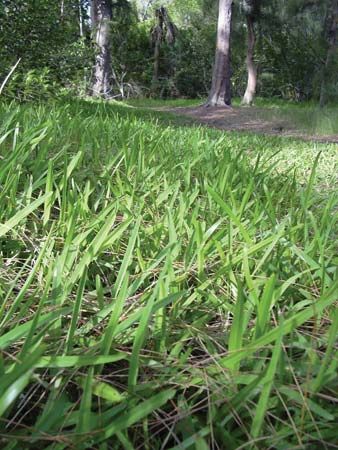
In their natural environment, these grasses utilize stolons—prostrate, creeping stems—to expand across the ground. The plant roots readily along these stems, allowing it to form low, mat-like colonies. This process of vegetative reproduction is a natural method of regeneration that enables the grass to colonize moist environments effectively. Notably, species such as Stenotaphrum secundatum (St. Augustine grass) typically do not produce viable seeds, making this asexual spread essential for their survival and propagation.123
What are the common names for Stenotaphrum grasses, and why are they called that?
The most common name for the primary species in the genus Stenotaphrum is St. Augustine grass (Stenotaphrum secundatum). This grass is also sometimes referred to as buffalo grass in certain regions of Australia and North America, though this can lead to confusion with other unrelated grass species.21
The name “St. Augustine grass” is believed to be derived from St. Augustine, Florida, where the plant is commonly found.4
The scientific name Stenotaphrum itself is derived from New Latin, combining the Greek prefix sten- (narrow) and taphros (ditch or trench), which relates to the plant’s unique inflorescence where the flowers are sunk into pockets along a thickened axis.25
How many species are included in the Stenotaphrum genus, and which are the most well-known?
The genus Stenotaphrum consists of approximately seven species of low, mat-forming grasses within the Poaceae family.2
These grasses are native to tropical and subtropical regions globally, characterized by their ability to spread vegetatively through stolons. Among these, the most well-known species is St. Augustine grass (Stenotaphrum secundatum).2
St. Augustine grass is widely recognized because it is cultivated as a coarse lawn grass in parts of Australia and North America. While it is native to the American South and Central America, it has successfully naturalized along many seacoasts around the world. Other species in the genus are less commonly cited in general horticultural or botanical contexts compared to this widely distributed and utilized grass.25
Where is Stenotaphrum commonly found, and what are its preferred habitats?
The genus Stenotaphrum is native to tropical and subtropical regions across the globe. Its most prominent member, St. Augustine grass (Stenotaphrum secundatum), is native to the American South, central and southeastern North America, and Central America.21
Regarding preferred habitats, these grasses are well-adapted to coastal environments and have successfully naturalized along many seacoasts worldwide. They are frequently utilized as lawn grasses and sand binders, particularly in the southern United States. As a vigorous, warm-season plant, St. Augustine grass thrives in moist environments, though it possesses limited drought tolerance. These plants are characterized by their low, mat-forming growth habit, spreading vegetatively through stolons that root readily along prostrate stems.214
Sources
- St. Augustine grass — Encyclopædia Britannica
- Stenotaphrum — Encyclopædia Britannica
- horticulture - Vegetative propagation — Encyclopædia Britannica
- Saint Augustine grass — Merriam-Webster
- Stenotaphrum — Merriam-Webster
- list of plants in the family Poaceae — Encyclopædia Britannica
Published on · 2 min read