Stingray
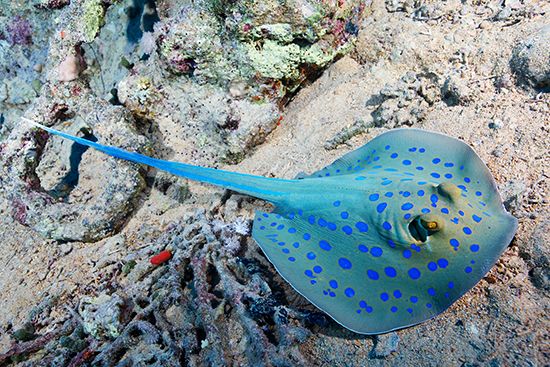
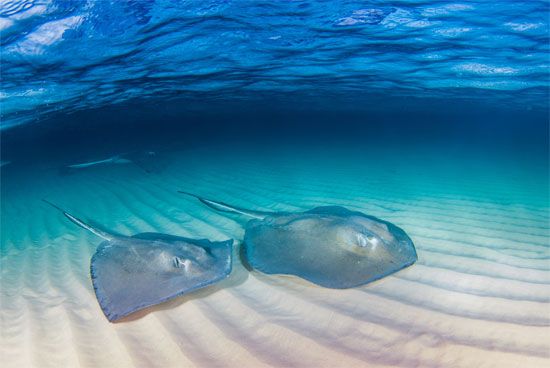
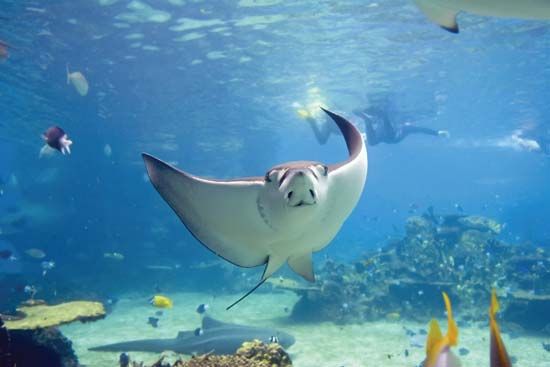
Stingrays are flat-bodied rays primarily distinguished by their disk-shaped bodies and long, flexible, tapering tails. Most species possess one or more…
What are the defining characteristics of stingrays?
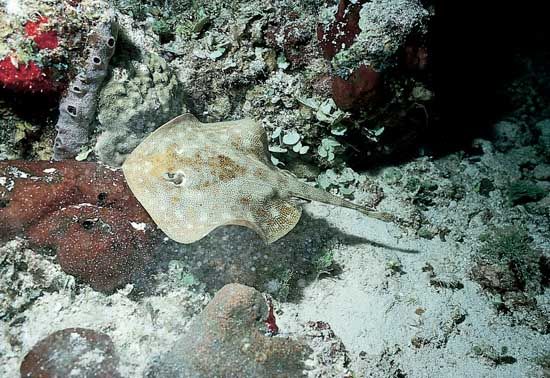
Stingrays are flat-bodied rays primarily distinguished by their disk-shaped bodies and long, flexible, tapering tails. Most species possess one or more saw-edged, venomous spines on their tails, which they use for defense.1
Key characteristics include:
- Habitat: They are bottom dwellers that inhabit warm temperate and tropical waters, often lying partially buried in shallow areas.1
- Diet: They feed on invertebrates such as worms and mollusks.1
- Physical Variation: Species range significantly in size, from small varieties like Dasyatis sabina (about 25 cm wide) to large species reaching widths of 2 metres.1
- Reproduction: Like other chondrichthyans, stingrays utilize internal fertilization via male claspers. Most rays are ovoviviparous, meaning the eggs hatch within the mother, where embryos receive nourishment from yolk sacs and uterine secretions.2
Stingrays are known for their ability to inflict extremely painful wounds with their tail spines, which can be dangerous if they penetrate the abdomen.1
What are some of the different species of stingrays and where can they be found?
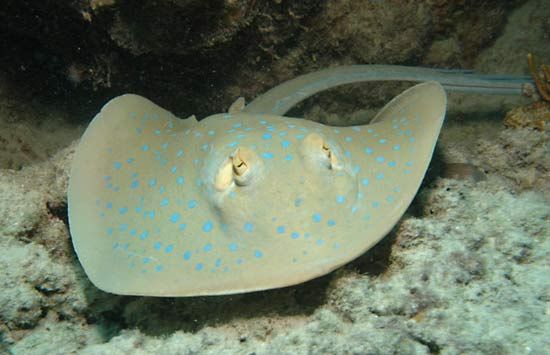
Stingrays, belonging to the suborder Myliobatoidei, are found in warm temperate and tropical waters across all oceans, with some species inhabiting South American rivers. They are generally categorized into several families based on their physical traits and habitats:13
- Dasyatidae (Whip-tailed rays): These inhabit all oceans and certain rivers. They are known for their slim, long, whiplike tails. Notable examples include the small Dasyatis sabina of the North Atlantic and the large Australian D. brevicaudata.1
- Urolophidae (Round stingrays): These are smaller than dasyatids, featuring relatively short tails and well-developed tail fins. They are primarily found in the Pacific and western Atlantic.1
- Myliobatidae (Eagle rays): These inhabit warm and temperate coastal waters. They are distinguished by heads that project beyond their body disks. Examples include the spotted duckbilled ray (Aetobatus narinari) and the bat stingray (Myliobatis californicus).1
- Gymnuridae (Butterfly rays) and Rhinopteridae (Cow-nosed rays): Both families are found in shallow coastal waters of tropical and warm temperate seas.1
- Hexatrygonidae: A rare deepwater family identified by the species Hexatrygon bickelli, found off the coast of South Africa.1
How are stingrays related to other cartilaginous fish like sharks?
Stingrays and sharks are both members of the class Chondrichthyes, a group of cartilaginous fishes that lack true bone in their skeletons. They share several fundamental biological traits, including:45
- Internal Anatomy: Both possess a skeleton made of cartilage, a spiral valve in the intestine, and a urea retention habitus.51
- Reproduction: Both groups utilize internal fertilization, with males using specialized copulatory organs called claspers.516
- Sensory and Protective Features: They share similar scales known as dermal denticles and possess spiracles—openings behind the eyes used for respiration.5
Despite these similarities, rays evolved from bottom-living sharklike ancestors during the Jurassic Period. They are distinguished from sharks by their flattened, disklike bodies, with gill openings and mouths located on the underside. While sharks typically swim using their tails, rays are characterized by greatly enlarged, winglike pectoral fins that extend forward along the sides of the head, which they use for propulsion.36
How do stingrays differ from skates?
While both stingrays and skates are cartilaginous fishes within the order Batoidei, they possess distinct biological and physical differences:
- Reproduction: The most significant difference is their reproductive method. Stingrays generally bear live young, whereas all known species of skates are oviparous, meaning they lay eggs. These eggs are encased in leathery, oblong protective cases often referred to as “mermaid’s purses.”83
- Tail Characteristics: Stingrays are characterized by long, slender, whiplike tails that typically feature one or more sharp, venomous, barbed spines used for defense. In contrast, skates lack these stinging spines; their tails are generally shorter and thicker, often possessing two small dorsal fins.83
- Physical Structure: While both have flattened bodies, the pectoral fins of skates extend from the snout to the base of the tail. Stingrays, particularly those in the suborder Myliobatoidei, have pectoral fins that form a distinct disk shape, often with a more pronounced separation from the tail.83
Sources
- stingray — Encyclopædia Britannica
- chondrichthyan - Reproduction and development — Encyclopædia Britannica
- ray — Encyclopædia Britannica
- chondrichthyan — Encyclopædia Britannica
- chondrichthyan - Distinguishing features — Encyclopædia Britannica
- chondrichthyan - Evolution — Encyclopædia Britannica
- fish - Chondrichthyes : sharks and rays — Encyclopædia Britannica
- chondrichthyan - Reproductive behaviour — Encyclopædia Britannica
- skate — Encyclopædia Britannica
Published on · 3 min read