Skate
Skates reproduce through internal fertilization, a process involving specific physical adaptations. During mating, the male secures the female by biting her…
How do skates reproduce, and what unique adaptations do they have for this process?
Skates reproduce through internal fertilization, a process involving specific physical adaptations. During mating, the male secures the female by biting her pectoral fin and pressing his ventral surface against hers. To facilitate this, male skates possess unique, retractile clawlike spines on their pectoral fins, which help them grip the female. The male then inserts one or both of his claspers—modified pelvic fins—into the female’s cloaca to transfer sperm.1
Following fertilization, female skates lay their eggs in protective, leathery cases often referred to as a mermaid’s purse. These eggs are typically extruded in series, often two at a time, with rest periods occurring between each extrusion. This reproductive strategy ensures the developing embryos are shielded within their durable casings until they are ready to hatch.21
How are skates different from rays, and why are they often confused?
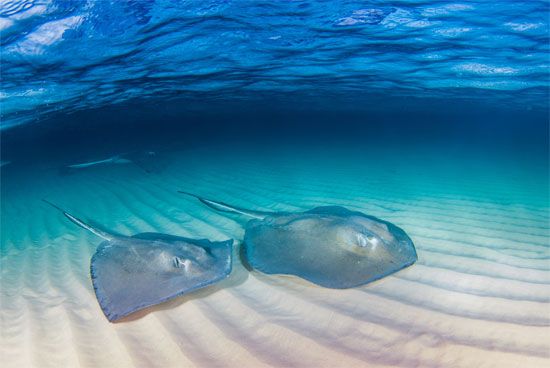
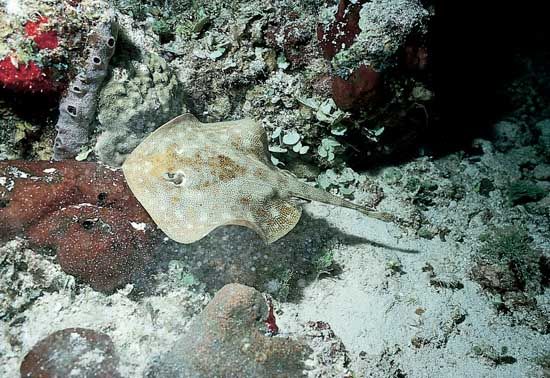
Skates and rays are often confused because they are both cartilaginous fishes belonging to the class Chondrichthyes and share a similar flattened, disklike body shape with pectoral fins extending along the sides of the head.13
However, they possess distinct biological and physical differences:
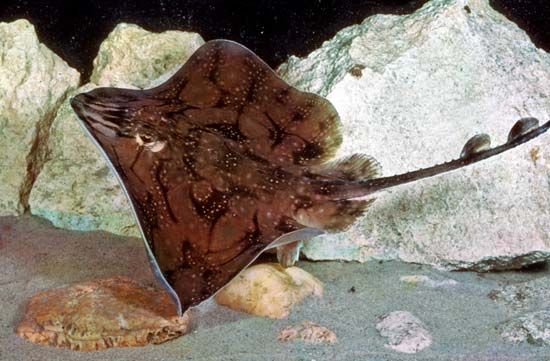
- Reproduction: The most significant difference is that skates are oviparous, meaning they lay eggs encased in leathery shells known as “mermaid’s purses.” In contrast, most other rays are viviparous, bearing live young.34
- Tail Characteristics: Skates have relatively thick, fleshy tails that typically lack the long, venomous, saw-edged barbed spines found on the slender, whiplike tails of many other rays, such as stingrays.34
- Physical Structure: In skates, the pectoral fins extend to the snout and stop abruptly at the base of the tail. Additionally, skates often have two small dorsal fins on their tails, whereas other rays generally lack these.34
Because both groups are bottom-dwelling, share similar habitats, and exhibit comparable swimming motions, they are frequently grouped together in casual observation despite these clear anatomical and reproductive distinctions.34
What are some interesting facts about skate eggs, also known as ‘mermaid’s purses’?
Skate eggs, commonly known as mermaid’s purses, are fascinating biological structures that serve as protective nurseries for developing embryos. Here are some key facts about them:
- Protective Design: These eggs are encased in a dark, leathery, or horny shell that shields the embryo from predators and environmental hazards.21
- Anchoring Mechanisms: To keep the eggs secure in their environment, the cases are often equipped with tendrils for coiling around solid objects or spikelike projections that help anchor them into mud or sand.6
- Developmental Period: Once laid, the embryo relies on an abundant supply of yolk within the case for nourishment. Development is a slow process, typically lasting between 18 and 59 weeks before the young skate is ready to hatch.6
- Extrusion Patterns: Female skates often lay their eggs in series, typically two at a time, with rest periods lasting one to five days between each set.5
- Common Sightings: Because of their durable, oblong shape, these empty egg cases are frequently washed up on beaches, where they are easily spotted by beachcombers.1
How do skates feed, and what are their primary food sources?
Skates are bottom-dwelling predators that primarily consume mollusks, crustaceans, and various fishescom/animal/crustacean), and various fishes.5
Their hunting strategy is highly specialized for their environment:
- Ambush Tactics: Skates often lie on the seafloor, sometimes partially buried in sand or mud, to remain camouflaged while waiting for prey.57
- Active Pursuit: Despite their sedentary appearance, they are capable of rising from the bottom to pursue active prey, such as herring.7
- Trapping Method: To secure their victims, skates swim over the prey and then settle down upon it, effectively trapping the animal beneath their bodies.57
- Nocturnal Hunting: This hunting behavior is often facilitated by their habit of being active at night, which helps them surprise their prey.7
Sources
- chondrichthyan - Reproductive behaviour — Encyclopædia Britannica
- mermaid's purse — Merriam-Webster
- ray: Top Questions — Encyclopædia Britannica
- ray — Encyclopædia Britannica
- skate — Encyclopædia Britannica
- chondrichthyan - Reproduction and development — Encyclopædia Britannica
- chondrichthyan - Rays — Encyclopædia Britannica
Published on · 3 min read