Mount Saint Helens
The 1980 eruption of Mount Saint Helens was primarily caused by the accumulation of magma beneath the volcano, which created significant pressure and caused…
What caused the famous 1980 eruption of Mount Saint Helens?
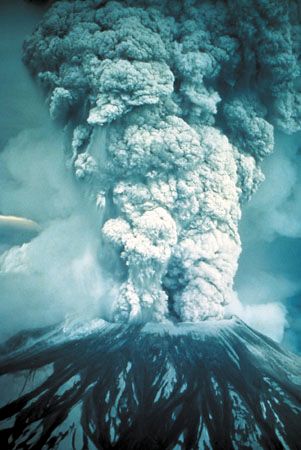
The 1980 eruption of Mount Saint Helens was primarily caused by the accumulation of magma beneath the volcano, which created significant pressure and caused a bulge to form on the mountain’s north flank.1
This instability culminated on the morning of May 18, when a 5.1-magnitude earthquake triggered a massive landslide on the north face. The removal of this material released the pent-up pressure, resulting in a powerful lateral air blast of superheated ash and stone, followed by a vertical eruption column. This cataclysmic event fundamentally altered the landscape, replacing the mountain’s peak with a horseshoe-shaped crater.1
What scientific discoveries have been made from studying Mount Saint Helens?
The study of Mount Saint Helens has provided significant scientific insights into the behavior of active composite volcanoes and the processes of ecological recovery following catastrophic events.
Key areas of scientific discovery and research include:
- Volcanic Dynamics and Forecasting: The 1980 eruption highlighted the importance of monitoring seismic activity and surface deformation. Observations of the mountain’s north flank bulge and increased earthquake frequency provided critical data that helped authorities implement partial evacuations, demonstrating the life-saving potential of monitoring volcanoes that may appear dormant but are actually active.12
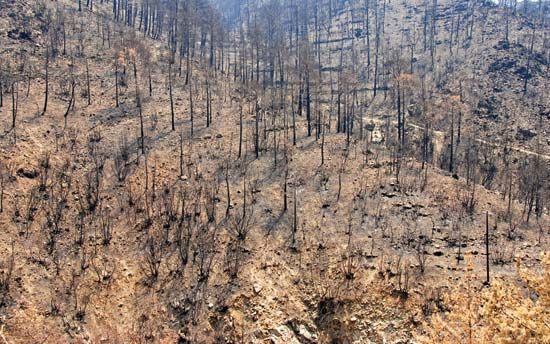
- Ecological Succession: The Mount Saint Helens National Volcanic Monument serves as a living laboratory for studying how ecosystems respond to major disturbances. Researchers have been able to observe the natural recolonization of the blast zone by various plants and animals, offering unique data on biological recovery in landscapes devastated by volcanic activity.1
- Geological Processes: The event allowed scientists to study the mechanics of lateral air blasts, massive landslides, and the formation of lava domes, deepening the understanding of how these phenomena reshape the surrounding terrain.1

How does Mount Saint Helens compare to other volcanoes in the Cascade Range?
Mount Saint Helens is a prominent composite volcano within the Cascade Range, a chain of volcanic peaks extending from northern California to southern British Columbia. While many summits in the range are considered extinct, Mount Saint Helens is distinguished by its recent and highly explosive activity.45
Compared to other peaks in the range, such as Mount Rainier (the highest in the Cascades at 14,410 feet) or Mount Hood, Mount Saint Helens is relatively shorter, currently standing at 8,363 feet following the 1980 eruption that removed its central peak.642
Geologically, all Cascade composite cones are explosive due to their high-silica molten rock. However, the 1980 eruption of Mount Saint Helens was of a greater magnitude than any other event in the region since the collapse of Mount Mazama 6,600 years ago. Unlike the more stable peaks, Mount Saint Helens has a history of frequent eruptive periods characterized by lava-dome construction and explosive events, followed by long periods of dormancy.52
What is Mount Saint Helens and where is it located?
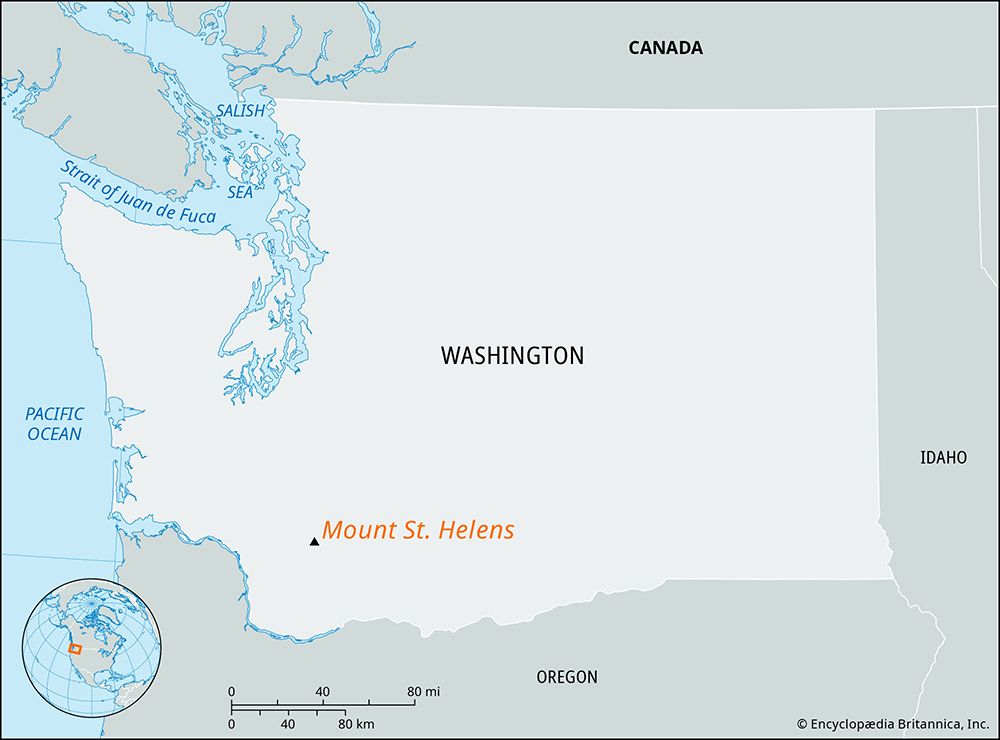
Mount Saint Helens is an active composite volcano located in the Cascade Range in southwestern Washington, U.S.41
Named by navigator George Vancouver for the British ambassador to Spain, Baron St. Helens, the peak is widely known for its major eruption on May 18, 1980. This event, one of the most significant volcanic explosions in North America, triggered a massive landslide that removed the mountain’s central peak, reducing its elevation from 9,677 feet to its current height of 8,363 feet (2,549 meters).14
Today, the area is protected as the Mount Saint Helens National Volcanic Monument, which serves as a vital site for studying volcanic dynamics and ecological recovery.1
Sources
- Mount Saint Helens — Encyclopædia Britannica
- 35th Anniversary of Mount Saint Helens Eruption — Encyclopædia Britannica
- volcano - Volcano forecasting and warning — Encyclopædia Britannica
- Saint Helens, Mount — Merriam-Webster
- Cascade Range — Encyclopædia Britannica
- Pacific mountain system - Geology — Encyclopædia Britannica
- volcano - Two 20th-century eruptions — Encyclopædia Britannica
Published on · 3 min read