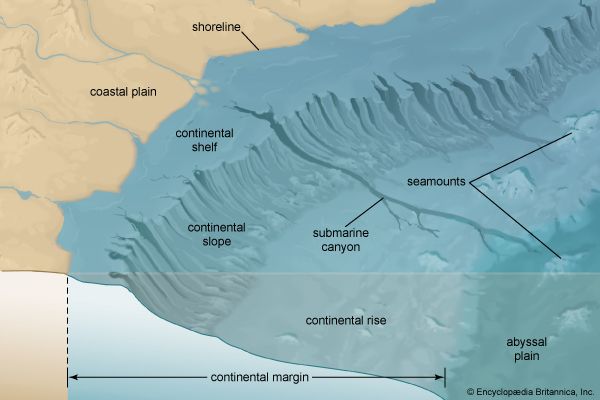
Submarine Fan
Submarine canyons serve as the primary conduits for the formation of submarine fans. These canyons act as funnels for dense slurries of water and terrigenous…
How do submarine canyons relate to the formation of submarine fans?
Submarine canyons serve as the primary conduits for the formation of submarine fans. These canyons act as funnels for dense slurries of water and terrigenous sediment known as turbidity currents.
The relationship between the two features is defined by the following process:
- Transportation: Submarine canyons transport sediment from continental margins down to the deep seafloor.1
- Deposition: Upon exiting the mouth of a submarine canyon, the turbidity current experiences a sudden loss of confinement and gradient, causing its velocity to decrease.2
- Accumulation: As the current slows, suspended matter drops out of the water column. Finer particles are deposited as the flow continues to decelerate, creating a fan-shaped accumulation of sediment at the base of the canyon.23
- Distribution: Over time, repeated deposition through these canyon systems builds the fan, which is often characterized by branching distributary channels that spread sediment across the abyssal seafloor.23
In essence, the submarine fan is the deep-sea equivalent of an alluvial fan, with the submarine canyon providing the necessary pathway for sediment delivery.3
What types of sediments are commonly found in submarine fans?
Submarine fans are primarily composed of land-derived, or terrigenous, sediments transported to the deep seafloor by turbidity currents.15
The composition of these deposits is characterized by:
- Sandy Material: The fans consist largely of successive layers of sand.15
- Graded Bedding: These layers typically exhibit a specific structure where the sediment grades upward from coarser to finer particle sizes. This occurs because larger, heavier particles settle out of the water column first as the current decelerates, while smaller, finer particles remain in suspension for longer distances and settle later.136
- Turbidites: The resulting sedimentary rock formations created by these ancient currents are known as turbidites.35
Because these currents carry a mixture of various sediment types and sizes, the distribution of material across the fan is highly dependent on the velocity of the flow and the settling velocities of the individual particles.6
What are the main components and features of a typical submarine fan?
A typical submarine fan is a large, cone-shaped accumulation of sediment located on the deep seafloor. Its structure and features are defined by the following components:
- Apex: The fan begins at the base of a submarine canyon, which acts as the primary conduit for sediment delivery from the continental slope.1
- Sediment Layers: The fan is composed of successive layers of terrigenous sediment. These layers typically exhibit graded bedding, where material transitions from coarse sand at the base to finer particles at the top as turbidity currents lose velocity.1
- Fan Valleys and Levees: The surface of the fan is marked by valleys characterized by low relief and natural levees.1
- Distributary Channels: These valleys branch outward and downward into distributary channels. Similar to a river delta, these channels migrate laterally to distribute sediment across the entire fan surface.1
- Continental Rise: In many regions, multiple individual fans may coalesce laterally to form a broader feature known as a continental rise.1
What can submarine fans tell us about past climate and sea-level changes?
Submarine fans serve as vital archives for understanding Earth’s history, as their formation and structure are deeply influenced by external environmental factors, including climate and sea-level fluctuations.1
- Sea-Level Changes: Changes in global sea levels significantly alter deep-sea sedimentation patterns. When sea levels rise or fall, the delivery of terrigenous sediment to the deep ocean is modified, directly impacting the growth and distribution of submarine fans. These shifts can lead to periods of active deposition or, conversely, periods of erosion and the creation of geological unconformities—gaps in the sedimentary record.1
- Climate Influence: Climate variations affect the volume and type of sediment transported from land to the seafloor. For instance, shifts between warm, mild climates and cooler, glacial periods influence the intensity of weathering and the amount of material available for turbidity currents to transport.1
- Sedimentary Record: By analyzing the layers of turbidites within these fans, scientists can reconstruct past environmental conditions. The composition and thickness of these layers provide evidence of the frequency and magnitude of past sediment-transport events, which are often linked to broader climatic or tectonic triggers.3671
Sources
- submarine fan — Encyclopædia Britannica
- submarine canyon — Encyclopædia Britannica
- turbidity current — Encyclopædia Britannica
- canyon — Encyclopædia Britannica
- turbidite — Encyclopædia Britannica
- density current - Turbidity currents — Encyclopædia Britannica
- river - Fan deposits and depositional processes — Encyclopædia Britannica
- ocean basin - Sedimentation patterns — Encyclopædia Britannica
- ocean basin - Sediment types — Encyclopædia Britannica
Published on · 3 min read