Turbidite
A turbidite is a type of sedimentary rock formed from the deposits of turbidity currents—underwater density currents triggered by events like earthquakes or…
What is turbidite?
A turbidite is a type of sedimentary rock formed from the deposits of turbidity currents—underwater density currents triggered by events like earthquakes or sediment slumping on continental slopes.123
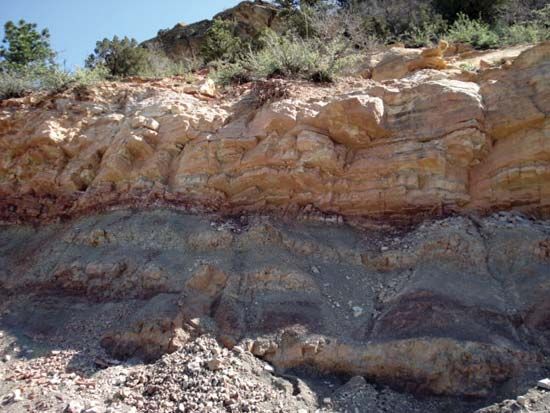
These rocks are characterized by layers of particles that typically grade upward from coarser material at the bottom to finer material at the top, a result of the sediment settling out of the current as it loses velocity. Turbidites often contain a mixture of shallow-water and deep-water organism remains, reflecting the transport of material from the shelf down to the deep seafloor.124
They are primary components of submarine fans and abyssal cones, and they contribute to the formation of abyssal plains where large quantities of sediment accumulate. Because they are deposited by distinct, separate flows, turbidites often exhibit clear boundaries between individual units.132
What role do submarine canyons play in moving sediment?
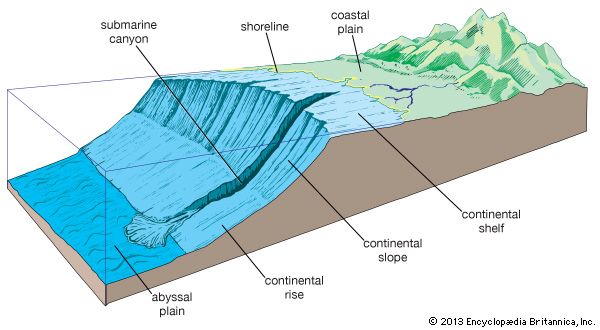
Submarine canyons serve as the primary conduits for transporting land-derived sediment from continental shelves and slopes to the deep seafloor. They act as essential pathways that allow sand and mud to bypass the slope-rise system, often depositing this material directly onto abyssal plains.53
The movement of sediment through these canyons is primarily driven by turbidity currents—dense, abrasive slurries of water and sediment. These currents are frequently triggered by earthquakes or the slumping of unstable sediment masses that have accumulated at the canyon heads. Once initiated, these flows can travel at speeds of several tens of kilometers per hour, funneling material down the steep, narrow floors of the canyons.6352
The effectiveness of this transport depends heavily on sea level:
- Lowstands: During periods of lower sea level, rivers often empty directly into canyon heads, facilitating the efficient delivery of sediment to the deep ocean.5
- Highstands: When sea levels are high, canyons may be located far from the coastline, significantly slowing or halting the downslope movement of sediment.5
Upon reaching the base of the canyon, the loss of confinement and gradient causes the current to decelerate, depositing its load to form submarine fans.2
How do scientists use sediment cores to study Earth’s history?
Scientists use sediment cores—cylindrical samples extracted from the floors of oceans, lakes, and bogs—as vital “natural archives” to reconstruct Earth’s history. By analyzing these cores, researchers can interpret environmental and climatic conditions spanning millions of years.1011
Key methods and data derived from sediment cores include:
- Biostratigraphy: Scientists study microfossils, such as foraminifera and diatoms, found within the layers. Shifts in these fossil assemblages help correlate strata across different regions and determine the age and depositional environment of the rocks.121314
- Geochemical Analysis: Isotopic records, particularly oxygen isotopes, provide insights into past ocean temperatures and global ice volume. Additionally, radioisotopic dating (such as potassium-argon or thorium-230 dating) allows scientists to assign precise ages to specific sediment horizons.12151316
- Magnetostratigraphy: Rocks often retain the orientation of Earth’s magnetic field at the time of their formation. By identifying patterns of magnetic polarity reversals in deep-sea cores, researchers can build a chronology of the seafloor and calibrate geologic time scales.1311
- Marker Horizons: Distinctive layers, such as volcanic ash, serve as “instantaneous” markers that can be identified by their unique chemistry and correlated across vast distances, linking marine, terrestrial, and ice-core records.1215
What is the difference between pelagic and hemipelagic sediments?
The primary difference between hemipelagic and pelagic sediments lies in their location, rate of accumulation, and composition.
Hemipelagic Sediments
- Location: These are deposited on continental shelves and rises, relatively near landmasses.2
- Accumulation: They accumulate rapidly, which often prevents them from reacting chemically with seawater, allowing individual grains to retain characteristics from their source area.2
- Composition: They are often influenced by land-derived materials, such as silicate minerals, rock fragments, or volcanic ash, and may contain abundant carbonate material in tropical regions near coral reefs.2
Pelagic Sediments
- Location: These cover approximately 75 percent of the deep seafloor, far from the influence of continents.2
- Accumulation: They accumulate very slowly in the open ocean, either by settling through the water column or by chemical precipitation.219
- Composition: Because they are distant from land-derived sediment sources, they are dominated by biogenic constituents—the skeletal remains of marine organisms like diatoms, radiolarians, and foraminiferans. If these biological components are less than 30 percent of the total, the deposit is typically classified as deep-sea clay or red mud.2
Sources
- turbidite — Encyclopædia Britannica
- marine sediment — Encyclopædia Britannica
- turbidity current — Encyclopædia Britannica
- density current - Turbidity currents — Encyclopædia Britannica
- submarine canyon — Encyclopædia Britannica
- submarine fan — Encyclopædia Britannica
- canyon — Encyclopædia Britannica
- continental shelf - Origin — Encyclopædia Britannica
- submarine slump — Encyclopædia Britannica
- Quaternary - Correlation of Quaternary deposits — Encyclopædia Britannica
- Tertiary Period - Correlation of Tertiary strata — Encyclopædia Britannica
- geology - Micropaleontology — Encyclopædia Britannica
- Earth sciences - Micropaleontology — Encyclopædia Britannica
- ice core — Encyclopædia Britannica
- Pleistocene Epoch - Ice-core records — Encyclopædia Britannica
- dating - Thorium-230 dating — Encyclopædia Britannica
- Climate change - Evidence for climate change — Encyclopædia Britannica
- ocean basin - Deep-sea sediments — Encyclopædia Britannica
- ocean basin - Sediment types — Encyclopædia Britannica
- coastal landforms - Landforms of depositional coasts — Encyclopædia Britannica
Published on · 3 min read