Ocean Basin
Ocean basins serve as the primary reservoir for Earth's water, containing approximately 97.957 percent of the planet's total water volume. They are central…
How do ocean basins contribute to the global water cycle?
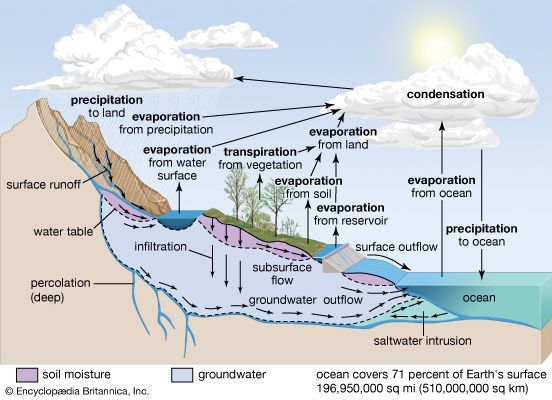
Ocean basins serve as the primary reservoir for Earth’s water, containing approximately 97.957 percent of the planet’s total water volume. They are central to the hydrologic cycle, acting as the main source of atmospheric moisture through the process of evaporation.12
This contribution to the global water cycle functions through several key mechanisms:
- Energy and Moisture Exchange: Driven by solar radiation, oceans transfer heat and moisture to the atmosphere. This exchange is vital for creating atmospheric motion, which dictates global weather and climate patterns.32
- Heat Regulation: The surface layer of the ocean acts as a massive heat reservoir. Through ocean currents, these basins redistribute thermal energy from the tropics toward the poles, significantly influencing regional climates.34
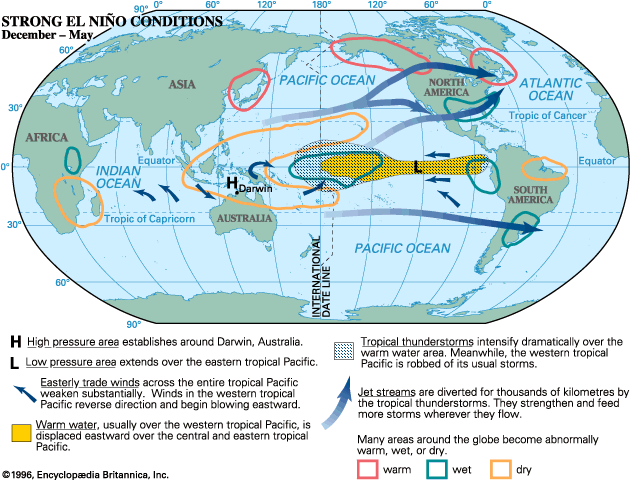
- Atmospheric Feedback: Processes such as upwelling and large-scale interactions like the El Niño/Southern Oscillation (ENSO) alter sea surface temperatures, which in turn shift precipitation patterns and cloud formation on a global scale.35
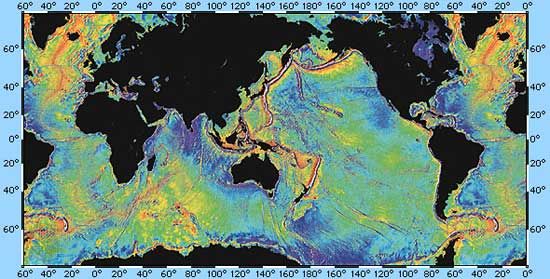
What role do ocean basins play in the Earth’s tectonic plate system?
Ocean basins are not static features; they are dynamic components of the plate tectonics system that constantly evolve through the creation and destruction of oceanic crust.8
Creation and Expansion
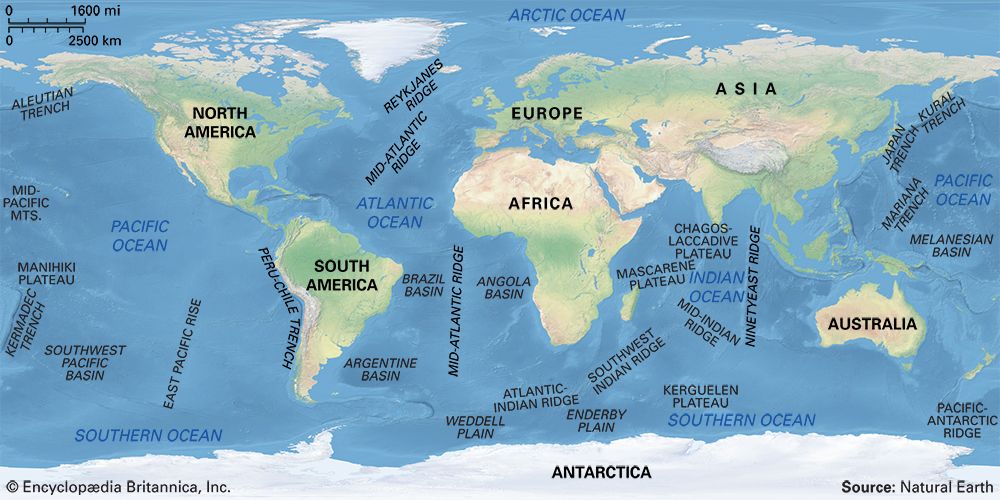
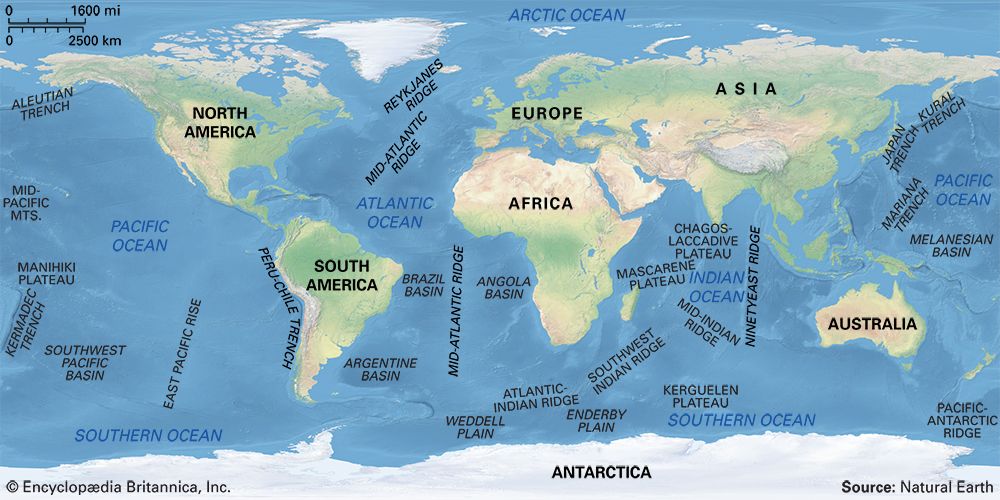
Ocean basins expand through seafloor spreading, a process occurring at mid-ocean ridges. As tectonic plates diverge, magma from the mantle rises to fill the gap, cooling to form new, buoyant crust. This elevated ridge system acts as a primary driver of plate motion through “ridge push,” where gravitational force pulls the cooling, denser crust away from the ridge axis.8910
Destruction and Recycling
To maintain a balance, old oceanic crust is consumed at subduction zones, typically found at deep-sea trenches. Here, older, colder, and denser crust sinks back into the mantle, a process known as “slab pull” that further drives plate movement. Because of this continuous cycle of formation and recycling, the ocean floor is geologically young, rarely exceeding 200 million years in age.81112109
Global Impact
The changing shape and depth of these basins directly influence global sea level. When spreading rates are high, the resulting broad, warm ridges displace seawater onto continents; conversely, as crust cools, densifies, and subsides, the basins deepen, causing sea levels to drop.1314
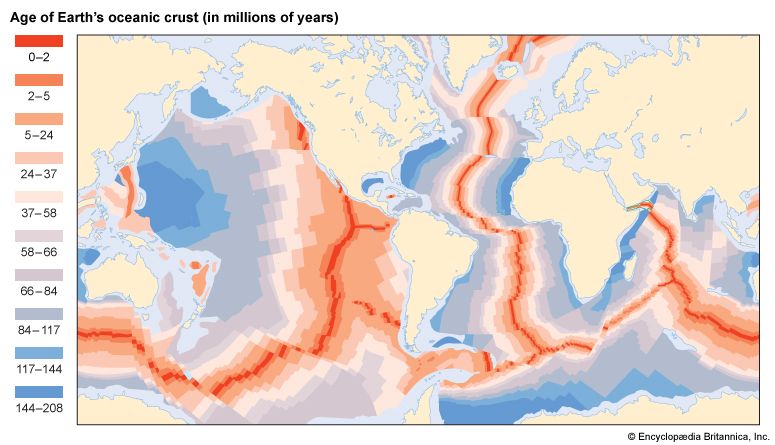
How deep are typical ocean basins, and how does this depth compare to other Earth features?
Ocean basins are vast, deep regions that cover nearly three-quarters of the Earth’s surface, with an average depth of approximately 4 kilometres (about 2.5 miles). While the world’s oceans have an average depth of 3,688 metres (12,100 feet), the topography of the seafloor is highly varied, featuring ocean ridges, abyssal hills, and deep-sea trenchesdeep-sea trenches](https://www.britannica.com/science/deep-sea-trench).1718
When compared to other Earth features, the contrast is significant:
- Land Elevation: While ocean basins lie deep below sea level, continents stand high, with an average elevation of about 840 metres (2,756 feet).1819
- Extreme Points: The deepest point in the ocean, located in the Mariana Trench, reaches 11,034 metres (36,201 feet) below sea level, whereas the highest point on land, Mount Everest, reaches 8,850 metres (29,035 feet) above sea level.18
- Crustal Differences: This depth difference is explained by the nature of the Earth’s crust; oceanic crust is dense and thin, while continental crust is light and thick, causing the continents to “float” higher on the mantle.19
What are the main features of an ocean basin?
Ocean basins are dynamic, vast submarine regions that cover nearly three-quarters of the Earth’s surface. Their topography is shaped primarily by plate tectonics, volcanic activity, and sedimentation.921
Major Relief Features
- Oceanic Ridges: These are the largest features in ocean basins, forming a continuous global system of submarine mountain chains. They act as spreading centres where tectonic plates diverge and new oceanic crust is created.2119
- Deep-sea Trenches: Located at subduction zones, these narrow, deep depressions occur where one tectonic plate slides beneath another, leading to the destruction of old crust.2122
- Abyssal Plains: These are vast, flat seafloor areas found at depths of 3,000 to 6,000 metres. They are formed as sedimentation blankets and smooths out irregular, preexisting topography.2123
- Volcanic Features: Seamounts (underwater mountains) and guyots (flat-topped seamounts) are common, often occurring in linear clusters or chains.924
- Continental Margins: These include the continental shelf, the continental slope, and the continental rise, representing the transition from land to the deep ocean floor.25
Sources
- ocean — Encyclopædia Britannica
- Climate - Climate and the oceans — Encyclopædia Britannica
- evaporation — Encyclopædia Britannica
- ocean current - Pressure gradients — Encyclopædia Britannica
- Pacific Ocean - Deepwater circulation — Encyclopædia Britannica
- Atlantic Meridional Overturning Circulation: Top Questions — Encyclopædia Britannica
- Atmosphere - Effect of oceans on air movement — Encyclopædia Britannica
- plate tectonics - Seafloor spreading — Encyclopædia Britannica
- ocean basin - General features — Encyclopædia Britannica
- subduction zone — Encyclopædia Britannica
- seafloor spreading — Encyclopædia Britannica
- hydrologic sciences - The origin of the ocean basins — Encyclopædia Britannica
- oceanic ridge - Principal characteristics — Encyclopædia Britannica
- plate tectonics - Back-arc basins — Encyclopædia Britannica
- plate tectonics - Sea level — Encyclopædia Britannica
- How do tectonic plates move? — Encyclopædia Britannica
- hypsometric curve — Encyclopædia Britannica
- ocean - Major subdivisions of the oceans — Encyclopædia Britannica
- ocean basin — Encyclopædia Britannica
- continental slope — Encyclopædia Britannica
- abyssal plain — Encyclopædia Britannica
- deep-sea trench - Types — Encyclopædia Britannica
- seamount — Encyclopædia Britannica
- mid-ocean ridge — Merriam-Webster
- continental shelf - Structure — Encyclopædia Britannica
- oceanic ridge — Encyclopædia Britannica
Published on · 4 min read