Scripps Canyon
Scripps Canyon is a shallow submarine canyon located in the Pacific Ocean off the coast of La Jolla, California. It is recognized as the most extensively…
What is Scripps Canyon?
Scripps Canyon is a shallow submarine canyon located in the Pacific Ocean off the coast of La Jolla, California. It is recognized as the most extensively studied submarine canyon in the world due to its proximity to the Scripps Institution of Oceanography, which is also its namesake.1
The canyon is characterized by shallow tributary valleys that begin very close to the shoreline in water as shallow as 40 feet (12 meters). Approximately 1.3 miles from its head, the canyon reaches an axial depth of 980 feet, where it merges with the larger La Jolla Canyon. At this junction, the walls of Scripps Canyon form a distinct V-shape and stand approximately 360 feet high.1
How are submarine canyons formed?
The formation of submarine canyons is a complex geological process that has been the subject of significant scientific debate. Prevailing theories suggest that these features are created through a combination of subaerial and marine processes.2
- Subaerial Erosion: Many researchers believe that the initial formation of numerous undersea canyons began with subaerial erosion. This likely occurred during the Pleistocene Epoch, when lower sea levels exposed parts of the continental shelf, allowing rivers to carve into the landscape.23
- Marine Processes: While subaerial erosion explains the initiation of some canyons, it is insufficient to account for their extreme depths. The primary agents responsible for excavating and maintaining these deep-sea valleys are turbidity currents—dense, underwater slurries of water and sediment.24
- Sediment Movement: These currents are often triggered by the slumping of unconsolidated rock material near the canyon heads. As these currents flow down the continental slope, they erode the seafloor and transport sediment to the deep ocean, eventually depositing it on submarine fans at the base of the canyon.243
What kind of marine life lives in deep-sea canyons?
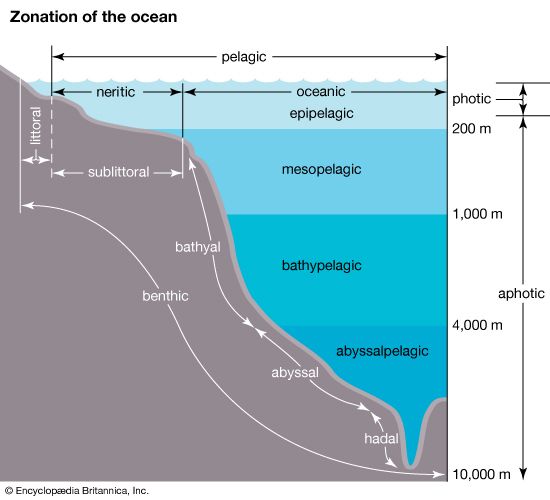
Deep-sea canyons serve as unique environments that host a variety of specialized marine life. Because these canyons often act as conduits for sediment and nutrients moving from the continental shelf to the deep ocean, they support diverse biological communities adapted to extreme conditions, including high pressure, cold temperatures, and darkness.524
The marine life found in these areas can be categorized by their habitat and feeding strategies:
- Benthic Organisms: Many species live on or within the canyon floor. These include deposit feeders like holothurians (sea cucumbers), echinoids (sea urchins), and gastropods that consume organic material in the sediment. Suspension feeders, such as bivalves and crinoids, filter plankton from the water column.6
- Deep-Sea Fish: The fish populations in these depths are highly specialized. Mid-water species often possess luminous organs to attract prey or mates, as well as enlarged eyes and mouths. Notable examples include anglerfishes, viperfishes, and bristlemouths. In contrast, bottom-dwelling (benthic) fish, such as grenadiers and cusk eels, typically have smaller eyes and lack light-producing organs.4
- Sessile Assemblages: In areas where rocky substrates are exposed along canyon walls, diverse communities of sponges, anemones, and ascidians thrive, particularly where current speeds are high.6
Why is the Scripps Institution of Oceanography important for marine research?
The Scripps Institution of Oceanography is a vital center for marine research, primarily recognized for its role in advancing the study of submarine canyons. It is specifically noted for its proximity to Scripps Canyon, which is considered the most extensively studied submarine canyon in the world due to its accessibility from the institution.1
Beyond its focus on local geological features, the institution contributes to the broader field of undersea exploration by utilizing sophisticated methodologies to map the seafloor and analyze deep-sea sediments. These research efforts are essential for understanding:
- Earth History: Analyzing sediment layers provides a historical record of the last 200 million years, including shifts in ocean currents, climate changes, and the evolution of marine life.7
- Geological Processes: Researchers employ acoustic signals, seismic reflection methods, and various sampling equipment—such as dredges and coring devices—to investigate the structure of the ocean floor and the Earth’s crust.78
Sources
- Scripps Canyon — Encyclopædia Britannica
- submarine canyon — Encyclopædia Britannica
- submarine fan — Encyclopædia Britannica
- canyon — Encyclopædia Britannica
- Marine ecosystem - Benthos — Encyclopædia Britannica
- deep-sea fish — Encyclopædia Britannica
- ocean basin - Deep-sea sediments — Encyclopædia Britannica
- undersea exploration - Exploration of the seafloor and the Earth’s crust — Encyclopædia Britannica
Published on · 3 min read