Sugar Beet
The sugar beet (Beta vulgaris) is a cultivated plant of the amaranth family (Amaranthaceae) grown primarily for the high concentration of sucrose in its…
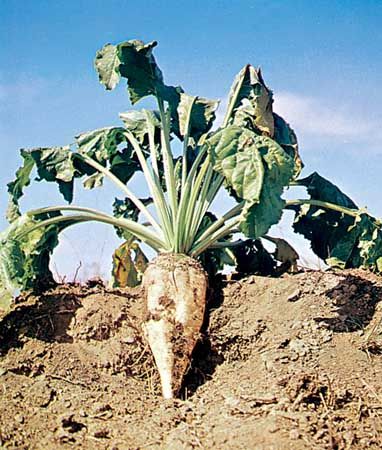
What is a sugar beet and how does it differ from other beet varieties?
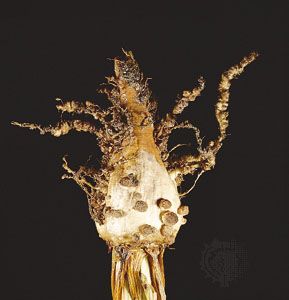
The sugar beet (Beta vulgaris) is a cultivated plant of the amaranth family (Amaranthaceae) grown primarily for the high concentration of sucrose in its white, fleshy root. It is one of four distinct forms of the same species, each developed for different agricultural purposes.123
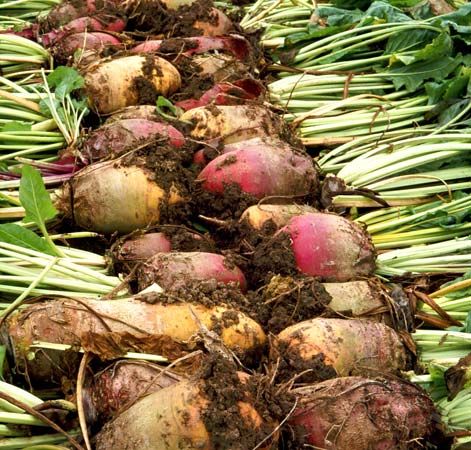
The four cultivated varieties of Beta vulgaris differ by their primary use:
- Sugar beet: Specifically bred to accumulate high levels of sucrose (up to 22 percent) in its root for commercial sugar production.13
- Garden beet (beetroot/table beet): Cultivated as a vegetable for its edible, typically dark red taproot.3
- Chard (leaf beet/Swiss chard): Grown for its nutrient-rich, edible leaves and stalks rather than its root.3
- Mangel-wurzel (fodder beet): A large, succulent variety primarily used as livestock feed, though it is also edible for humans.3
While sugar beets and mangel-wurzel both contain high levels of sucrose, the sugar beet is the most economically significant source of beet sugar globally.3
How has the cultivation of sugar beets impacted the global sugar industry?
The cultivation of the sugar beet has fundamentally reshaped the global sugar industry by providing a major alternative to sugarcane, the world’s primary sugar source.1
Historical Impact
The industry emerged as a strategic response to geopolitical conflict. During the Napoleonic Wars, British blockades severed continental Europe’s access to cane sugar from the West Indies. This prompted Napoleon to aggressively promote beet sugar production through state-funded factories and agricultural schools. Although the industry faced initial instability, it rebounded in the 1840s, and by the late 19th century, beet sugar production had surpassed that of cane sugar.16
Modern Industry Significance
Today, sugar beets account for approximately one-fifth of total global sugar production and remain the dominant source of sugar within the European Union. The industry has been defined by:1
- Technological Advancement: The development of single-germ seeds and mechanized harvesters drastically reduced labor requirements, shifting production from a manual process to a highly efficient industrial operation.6
- Economic Integration: Sugar beet processing creates valuable by-products, such as molasses for animal feed and ethanol production.74
- Geographic Expansion: While traditionally a summer crop in temperate zones, the sugar beet is now grown as a winter crop in warmer regions, including parts of Africa, the Middle East, and South America.1
What are the ideal growing conditions for sugar beets?
The ideal growing conditions for sugar beets involve specific climate, soil, and moisture requirements to maximize root weight and sucrose content:
Climate and Temperature
- Growth Cycle: Sugar beets thrive in temperate zones, traditionally grown as a summer crop. In warmer regions, they are cultivated as a winter crop.
- Temperature Needs: A mild climate throughout the 170–200 day growing period is essential for good yields. Crucially, the final stage of growth requires cold temperatures to ensure a high sucrose content.
Soil Requirements
- Soil Type: While they can grow in various soils ranging from sandy loam to heavy clay, the ideal medium is a deep, homogeneous loam rich in humus.
- Characteristics: The soil should possess appropriate adhesion and a mild moisture-holding capacity. Proper preparation involves deep plowing after the preceding crop is harvested.
Moisture and Irrigation
- Precipitation: Sugar beets require approximately 610 mm (24 inches) of well-distributed precipitation. If natural rainfall is insufficient, the crop must be irrigated. For winter crops, ripening is specifically promoted by withholding water during the final spring period.
How are sugar beets genetically modified to improve their sugar content and pest resistance?
The development of improved sugar beet varieties relies on both traditional breeding and modern genetic engineering. While researchers constantly seek to enhance sucrose content and root weight through selective breeding and the development of superior polyploid hybrids, specific laboratory-based modifications have also been implemented.1
In the United States and several other countries, the most widespread genetic modification for sugar beets is the introduction of resistance to the herbicide glyphosate. This modification allows farmers to manage weeds more effectively without damaging the crop.1
While genetic engineering techniques—such as the use of recombinant DNA—are capable of creating traits like pest or drought resistance in various crops, the primary commercial focus for sugar beets has been herbicide tolerance. These bioengineered crops are subject to rigorous safety and environmental standards regulated by agencies such as the USDA, the EPA, and the FDA.1016
Sources
- Sugar beet — Encyclopædia Britannica
- sugar beet — Merriam-Webster
- Beta vulgaris — Encyclopædia Britannica
- sugar - Sugar beet harvest and delivery — Encyclopædia Britannica
- What’s the Difference Between Cane Sugar and Beet Sugar? — Encyclopædia Britannica
- Origins of agriculture - The sugar beet — Encyclopædia Britannica
- sugar - Washing and extraction — Encyclopædia Britannica
- sugar - Molasses — Encyclopædia Britannica
- sugar - Packaging and storing — Encyclopædia Britannica
- Genetically modified organisms (GMOs) — Encyclopædia Britannica
- Climate change - 3. GMOs (Genetically Modified Organisms) — Encyclopædia Britannica
Published on · 4 min read