Plume Grass
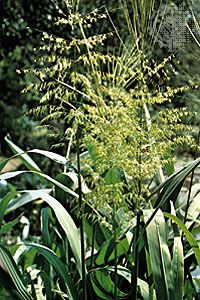
Plume grass refers to a genus of approximately 20 species of tall, reedlike perennials in the Poaceae family, scientifically classified as the genus…
What is Plume grass?
Plume grass refers to a genus of approximately 20 species of tall, reedlike perennials in the Poaceae family, scientifically classified as the genus Saccharum. These plants are native to warm regions across both hemispheres and are characterized by their thick, jointed, sugar-rich stems and long, straplike leaves.1
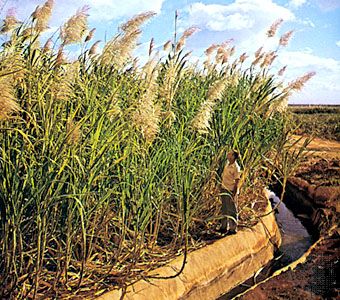
The name is most commonly associated with Saccharum, which includes sugarcanes and ornamental varieties like Ravenna grass (S. ravennae). These grasses typically reach heights of 1 to 3 metres and are named for their dense, cylindrical, plumelike flower clusters. While the term is primarily used for Saccharum, it is also occasionally applied to grasses of the genus Erianthus or the Australian genus Dichelachne, the latter of which is known for its showy, feathery panicles. Because these plants hybridize easily, they are frequently cultivated from cuttings.12
How is sugarcane related to ornamental plume grass?
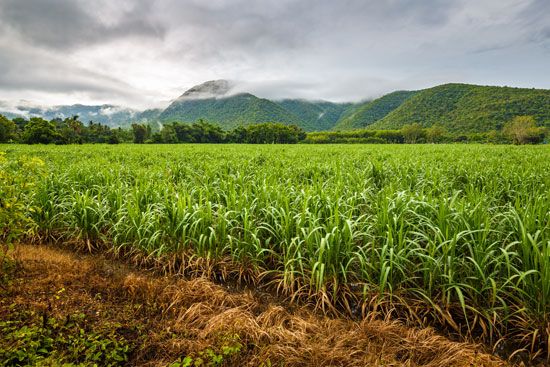
Sugarcane and ornamental plume grass are closely related because they both belong to the same genus, Saccharum, within the Poaceae family.2
Rather than being distinct types of plants, they are different species within this single genus of approximately 20 perennial grasses. For example, sugarcane (Saccharum officinarum) is a member of this group, as is the popular ornamental variety known as Ravenna grass (Saccharum ravennae).2
They share several key botanical characteristics, including:
- Structure: Both are tall, reedlike plants that typically grow between 1 and 3 metres in height.2
- Appearance: Both feature thick, jointed stems and long, straplike leaves.2
- Inflorescence: Both produce dense, cylindrical, plumelike flower clusters, which is the source of the common name “plume grass.”2
- Genetics: Because these species readily hybridize with one another, they are frequently propagated through cuttings to maintain specific traits.2
We could dive deeper into the history of how these grasses were domesticated for sugar production versus landscape use.
What are the characteristics of the Poaceae plant family?
The Poaceae family, commonly known as the grass family, is a globally distributed group of monocotyledonous flowering plants within the order Poales. They are the most abundant and economically significant family of Earth’s flora, providing essential food sources, construction materials, and forage.345
Morphological Characteristics
- Stems: Often called culms, stems are typically round, jointed, and either hollow or filled with spongy pith. They range from small, herbaceous stalks to the massive, woody structures of bamboo.6
- Leaves: Grass leaves are arranged in two vertical ranks and consist of a sheath that encircles the stem and a long, narrow blade with parallel veins. A small structure called a ligule is often present at the junction of the sheath and blade.6
- Roots: The family is characterized by extensive, fibrous root systems rather than a single taproot.64
- Growth: Grasses are unique in their growth method, elongating through cell division and enlargement at the basal point of the stem.6
Reproductive Features
- Inflorescence: The primary unit is the spikelet, a specialized structure consisting of small, chaffy scales (glumes, lemmas, and paleas) that protect the flowers.6
- Flowers: Grass flowers are highly simplified and adapted for wind-pollination. They lack showy petals, instead using tiny structures called lodicules to force the floret open for pollen exchange.6
- Fruit: The fruit, known as a caryopsis or grain, is unique because the fruit wall is fused to the seed coat.6
Why do some grasses have feathery flower panicles?
Grasses have evolved feathery flower panicles and stigmas primarily as an adaptation for wind pollination, a process known as anemophily. Because grasses do not produce showy petals, fragrances, or nectar to attract animal pollinators, they rely on air currents to transport their lightweight pollen.74
The feathery structure of the stigmas—the receptive surfaces of the flower—is specifically designed to maximize the surface area available for catching airborne pollen grains as they drift by. Similarly, the panicle, which is a type of inflorescence or flower cluster, serves to hold these flowers in a position where they can easily shake in the breeze, effectively scattering pollen into the air.74
This strategy is highly efficient for plants that grow in dense populations, as it increases the likelihood that pollen will successfully land on a receptive stigma. By producing an abundance of smooth, lightweight pollen and utilizing these specialized, feathery structures, grasses ensure reproduction in environments where insect pollinators may be scarce or ineffective.7
Sources
- plume grass — Merriam-Webster
- plume grass — Encyclopædia Britannica
- Poaceae — Encyclopædia Britannica
- Poaceae - Characteristic morphological features — Encyclopædia Britannica
- grass — Encyclopædia Britannica
- Poales — Encyclopædia Britannica
- Pollination - Wind — Encyclopædia Britannica
Published on · 3 min read