Tabasco
Tabasco refers to two distinct but related items: a specific variety of chili pepper and the world-famous hot sauce derived from it.
What is Tabasco?
Tabasco refers to two distinct but related items: a specific variety of chili pepper and the world-famous hot sauce derived from it.
The Tabasco Pepper
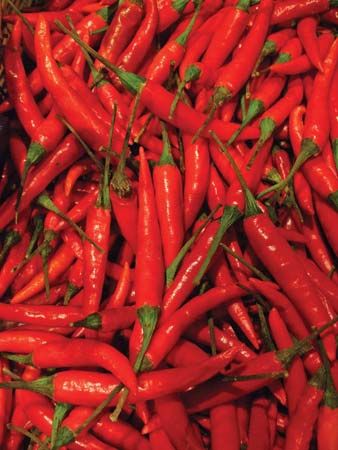
The tabasco pepper (Capsicum frutescens variety tabasco) is a small, hot red chili in the Solanaceae family. Named after the Mexican state of Tabasco, it is typically grown as an annual plant. On the Scoville scale, which measures the heat of peppers, the tabasco chili is rated between 30,000 and 50,000 Scoville Heat Units (SHU).12
Tabasco Sauce
Tabasco sauce is a spicy condiment created by Edmund McIlhenny in Louisiana. It is made by fermenting crushed tabasco chilies with salt, then blending the mash with vinegar and aging the mixture. First marketed in 1869, the sauce became a staple of Cajun and Creole cuisines and gained global popularity, notably becoming a common inclusion in military rations.3
What is capsaicin and how does it create the sensation of heat?
Capsaicin is an organic nitrogen compound and the primary pungent component found in chili peppers (Capsicum). Often categorized within the lipid group, it is a colorless, crystalline substance with the molecular formula C18H27NO3C_{18}H_{27}NO_{3}.34
The sensation of heat produced by capsaicin occurs because it acts as an excitatory compound that binds to specific receptors in the nerve endings of the skin and mouth. Physiologist David Julius identified this receptor as an ion channel known as TRPV1 (transient receptor potential cation channel subfamily V member 1).5
Normally, TRPV1 functions to detect physical heat; however, when capsaicin binds to it, the receptor is activated, tricking the human nervous system into perceiving a burning sensation even in the absence of actual high temperatures. Because of its ability to interact with these pain-sensing pathways, capsaicin is also utilized in topical creams as an analgesic to treat muscle, joint, and nerve pain.534
How does the fermentation process change the flavor of hot sauce?
The fermentation process is a critical step in developing the complex flavor profile of hot sauces like Tabasco sauce. During this process, crushed chili peppers are mixed with salt and stored in barrels, allowing lactic-acid bacteria to break down carbohydrates into lactic acid.17
This biochemical transformation serves several purposes:
- Flavor Development: The production of lactic acid introduces a characteristic tang and acidity that balances the natural heat and fruitiness of the peppers.17
- Preservation: The acidic environment created by the bacteria acts as a natural preservative, which was historically significant for stabilizing the mash before the addition of vinegar.17
- Aging: In modern production, the mash is aged in oak barrels for up to three years. This extended period allows the flavors to mellow and integrate, resulting in a more nuanced and sophisticated final product compared to a simple blend of fresh ingredients.1
What are some other popular types of chili peppers used in cooking?
Beyond the well-known jalapeño and habanero, there is a vast array of chili peppers used in global cuisine, each offering distinct heat levels and flavor profiles:
- Poblano: A mild pepper typically measuring 1,000–2,000 Scoville Heat Units (SHU). It is frequently used in traditional Mexican dishes like chile relleno.893
- Serrano: Often used in fresh salsas, this pepper is a common cultivar of Capsicum annuum and is generally hotter than a jalapeño.10
- Cayenne: A popular, moderately hot pepper (30,000–50,000 SHU) often dried and ground into a powder to add spice to various dishes.108
- Tabasco: Primarily known for its role in hot sauce, this cultivar of C. frutescens shares a similar heat range with cayenne.108
- Ghost Pepper (Bhut Jolokia): A significantly hotter variety reaching approximately 1 million SHU, belonging to the C. chinense species.1089
- Carolina Reaper: Currently one of the world’s hottest peppers, capable of reaching up to 2.2 million SHU.89
- Chipotle: This is not a distinct species but rather a jalapeño that has been smoke-dried. It is prized for its deep, barbecue-like flavor.11
Sources
- Tabasco sauce — Encyclopædia Britannica
- Tabasco — Encyclopædia Britannica
- Scoville scale — Encyclopædia Britannica
- Capsaicin — Encyclopædia Britannica
- David Julius — Encyclopædia Britannica
- capsaicin — Merriam-Webster
- Lactic-acid bacterium — Encyclopædia Britannica
- chipotle — Encyclopædia Britannica
- chili pepper — Encyclopædia Britannica
- habanero — Encyclopædia Britannica
- Where In the World to Use 'Chili,' 'Chilli,' and 'Chile' — Merriam-Webster
Published on · 3 min read