Tänn Falls
Tänn Falls is a prominent waterfall located in the län (county) of Jämtland in northwestern Sweden. Situated on the upper Indals River, the falls are…
What is Tänn Falls?
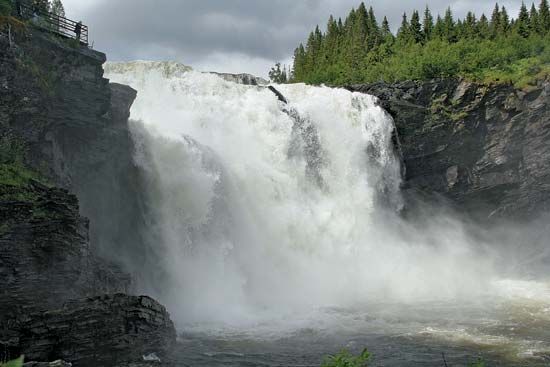
Tänn Falls is a prominent waterfall located in the län (county) of Jämtland in northwestern Sweden. Situated on the upper Indals River, the falls are positioned between Tänn and Östra Norn lakes, near the notable Mount Åreskutan.
Recognized as one of the country’s most impressive waterfalls, Tänn Falls is characterized by two parallel cataracts, each measuring approximately 81 feet (25 meters) in height. The water descends a total drop of 121 feet (37 meters) before flowing into Östra Norn Lake.1
What is the significance of the Indals River in Sweden?
Sorry, the Britannica knowledge base does not contain information regarding the significance of the Indals River in Sweden. The provided search results discuss the Ångerman River in Sweden and the Indus River in Asia, but they do not mention the Indals River.
How do waterfalls like Tänn Falls form?
Waterfalls like Tänn Falls form when a river encounters a sudden, near-vertical drop in its course, creating a significant interruption in the river’s flow. While waterfalls are temporary features that rivers naturally work to smooth out over time through erosion, they arise due to several geological and structural conditions.5
Common factors contributing to their formation include:
- Differential Erosion: When a river flows from a resistant rock bed to a softer one, it erodes the softer rock more quickly, steepening the gradient at the junction.5
- Tectonic Activity: Movements along a fault can create cliffs or scarps that force a river to drop abruptly.51
- Glaciation: This is a frequent cause of waterfalls, particularly through the creation of hanging valleys. As glaciers deeply erode a main valley, tributary valleys are often left high above the main floor; once the ice retreats, streams from these tributaries must fall to join the main drainage system.51
- Land Morphology: Features such as uplifted plateaus or steep scarp slopes can create platforms over which rivers must descend.51
What other natural landmarks are found in the Jämtland region?
The Jämtland region in western Sweden is characterized by diverse natural landmarks, ranging from rugged mountain terrain to expansive lake systems. Notable features include:
- Storsjön: This is the largest lake in the region and serves as a central geographical feature, known for its beautiful scenery and historical significance, including the island of Frösön.7
- Mount Åreskutan: Rising to 4,659 feet (1,420 meters), this mountain is a prominent landmark near the popular resort town of Åre.71
- Flatruet Plateau: Located in the west, this area is home to 4,000-year-old rock paintings, offering a glimpse into the region’s ancient history.8
- Rogen Area: Often described as a “frozen sea,” this landscape is noted for its unique geological formations, specifically its abundance of boulders left behind by the Ice Age.8
- Waterfalls: Beyond Tänn Falls, the region is famous for its wild mountains and numerous waterfalls, which contribute to its status as a significant tourist destination.71
Sources
- Tänn Falls — Encyclopædia Britannica
- Angerman River — Encyclopædia Britannica
- Indus River - Hydrology of the Indus River — Encyclopædia Britannica
- Indus River - Physical features — Encyclopædia Britannica
- waterfall — Encyclopædia Britannica
- river - Falls attributable to discordance of river profile — Encyclopædia Britannica
- Jämtland — Encyclopædia Britannica
- Härjedalen — Encyclopædia Britannica
Published on · 2 min read