Angerman River
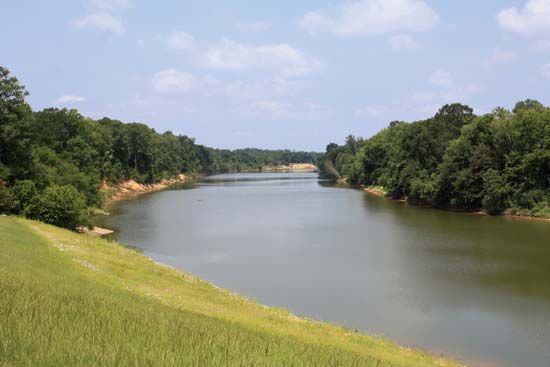
The Ångerman River (often spelled Angerman) is a major waterway in northern Sweden. It originates in Swedish Lapland near the Norwegian border and flows…
What is Angerman River?
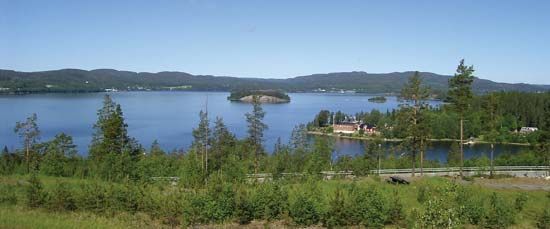
The Ångerman River (often spelled Angerman) is a major waterway in northern Sweden. It originates in Swedish Lapland near the Norwegian border and flows southeast for 285 miles (460 km) through the counties of Västerbotten and Västernorrland before emptying into the Gulf of Bothnia.1
The river features a drainage area of 12,302 square miles (31,865 square km) and is regulated by several lakes, including Lake Vojm and Lake Flå. Due to the numerous falls along its course, the river is a significant source of hydroelectric power. Its 20-mile-long navigable estuary supports various lumber and pulp mills, reflecting the historical importance of forestry in the surrounding Ångermanland province. Its primary tributaries include the Fjällsjö and Fax rivers.12
How is hydroelectric power generated from river falls?
Hydroelectric power is generated by converting the potential energy of falling or fast-flowing water into mechanical energy and, ultimately, into electricity.3
The Generation Process
The process typically occurs at dams that impound rivers, creating a reservoir at a higher elevation. The vertical distance between the water level in the reservoir and the turbine is known as the head.3
- Conveyance: Water is directed from the reservoir downward through large pipes or tunnels called penstocks.3
- Turbine Rotation: As the water reaches the end of the penstock, its force causes turbines to rotate. In some systems, such as those using impulse turbines, the water is discharged through a nozzle to convert its head into kinetic energy before striking the turbine buckets.34
- Electricity Production: The rotating turbines drive generators, which convert the mechanical energy into electricity.
- Transmission: Transformers then increase the voltage of the generated electricity to make it suitable for long-distance transmission.3
While this process provides a renewable energy source, it is important to acknowledge that the construction of dams can cause significant environmental disruption, including the displacement of human communities and the interference with fish migration patterns.536
What is the significance of the Gulf of Bothnia to Sweden?
The Gulf of Bothnia is highly significant to Sweden, serving as a vital economic and industrial hub. Its coastal regions have historically been central to the development of Sweden’s pulp and paper industry, which emerged at the mouths of major rivers flowing into the gulf. These rivers provide essential resources and power, supporting the processing of the country’s vast forest products.78
Beyond forestry, the gulf is home to key Swedish ports such as Luleå, Härnösand, Sundsvall, and Gävle. These locations facilitate the export of industrial goods, including products from the iron and steel sector, such as the mills established in Luleå during the 20th century.78
Physically, the gulf is a dynamic environment where land uplift and sediment deposition continue to reshape the coastline. While its low salinity and seasonal ice cover present navigational challenges, the gulf remains an integral part of Sweden’s maritime and economic landscape.97
What are the primary industries in the Norrland region?
The economy of the Norrland region is primarily driven by its vast natural resources. The following industries are of prime importance to the region:
- Forestry: The region possesses extensive forests, which have historically formed the basis for a significant timber and wood-processing industry. Historically, the region’s great rivers were used to transport timber to sawmills located near the coast.11
- Mining: Norrland is rich in mineral resources. The Boliden area is a notable center for mining a wide range of metals, including gold, copper, lead, and zinc. Additionally, the region is home to massive iron ore deposits, such as those at Kiruna in Lappland.1112
- Hydroelectric Power: The region’s great rivers, such as the Lule, Ume, and Ångerman, serve as a major source of hydroelectric power, which is essential to Sweden’s industrial economy.1211
- Manufacturing: Industrial activities, including iron smelting, engineering, and shipbuilding, are concentrated in coastal cities like Luleå, which also serves as a major export harbor for iron ore.13
While there is some agriculture in the region, it remains secondary to these resource-based industries.11
Sources
- Angerman River — Encyclopædia Britannica
- Ångermanland — Encyclopædia Britannica
- Did you know? — Merriam-Webster
- hydroelectric power — Encyclopædia Britannica
- turbine - Impulse turbines — Encyclopædia Britannica
- reservoir — Encyclopædia Britannica
- Gulf of Bothnia — Encyclopædia Britannica
- Bay of Bothnia — Encyclopædia Britannica
- Sweden - Manufacturing — Encyclopædia Britannica
- Baltic Sea - Physiography — Encyclopædia Britannica
- Sweden - Resources and power — Encyclopædia Britannica
- Norway - Electrometallurgy — Encyclopædia Britannica
- Norway - Agriculture, forestry, and fishing — Encyclopædia Britannica
- Norrland — Encyclopædia Britannica
- Bergslagen — Encyclopædia Britannica
- Luleå — Encyclopædia Britannica
Published on · 3 min read