Tapeworm
Parasitic flatworms, including tapeworms and flukes, have evolved from free-living Turbellaria ancestors by developing specialized adaptations for survival…
How have tapeworms and flatworms evolved and adapted to their parasitic lifestyle over time?
Parasitic flatworms, including tapeworms and flukes, have evolved from free-living Turbellaria ancestors by developing specialized adaptations for survival within host environments.123
Evolutionary Adaptations
The transition to parasitism involved significant morphological and physiological changes:
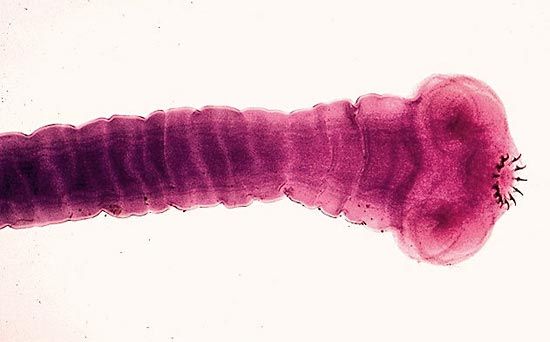
- Attachment Organs: Parasites evolved specialized structures such as suckers, hooks, and spines on the scolex (head) to anchor themselves firmly within a host.45
- Tegument Modification: Unlike the ciliated epidermis of free-living forms, parasitic flatworms possess a metabolically active, non-ciliated tegument. In tapeworms, this surface features microtriches, which increase surface area for nutrient absorption, as these organisms lack a digestive tract.45
- Reproductive Efficiency: To ensure survival despite the challenges of finding hosts, many species became hermaphroditic, with each proglottid acting as a self-sufficient reproductive unit capable of producing thousands of embryos.45
- Complex Life Cycles: Parasites adapted to utilize intermediate hosts, which facilitates transmission between definitive hosts. Some species even evolved to manipulate host behavior to increase the likelihood of being ingested by a final host.16
How do tapeworms and flatworms feed and survive within their host organisms?
Parasitic flatworms and tapeworms have evolved specialized mechanisms to feed and survive within their hosts, often overcoming the challenges of internal environments through unique physiological adaptations.
Feeding Mechanisms
The method of nutrient acquisition depends on the parasite’s group:
- Tapeworms (Cestoda): Lacking a digestive tract entirely, tapeworms absorb all necessary nutrients directly through their body covering, or tegument. This surface is covered in microtriches, which increase surface area for absorption. They utilize active transport to take up amino acids and sugars from the host against a concentration gradient, a process requiring energy expenditure.17
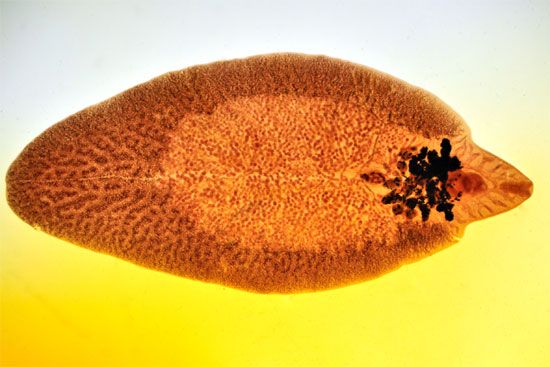
- Flukes (Trematoda and Monogenea): These parasites possess a gut and perform both extracellular and intracellular digestion. While they can ingest host tissues or fluids, they also supplement their nutrition by absorbing glucose and other materials through their metabolically active tegument.7
Survival and Attachment
To maintain their position and thrive within a host, these organisms utilize several strategies:
- Attachment: Parasites use specialized structures on the scolex, such as suckers, hooks, or spines, to anchor themselves securely to host tissues like the gut wall or gill arches.12
- Physiological Adaptation: Parasites are highly sensitive to the biochemical and immunological conditions of their hosts. For instance, some tapeworms are triggered to reach sexual maturity by the specific body temperature of their final host, which differs significantly from the environment of their intermediate host.2
- Metabolic Activity: The tegument is not a passive layer but a living, metabolically active syncytium that protects the parasite while facilitating nutrient exchange and secretion.1
What are the main structural differences between tapeworms and other types of flatworms?
Tapeworms (Class Cestoda) exhibit several distinct structural differences compared to other flatworms, such as turbellarians and flukes.
Key Structural Differences
- Absence of Digestive System: Unlike most other flatworms, which possess a mouth, pharynx, and intestine, tapeworms lack a digestive tract entirely. They absorb nutrients directly from their host through their body covering, or tegument.18
- Body Segmentation: Most tapeworms are polyzoic, meaning their body (strobila) is divided into numerous segments called proglottids. Each proglottid functions as a self-sufficient reproductive unit containing both male and female sexual organs. In contrast, other flatworm classes typically have unsegmented bodies.94
- Specialized Attachment Organs: While other flatworms may have suckers, tapeworms possess a specialized anterior structure called a scolex. The scolex is often equipped with unique combinations of suckers, hooks, or spines to anchor the parasite to the host’s gut.94
- Surface Modifications: The surface of tapeworms is covered in microtriches—spinelike structures that increase surface area for nutrient absorption. These are absent in flukes, which may instead feature simple spines.9
- Epidermal Composition: Free-living flatworms typically have a ciliated epidermis, whereas parasitic forms like tapeworms have a metabolically active, non-ciliated syncytial tegument.9
How do tapeworms reproduce, and what role do intermediate hosts play in their life cycle?
Tapeworms are hermaphroditic organisms, meaning each individual possesses both male and female reproductive organs. Their bodies are typically divided into segments called proglottids, each of which functions as a self-sufficient reproductive unit containing a complete set of genitalia. While cross-fertilization can occur, self-fertilization is more common. Following fertilization, the uterus within a proglottid can become greatly distended, sometimes holding tens of thousands of embryos.65
Intermediate hosts play a critical role in the complex life cycles of many tapeworm species. After fertilized eggs are passed out of the definitive host via feces, they must be ingested by an intermediate host (such as a mammal, fish, or crustacean). Inside this host, the larva emerges, migrates to tissues—often muscle—and forms a protective capsule known as a cysticercus. The life cycle is completed when the definitive host consumes the raw or undercooked meat of the intermediate host, allowing the larva to attach to the intestine and mature into an adult.610
Sources
- flatworm - External features — Encyclopædia Britannica
- flatworm - Ecology — Encyclopædia Britannica
- flatworm - Evolution — Encyclopædia Britannica
- flatworm — Encyclopædia Britannica
- flatworm - Development — Encyclopædia Britannica
- tapeworm — Encyclopædia Britannica
- flatworm - Parasitic forms — Encyclopædia Britannica
- flatworm - Annotated classification — Encyclopædia Britannica
- flatworm - Digestive and excretory systems — Encyclopædia Britannica
- flatworm - Reproduction — Encyclopædia Britannica
Published on · 4 min read