Tapir
Tapirs are generally solitary and shy animals that inhabit deep forests or swamps, where they travel along well-worn trails, typically near water. Because…
What are some interesting behaviors or social structures observed in tapir groups?
Tapirs are generally solitary and shy animals that inhabit deep forests or swamps, where they travel along well-worn trails, typically near water. Because they are not social animals that form complex groups, there is little evidence of the elaborate social structures or group behaviors often observed in other species.1
When disturbed, their primary behavioral response is to flee, often crashing through the undergrowth or seeking safety in water. While they are not known for complex social interactions, they do exhibit parental care, which is common among mammals; females carry their young through a long gestation period of approximately 400 days and provide essential care through lactation after birth.12
In which parts of the world can tapirs be found?
Tapirs are found in two distinct, widely separated regions: Southeast Asia and the New World (Central and South America).1
Southeast Asia
The Malayan tapir is the only species native to the Eastern Hemisphere. Its range includes the Malay Peninsula, Sumatra, and parts of southern Myanmar and Thailand.34
The New World
Four species inhabit Central and South America, occupying specific, often nonoverlapping ranges:14
- Central American tapir: Found in regions extending from Mexico through Central America into coastal Ecuador.4
- Mountain tapir: Inhabits the high-altitude forests and grasslands of the Andes in Colombia, Ecuador, and northern Peru.4
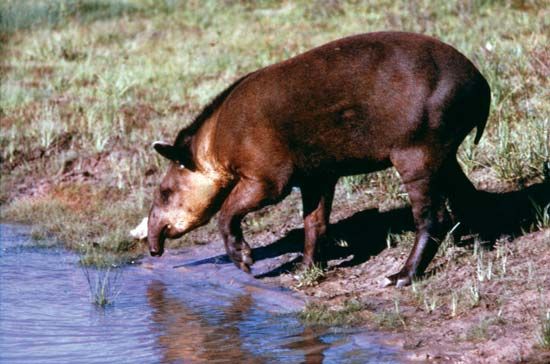
- Lowland tapir: The most widespread species, found throughout the Brazilian subregion east of the Andes, as well as parts of northwestern Venezuela and northern Colombia.4
- Little black tapir: Also known as the Kobomani tapir, this species is found in South America.1
While tapirs were once widespread across North America, Europe, and China, their current distribution is limited to these tropical regions.1
What are the main physical characteristics of tapirs?
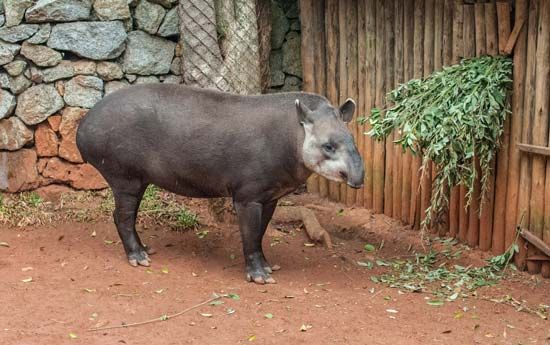
Tapirs are heavy-bodied, short-legged hoofed mammals belonging to the order Perissodactyla. They typically measure 1.3 to 2.5 meters in length and reach about 1 meter at the shoulder.1
Key physical features include:
- Snout: Their most distinctive feature is a short, fleshy proboscis or trunk that hangs over the upper lip.1
- Head and Limbs: They have small eyes and short, rounded ears. Their feet possess three functional toes; the first toe is absent, and the fifth is reduced or absent.1
- Coat: Body hair is generally short and sparse, though it is denser in the mountain tapir. Several species, including the Central American tapir and lowland tapir, feature a short, bristly mane.1
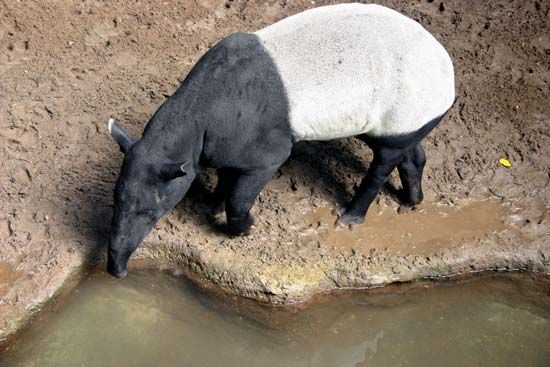
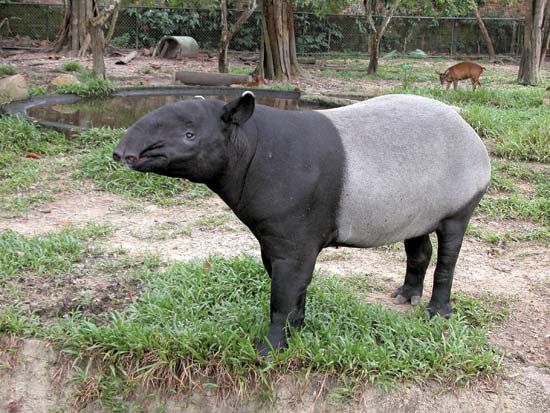
- Coloration: New World species are typically black, dark brown, or gray. In contrast, the Malayan tapir is uniquely patterned with a black head, shoulders, and legs, contrasted by a white back, rump, and belly. Young of all species are dark brown with yellowish-white streaks and spots.1
How many species of tapirs exist, and what are their names?
There are five extant species of tapirs currently recognized within the genus Tapirus. They are as follows:
- Malayan tapir (Tapirus indicus)
- Central American tapir, also known as Baird’s tapir (Tapirus bairdii)
- Mountain tapir (Tapirus pinchaque)
- Lowland tapir (Tapirus terrestris)
- Little black tapir, also known as the Kobomani tapir (Tapirus kabomani)1
Sources
- tapir — Encyclopædia Britannica
- Animal social behavior - Social interactions involving the costs and benefits of parental care — Encyclopædia Britannica
- Malayan tapir — Merriam-Webster
- perissodactyl - Tapirs — Encyclopædia Britannica
Published on · 3 min read