Titanothere
A titanothere, more accurately referred to as a brontothere, is any member of an extinct family of large, hoofed mammals known as Brontotheriidae. These…
What is titanothere?
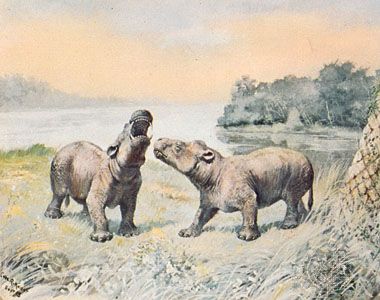
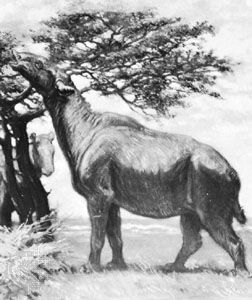
A titanothere, more accurately referred to as a brontothere, is any member of an extinct family of large, hoofed mammals known as Brontotheriidae. These animals originated in Asia and North America during the early Eocene Epoch (approximately 50 million years ago) and became extinct by the middle of the Oligocene Epoch.12345
Titanotheres were herbivorous perissodactyls that shared a common ancestry with the horse. While early forms were similar in size to tapirs, later species grew to be quite massive, with some standing up to 2.5 meters (about 8 feet) tall at the shoulder. They were characterized by bulky bodies, strong, pillarlike limbs, and massive skulls often adorned with large, bony, skin-covered protuberances. These structures may have served as defensive weapons or been used in intraspecific combat. Their teeth were adapted for consuming soft vegetation.251
How did the Eocene and Oligocene epochs differ?
The Eocene Epoch (56 to 33.9 million years ago) and the Oligocene Epoch (beginning 33.9 million years ago) represent a pivotal transition in Earth’s history, primarily defined by a shift from a warm, humid world to one characterized by cooling and the development of permanent ice.678
Climate and Environment
- Eocene: This epoch was generally warm and humid, featuring widespread temperate and subtropical forests. It included the Eocene Optimum, a period of high temperatures, followed by a steady cooling trend as the epoch progressed toward its boundary with the Oligocene.768
- Oligocene: Following the Eocene-Oligocene boundary, global temperatures continued to decline. A significant development during this time was the formation of a continental ice sheet in Antarctica, facilitated by the isolation of the continent as sea passages opened.689
Biological Shifts
- Eocene: This period saw the rapid diversification of modern mammal groups, including the first appearance of cetaceans, sirenians, and early bats. Perissodactyls and artiodactyls became prominent.710
- Oligocene: Global cooling triggered vegetation changes, converting rainforests into more open forests and grasslands. This shift led to the extinction of primitive herbivores, such as brontotheres, and the rise of modern mammalian communities dominated by groups like horses, rhinoceroses, and camels.10
What are other examples of extinct perissodactyls?
Beyond the well-known horses, rhinoceroses, and tapirs, the order Perissodactyla includes a diverse array of extinct lineages that flourished during the Paleogene and Neogene periods.113
Notable examples of extinct perissodactyls include:
- Chalicotheres (Family Chalicotheriidae): These unusual animals, such as the genus Chalicotherium, possessed horselike bodies but featured long front limbs and feet ending in large, developed claws rather than hooves. These claws were likely used for digging or pulling down tree branches for browsing.123
- Brontotheres (Family Brontotheriidae): Also known as titanotheres, these massive, herbivorous mammals were common in the Eocene and Oligocene. They are characterized by their large size—some standing 2.5 meters (8 feet) tall—and distinctive, bony, hornlike protuberances on their skulls.133
- Hyracodonts (Family Hyracodontidae): Often called “running rhinoceroses,” these were relatively small, long-legged, and slender animals that lived from the middle Eocene to the upper Oligocene.3
- Amynodonts (Family Amynodontidae): These rhinoceros relatives were hippopotamus-like in appearance, with heavy bodies and short, thick skulls adapted for their environment.3
- Indricotheres (e.g., Indricotherium): Also known as Paraceratherium, this giant, giraffe-like rhinoceros is considered the largest land mammal to have ever lived, standing approximately 5.5 meters (18 feet) at the shoulder.1411
Why did the brain size of titanotheres remain small?
The titanotheres (Brontotheriidae) possessed brains that were notably small in proportion to their massive, long skulls compared to most modern hoofed mammals. While the fossil record documents their rapid evolution toward larger body sizes and the development of prominent, hornlike skull processes, it does not explicitly state a singular evolutionary or biological reason for their limited brain growth.163
Their evolutionary trajectory focused heavily on physical size and specialized dental adaptations suited for consuming soft vegetation. As these animals became increasingly large, their cranial morphology remained characterized by a long, low structure that accommodated their primitive teeth rather than significant encephalization. Ultimately, this group, which thrived in North America, Asia, and eastern Europe during the Eocene and Oligocene, disappeared by the Miocene epoch.163
We could dive deeper into the environmental pressures that may have contributed to the extinction of the titanotheres during the Miocene.
Sources
- titanothere — Encyclopædia Britannica
- titanothere — Merriam-Webster
- brontothere — Encyclopædia Britannica
- Brontotheriidae — Merriam-Webster
- perissodactyl - Annotated classification — Encyclopædia Britannica
- Climate change - Cenozoic climates — Encyclopædia Britannica
- Eocene Epoch — Encyclopædia Britannica
- Paleocene-Eocene Thermal Maximum — Encyclopædia Britannica
- paleoceanography — Encyclopædia Britannica
- Tertiary Period - The rise of mammals — Encyclopædia Britannica
- Chalicotherium — Encyclopædia Britannica
- perissodactyl - Evolution and paleontology — Encyclopædia Britannica
- rhinoceros — Encyclopædia Britannica
- perissodactyl - General features — Encyclopædia Britannica
- artiodactyl - Annotated classification — Encyclopædia Britannica
- perissodactyl - Titanotheres — Encyclopædia Britannica
Published on · 3 min read