Perissodactyl
The order Perissodactyla, or "odd-toed ungulates," emerged during the early Eocene Epoch (approximately 55 million years ago), likely descending from…
How have perissodactyls evolved over time, and what were some of their prehistoric relatives?
The order Perissodactyla, or “odd-toed ungulates,” emerged during the early Eocene Epoch (approximately 55 million years ago), likely descending from unspecialized, carnivore-like mammals known as Condylarthra.12
Evolutionary Trends
Perissodactyls flourished during the Paleogene and Neogene periods, playing a dominant role in global fauna. Their evolution is characterized by several key adaptations:3
- Locomotion: Early forms were digitigrade, but many lineages transitioned to an unguligrade (hoofed) condition. Over time, they evolved elongated limbs with a reduced number of digits, concentrating body weight on the third digit (the mesaxonic condition).4
- Dentition: Evolution favored high-crowned, grinding teeth (hypsodonty) adapted for a herbivorous diet of grazing or browsing.34
- Parallel Evolution: Perissodactyls independently developed cursorial (running) features similar to those found in Artiodactyla, such as cattle and swine.3
Prehistoric Relatives and Groups
The fossil record reveals a diverse array of extinct perissodactyls, including:
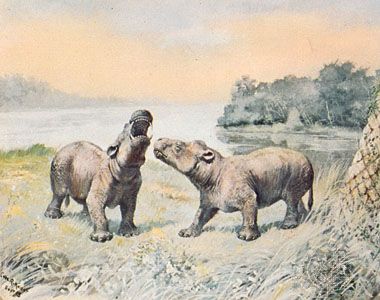
- Titanotheres: Massive, horn-bearing browsers that reached heights of 2.5 meters.4
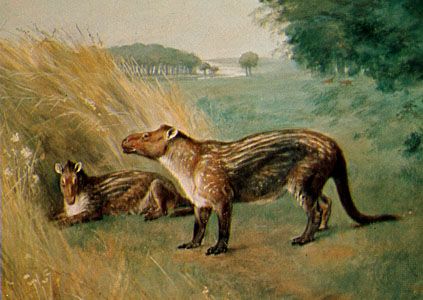
- Chalicotheres: Unusual, horse-related animals like Moropus, which possessed claws instead of hooves, likely for digging roots.54
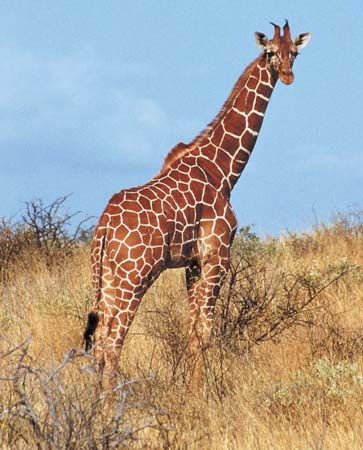
- Indricotherium: A giant, giraffe-like rhinoceros from the Oligocene that stands as one of the largest land mammals to ever live.3
- Diverse Rhinoceroses: Including the running hyracodonts and the hippopotamus-like amynodonts4.
How do scientists study and classify extinct perissodactyl species?
Because skeletal remains are the only evidence available for extinct species, scientists rely heavily on anatomical analysis to classify perissodactyls. Researchers examine specific diagnostic features to determine evolutionary relationships and functional adaptations.7
Key Taxonomic Criteria
- Skull Morphology: Scientists analyze the length of the facial region and the form of the nasal bones. The presence of a postorbital bar or hornlike structures provides critical data for identification.7
- Dentition: The number, form, and arrangement of teeth are essential. Researchers look for the presence of a diastema (a gap between teeth), the number of molariform premolars, and the height of the cheek teeth. The cusp structure and the presence of secondary cement on grinding surfaces—which indicate whether a species was a browser or a grazer—are particularly valuable for classification.78
- Limb Structure: The skeletal anatomy of the limbs is a primary aid. Scientists measure the length of limb segments and observe the degree to which the ulna and fibula are reduced or fused. Additionally, the number and form of carpal and tarsal bones, as well as the relative size of the digits, help define specific lineages.7
What ecological roles do perissodactyls play in their various habitats?
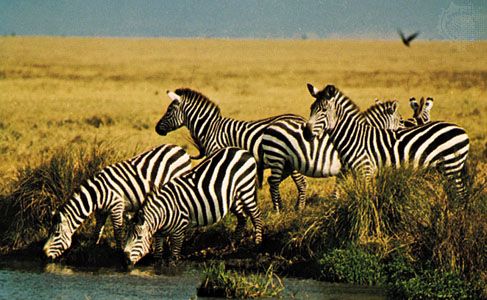
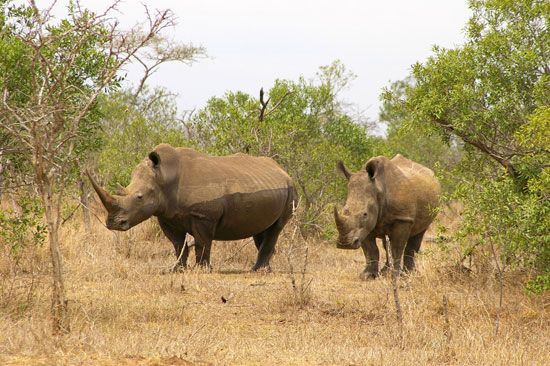
Perissodactyls, or odd-toed ungulates, function primarily as herbivores within their ecosystems, filling roles as either grazers or browsers. Their ecological impact is largely defined by their feeding habits and their movement across landscapes:1011
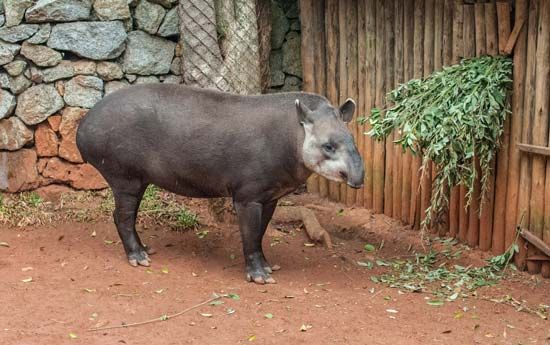
- Grazing and Browsing: Grazing species, such as horses, asses, and zebras, feed on grasses, often migrating long distances to follow rainfall and find succulent pastures. Browsing species, such as tapirs and most rhinoceroses, feed on the leaves and twigs of trees and shrubs.1011
- Habitat Modification: Browsing rhinoceroses can significantly alter their environment by breaking down trees and shrubs to access foliage that would otherwise be unreachable.10
- Resource Distribution: By moving between areas to find food, these animals influence the distribution of nutrients and vegetation in their habitats. Historically, perissodactyls played a dominant role in global fauna during the Paleogene and Neogene periods, shaping the structure of terrestrial communities.1011
While they are currently less numerous than artiodactyls, their evolutionary history as specialized herbivores remains a central subject in understanding the development of modern grassland and forest ecosystems.112
How do the digestive systems of perissodactyls differ from other herbivores?
Perissodactyls, such as horses, rhinoceroses, and tapirs, utilize a digestive strategy known as hindgut fermentation, which differs significantly from the ruminant system found in many other herbivores like cattle and sheep.15
Key Digestive Differences
- Stomach Structure: Unlike ruminants, which possess a complex, multi-chambered stomach including a rumen for pre-gastric fermentation, perissodactyls have a small, simple, and undivided stomach.1516
- Fermentation Site: In perissodactyls, bacterial fermentation occurs in the cecum and the large colon, which are exceptionally large and sacculated to allow for the breakdown of fibrous plant material.1516
- Efficiency and Mobility: While hindgut fermenters are generally less efficient at extracting nutrients from high-fiber foods than ruminants, they avoid the energy loss associated with ruminal fermentation. Furthermore, because they lack the heavy, bulky stomach of a ruminant, perissodactyls are often more athletic and capable of rapid movement to escape carnivore predators.15
- Anatomical Features: Perissodactyls lack a gall bladder, a feature that distinguishes them from many other mammalian groups.16
Sources
- perissodactyl - Evolution and paleontology — Encyclopædia Britannica
- perissodactyl - General features — Encyclopædia Britannica
- Moropus — Encyclopædia Britannica
- perissodactyl - Annotated classification — Encyclopædia Britannica
- perissodactyl — Encyclopædia Britannica
- Notoungulata — Encyclopædia Britannica
- perissodactyl - Distinguishing taxonomic features — Encyclopædia Britannica
- perissodactyl - Teeth — Encyclopædia Britannica
- oreodont — Encyclopædia Britannica
- perissodactyl - Feeding — Encyclopædia Britannica
- Eocene Epoch — Encyclopædia Britannica
- artiodactyl - Food habits — Encyclopædia Britannica
- Tertiary Period - The rise of mammals — Encyclopædia Britannica
- artiodactyl - General structure — Encyclopædia Britannica
- nutrition - Herbivores — Encyclopædia Britannica
- perissodactyl - Digestive system — Encyclopædia Britannica
Published on · 4 min read