Termite
Termites maintain a highly organized society through a continuous exchange of information, relying primarily on chemical signals, vibrations, and physical…
How do termites communicate with each other within their colonies?
Termites maintain a highly organized society through a continuous exchange of information, relying primarily on chemical signals, vibrations, and physical contact rather than visual cues, which are ineffective in the dark colony interior.1
Chemical Communication
Pheromones are essential for colony regulation and coordination. Foraging termites mark trails to food sources by dragging their abdomens to deposit scent trails, which others detect via olfactory receptors. Additionally, pheromones play a critical role in caste regulation; reproductive and soldier castes secrete chemicals that are spread through grooming and food sharing (trophallaxis). These signals inhibit the development of additional members of those castes, ensuring the colony maintains a balanced division of labour.12
Vibrations and Physical Contact
Termites communicate alarm through physical interactions and vibrations sensed by receptors on their legs. Alarmed individuals may tap their heads against the ground, quiver, or move in a zigzag pattern, bumping into others to spread the alert. While these head-tapping movements produce sounds, termites respond to the resulting substratum vibrations rather than airborne noise.1
What is the ecological importance of termites in their environments?
Termites play a vital ecological role by acting as essential decomposers within their environments. Their primary contribution is the breakdown of cellulose—a complex carbohydrate found in wood, grass, leaves, and other vegetative matter—into substances that can be recycled back into the ecosystem to support new plant growth.34
By consuming dead plant material, termites facilitate the nutrient cycling process, which is fundamental to maintaining healthy soil and supporting biological productivity. While some species are considered pests when they consume wooden structures or crops, only about 10 percent of the 2,750 known termite species are classified as such.35
Furthermore, the structures termites build, such as their elaborate mounds, provide microhabitats that offer shelter and warmth for various other organisms, including insects, lizards, snakes, and birds, thereby increasing the biodiversity of their local ecosystems.6
How do termites digest wood and other cellulose-rich materials?
Termites rely on specialized biological partnerships to break down cellulose, a complex carbohydrate found in wood and other plant materials. The method of digestion differs significantly between lower and higher termite families.4
Lower Termites
Lower termites depend entirely on symbiotic flagellate protozoans that reside in their hindgut. These microorganisms live in an anaerobic environment and secrete enzymes—specifically cellulase and cellobiase—that convert cellulose into simple sugar (glucose) and acetic acid. Because these protozoans are lost during each molt, termites must reacquire them through anal feeding from other colony members.4
Higher Termites
Higher termites (family Termitidae) do not harbor these symbiotic protozoans. Instead, they rely on bacteria present in their gut to assist with digestion. In some species, the termites themselves secrete the necessary cellulase and cellobiase enzymes to break down their food. Additionally, many termites benefit from fungi found in decayed wood, which help pre-digest materials and provide essential nitrogen and vitamins.4
How are termite colonies organized and what roles do different castes play?
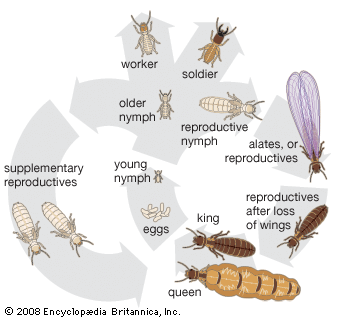
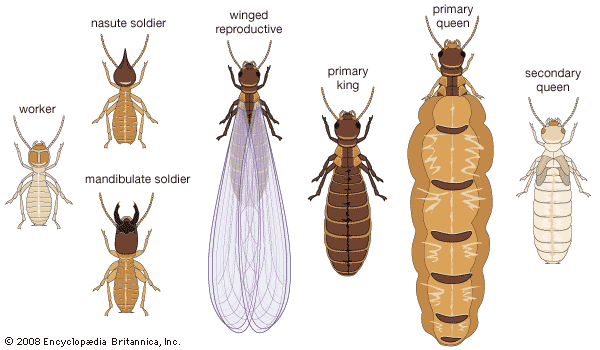
Termite colonies are highly integrated societies organized into a caste system, where individuals are differentiated by structure, function, and behavior. While all nymphs are genetically identical at hatching, their development into specific castes is regulated by pheromones and hormones, which ensure the colony maintains a precise balance of members.2
Major Castes and Their Roles
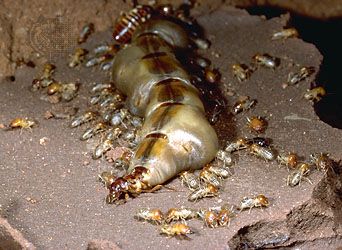
- Reproductives: The primary pair, a king and queen, are responsible for reproduction and colony formation. They originate from winged alates that leave the nest to mate. If a primary reproductive dies, they are replaced by secondary or supplementary reproductives known as neotenics.29
- Workers: These sterile, wingless individuals make up the majority of the colony. They are responsible for foraging, feeding other members, grooming, and nest construction and repair. Their activities are the primary cause of structural damage associated with termites.10
- Soldiers: Primarily tasked with defense, soldiers possess specialized features such as large, hardened heads and powerful mandibles to combat predators like ants. Some species utilize chemical defenses, ejecting sticky or toxic liquids from glands to entangle or repel enemies.10
Sources
- termite - Communication — Encyclopædia Britannica
- termite - Colony organization — Encyclopædia Britannica
- termite - Importance — Encyclopædia Britannica
- termite - Cellulose — Encyclopædia Britannica
- termite - Distribution and abundance — Encyclopædia Britannica
- termite - Nest types — Encyclopædia Britannica
- termite — Encyclopædia Britannica
- soil - Biological phenomena — Encyclopædia Britannica
- termite - Reproductives — Encyclopædia Britannica
- termite - Workers and soldiers — Encyclopædia Britannica
Published on · 3 min read