Thrips
Thrips (order Thysanoptera) hold significant economic importance in agriculture and horticulture due to their dual roles as pests and beneficial organisms.
What economic importance do thrips have in agriculture and horticulture?
Thrips (order Thysanoptera) hold significant economic importance in agriculture and horticulture due to their dual roles as pests and beneficial organisms.
Negative Impacts
Many thrips species are considered destructive pests. Their feeding habits can lead to:
- Direct Damage: They reduce seed production, disfigure flowers and fruits, and damage leaves. In warmer climates, they can cause the formation of plant galls and leaf rolls.1
- Disease Transmission: Thrips are economically significant because they act as vectors for various plant viruses, which can cause stunted growth, tissue distortion, and color changes in crops and ornamental plants.12
Beneficial Roles
Conversely, thrips can provide ecological services that benefit growers:
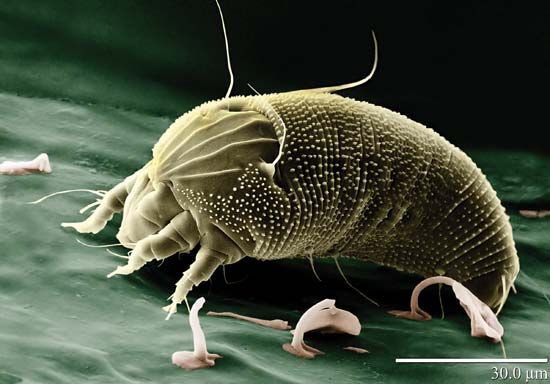
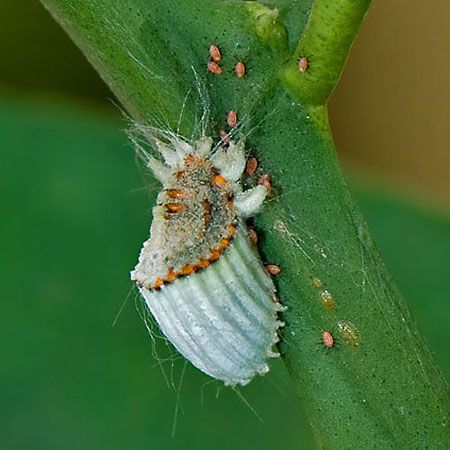
- Biological Control: A few species are predatory, feeding on destructive mites and scale insects that would otherwise harm plants.1
- Pollination: Several species contribute to the pollination of flowers, supporting plant reproduction.1
Due to their minute size, they are capable of infiltrating the smallest floral structures and plant crevices, making them difficult to manage in commercial settings.1
How have thrips evolved over time, and what is their relationship to other insect orders?
Thrips (order Thysanoptera) belong to the Psocoptera or Corrodentia-Hemiptera phyletic line of insects. Their evolutionary history is marked by specialized adaptations, most notably the development of the left mandible into an efficient, chisel-like tool for piercing pollen granules, which likely drove their early diversification as pollen feeders.3
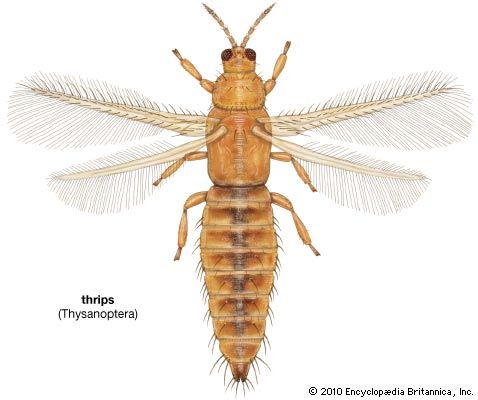
To overcome the aerodynamic drag caused by their minute size, thrips evolved narrow, fringed wings, a feature that defines the order name Thysanoptera (Latin for “fringed wings”). Their evolutionary trajectory also includes the development of asymmetrical mouthcones, characterized by an atrophied right mandible.341
The fossil record provides insight into their lineage, with Permothrips longipennis identified as the earliest known fossil, appearing closely related to the family Aeolothripidae, which is considered the most generalized and ancestral type. Over time, thrips diverged into two main suborders:3
- Terebrantia: These families generally retain the ancestral habit of feeding on vascular plants and pollen and possess a sawlike ovipositor.31
- Tubulifera: Represented by the family Phlaeothripidae, many members of this group have adapted to feeding in detritus and lack an ovipositor.31
Are there any beneficial roles that thrips play in ecosystems or human activities?
While thrips are often recognized for their role as agricultural pests, they also provide several beneficial services within ecosystems.
- Biological Control: A small number of thrips species act as predators, feeding on destructive mites and scale insects that can damage plants. By preying on these pests, they contribute to natural population regulation.1
- Pollination: Many thrips species aid in the pollination of flowers. Due to their minute size, they are capable of entering the smallest floral structures, allowing them to facilitate fertilization in plants that might be inaccessible to larger pollinators.1
- Ecological Balance: Within their natural habitats, thrips serve as a food source for a variety of predators, including other insects, birds, salamanders, and lizards, thereby supporting local food webs.7
What are the main characteristics that define thrips as a distinct insect order?
Thrips, which comprise the order Thysanoptera, are defined by several unique anatomical and developmental characteristics that distinguish them from other insects:
- Asymmetrical Mouthparts: A defining feature of the order is an asymmetrical mouthcone resulting from an atrophied right mandible, while the left mandible is developed into a chisel-like tool for piercing.169
- Wing Structure: Their name, derived from the Greek for “fringed wings,” refers to their narrow, fringed wings, which evolved to overcome aerodynamic drag due to their minute size (typically 1.5 to 3 mm).110
- Bladder Feet: Adults possess extensible bladders on the tarsi (feet) of their legs, which aid in movement.16
- Unique Metamorphosis: Thrips undergo an unusual developmental process. While they belong to a group that typically exhibits simple metamorphosis, they possess pupal stages—sometimes up to three—that resemble the complete metamorphosis seen in other insect orders.3
- Body Morphology: They often feature elaborate ornamentation, such as hexagonal designs, spines, or body flanges, and their antennae are frequently reduced by fusion.19
Sources
- thrips — Encyclopædia Britannica
- plant virus — Encyclopædia Britannica
- thrips - Evolution, paleontology, and classification — Encyclopædia Britannica
- thrips - Critical appraisal — Encyclopædia Britannica
- thrips — Merriam-Webster
- thrips - Annotated classification — Encyclopædia Britannica
- thrips - Ecology — Encyclopædia Britannica
- Biological control — Encyclopædia Britannica
- thrips - Life cycle — Encyclopædia Britannica
- thrips - The adult — Encyclopædia Britannica
- insect - Distinguishing taxonomic features — Encyclopædia Britannica
Published on · 3 min read