Mite
Mites belong to the subclass Acari within the class Arachnida. Their evolutionary history is characterized by significant morphological diversity and…
What is the evolutionary history of mites within the arachnid class?
Mites belong to the subclass Acari within the class Arachnida. Their evolutionary history is characterized by significant morphological diversity and specialization, which exceeds that of any other arachnid group.1
Fossil Record and Origins
Mites are believed to have descended from two distinct evolutionary lines, with a fossil record extending back to the Devonian Period, approximately 395 million years ago. Among the oldest known arthropod fossils preserved in amber are two extinct mite species, Triasacarus fedelei and Ampezzoa triassica, which date to the Triassic Period about 230 million years ago. These specimens suggest that mites were already interacting with ancient conifers by that time.12
Evolutionary Classification
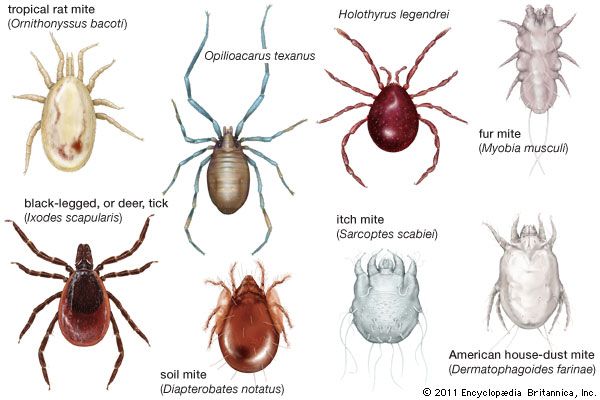
The subclass Acari is divided into two primary superorders, reflecting their divergent evolutionary paths:1
- Parasitiformes: Generally heavily sclerotized mites that include orders such as Mesostigmata, Holothyrida, Ixodida (ticks), and Opilioacarida.1
- Acariformes: Typically weakly sclerotized mites (with the exception of most Oribatida) that lack posterior body stigmata. This group includes the orders Sarcoptiformes and Trombidiformes.1
This evolutionary trajectory has enabled mites to occupy an incredibly wide range of habitats, including soil, plants, fresh and marine water, and as parasites on various animals.21
How do mites reproduce and what is their life cycle like?
Mites exhibit diverse reproductive strategies and life cycles, reflecting their wide range of ecological niches.
Reproduction
Mites are dioecious, meaning the sexes are separate. While most species are oviparous (egg-laying), some parasitic species are ovoviviparous, meaning eggs hatch within the female and the young are born alive. Many mites also utilize parthenogenesis, a form of reproduction where offspring develop from unfertilized eggs.67
Sperm transfer is highly variable. Males may use a specialized copulatory structure called an aedeagus to introduce sperm directly into the female, or they may deposit a sealed packet of sperm, known as a spermatophore, which the female then collects. In some cases, males use specialized appendages like suckers or spurs to grasp the female during mating.67
Life Cycle
The primitive mite life cycle consists of four active immature stages:
Significant deviations from this cycle exist across different groups. For instance, some mites have fewer nymphal stages, while others may develop directly from egg to larviform adult. Many Astigmata mites possess a non-feeding stage called a hypopal, which occurs during adverse environmental conditions to aid survival. Unlike most other arachnids, which hatch with four pairs of legs, mite larvae typically hatch with only three.67
What are some common mite-related health issues in humans and animals?
Mites and their close relatives, the ticks, are significant vectors of disease and causes of various health issues in humans and animals.
Skin Conditions
- Scabies: Caused by the itch mite (Sarcoptes scabiei), this condition involves intense itching and skin inflammation. The female mite burrows into the skin to lay eggs, triggering an allergic reaction to mite proteins, feces, and eggs.12
- Mange: This term refers to persistent, contagious skin diseases in domestic animals—and occasionally humans—characterized by inflammation, hair loss, and thickening of the skin. It is also caused by various parasitic mites, including Sarcoptes scabiei.1314
Disease Transmission and Allergies
- Vector-borne Diseases: Ticks (order Ixodida) are second only to mosquitoes in the number of diseases they transmit to humans, including Lyme disease, Rocky Mountain spotted fever, and relapsing fever. Mites also transmit illnesses such as scrub typhus via chiggers and rickettsialpox via the house-mouse mite.15
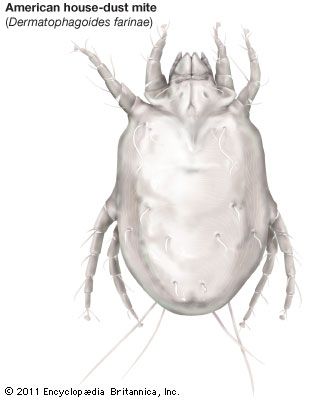
- Allergies: House-dust allergy is a common health issue caused by Dermatophagoides mites.15
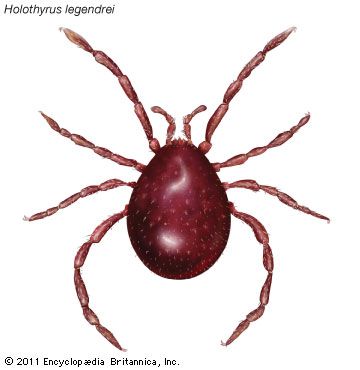
- Toxicity: Some mites, such as certain species of Holothyrus, secrete substances that are toxic to both humans and fowl.15
What are the main characteristics that distinguish mites from other arachnids?
Mites (subclass Acari) are distinguished from other arachnids by several unique morphological and developmental characteristics:
Body Structure
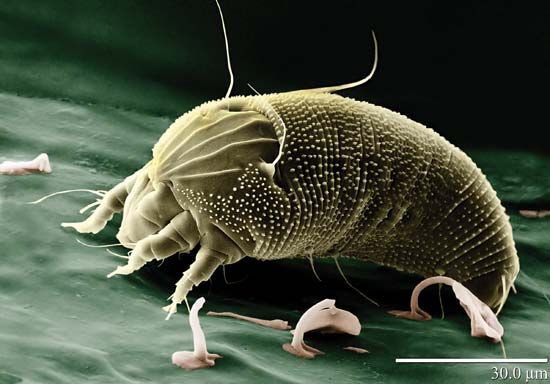
- Lack of Segmentation: Unlike most arachnids, which have bodies divided into two distinct regions (the cephalothorax and the abdomen), mites possess a single, unsegmented body region. This feature is shared only with daddy longlegs among the arachnid class.16
- Gnathosoma: Mites feature a specialized anterior region called the gnathosoma, which houses the mouth, chelicerae (feeding appendages), and pedipalps.7
- Size and Sclerotization: Mites exhibit extreme diversity in size—ranging from 0.1 mm to 30 mm—and in body texture, varying from soft-bodied to strongly sclerotized (hardened) forms with protective shields.42
Development and Life Cycle
- Larval Stage: A primary developmental distinction is that mite larvae typically hatch with only three pairs of legs, whereas the hatchlings of most other arachnids possess four pairs.172
- Life Stages: The mite life cycle is unique among arachnids, involving a hexapod (six-legged) larva that progresses through one or more nymphal stages before reaching adulthood.17
Sources
- mite — Encyclopædia Britannica
- acarid - Annotated classification — Encyclopædia Britannica
- arachnid — Encyclopædia Britannica
- acarid - External features — Encyclopædia Britannica
- mite — Merriam-Webster
- acarid - Reproduction and life cycle — Encyclopædia Britannica
- arachnid - Reproduction and life cycle — Encyclopædia Britannica
- Animal reproductive system - Parthenogenesis — Encyclopædia Britannica
- Parthenogenesis — Encyclopædia Britannica
- Metamorphosis — Encyclopædia Britannica
- acarid - Ecology — Encyclopædia Britannica
- mange — Encyclopædia Britannica
- scabies — Encyclopædia Britannica
- acarid - Importance — Encyclopædia Britannica
- mange — Merriam-Webster
- acarid - Size range and diversity of structure — Encyclopædia Britannica
- arachnid - Body and appendages — Encyclopædia Britannica
- spider: Top Questions — Encyclopædia Britannica
Published on · 4 min read