Trichogrammatid Wasp
A trichogrammatid wasp is any member of the family Trichogrammatidae, a group comprising approximately 1,000 species of minute, parasitic chalcid wasps.…
What is trichogrammatid wasp?
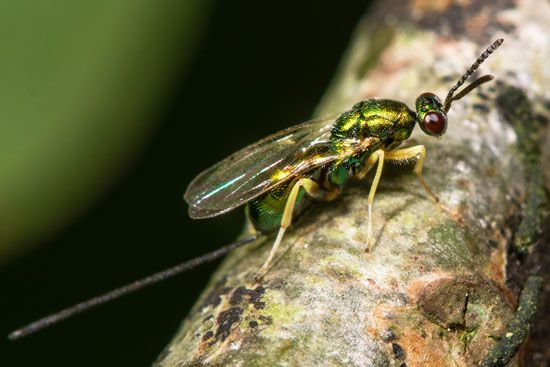
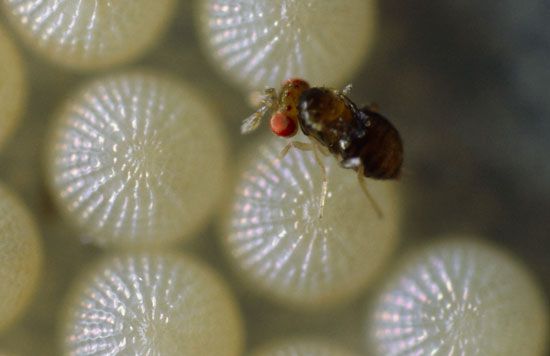
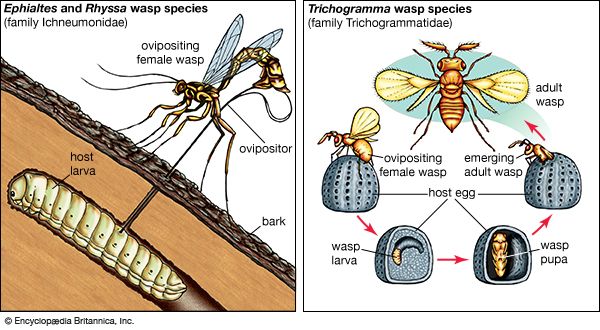
A trichogrammatid wasp is any member of the family Trichogrammatidae, a group comprising approximately 1,000 species of minute, parasitic chalcid wasps. These insects are among the smallest known, with many adults measuring less than 1 mm (0.04 inch) in length.1
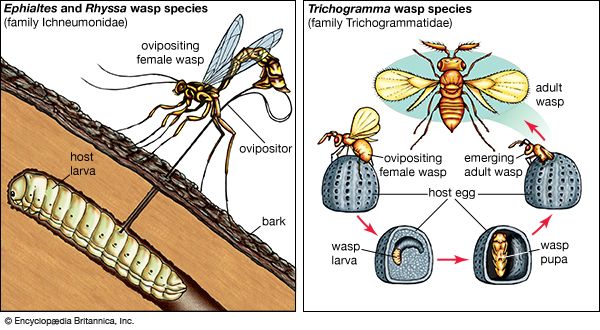
These wasps are parasitoids that develop as endoparasites within the eggs of other arthropods. A female wasp deposits her eggs directly into the host’s egg; upon hatching, the larvae consume the host’s nutrients and embryo before pupating and emerging as adults.1
Because of this life cycle, certain species—particularly those in the genus Trichogramma—are highly valued as biological control agents. They are frequently employed to manage various lepidopteran agricultural pests, as they effectively target the eggs of these insects before they can hatch and cause crop damage.12
How does biological pest control work?
Biological pest control is the practice of using living organisms to manage or reduce populations of pests that threaten human interests, such as crops or health. This approach involves introducing natural enemies—such as parasites, predators, or disease-causing organisms—into an environment or encouraging those already present to multiply and become more effective.34
Common strategies include:
- Predation: Introducing or supporting natural predators, such as the vedalia beetle, which was famously used to control the cottony-cushion scale.34
- Parasitism: Utilizing parasitoids, such as braconid wasps or chalcid wasps, which develop on or within the bodies of host insects.45
- Microbial Control: Applying disease-causing agents like the bacterium Bacillus thuringiensis to target specific pests.46
Because some introductions can lead to invasive species that harm native ecosystems, these methods must be carefully evaluated. Today, biological control is often a key component of integrated pest management, which combines biological, cultural, and chemical methods to minimize reliance on synthetic pesticides.437
What are the differences between parasites and parasitoids?
The primary difference between parasites and parasitoids lies in the outcome of their relationship with the host. While both organisms benefit at the expense of another, their survival strategies differ significantly.8
Parasitism
In a parasitic relationship, one species benefits by living on or within a host, but it does not necessarily kill the host organism. Parasites can be categorized based on their location:8
- Ectoparasites: These live on the body surface of the host, such as ticks, fleas, and lice.8
- Endoparasites: These inhabit the interior of the host, either between cells (intercellular) or within cells (intracellular), such as the protozoan that causes malaria.8
Parasitoidism
Parasitoidism is a specialized form of parasitism where the parasite always kills the host. A parasitoid is typically an insect whose larvae develop on or inside a single host, consuming it for nutrients until the host dies. Most parasitoids are wasps, though some flies, beetles, and moths have evolved this strategy.89
While parasites may evolve toward varying levels of virulence depending on host density and transmission rates, the parasitoid’s life cycle is fundamentally tied to the eventual death of its host.910
What are some common agricultural pests that these wasps help control?
Parasitic wasps, particularly those in the families Braconidae and Trichogrammatidae, are highly effective agents of biological control against a variety of agricultural pests. These wasps act as parasitoids, meaning their larvae consume and eventually kill their hosts.71
Common agricultural pests controlled by these wasps include:
- Lepidopteran Pests: Many braconid species target moths and butterflies that damage crops. For example, Apanteles glomeratus parasitizes the cabbage butterfly and the cabbage looper, both of which are significant pests of Brassica crops. Additionally, Apanteles congregatus targets the tobacco hornworm and the tomato hornworm. Various Trichogramma species are also employed to control a wide range of lepidopteran pests.71
- Wood-Boring Insects: Certain braconids attack wood-boring beetles, including those in the families Buprestidae and Cerambycidae.7
- Stored Grain Pests: The braconid Chremilus rubiginosus is known to attack the grain weevil.7
- Fruit Pests: In the Mediterranean, Opius concolor is used to manage the olive fly, a destructive pest of commercial olives.7
- Homopteran Pests: Various chalcid and encyrtid wasps parasitize aphids, scale insects, whiteflies, leafhoppers, and planthoppers.12
Sources
- trichogrammatid wasp — Encyclopædia Britannica
- trichogramma wasp — Merriam-Webster
- Pest — Encyclopædia Britannica
- Integrated pest management — Encyclopædia Britannica
- Biological control — Encyclopædia Britannica
- Bacillus thuringiensis — Encyclopædia Britannica
- braconid wasp — Encyclopædia Britannica
- parasitoid — Encyclopædia Britannica
- parasitism — Encyclopædia Britannica
- parasites — Merriam-Webster
- community ecology - Parasite - host interactions — Encyclopædia Britannica
- insect - Ecological factors — Encyclopædia Britannica
- homopteran - Associations with other insects — Encyclopædia Britannica
Published on · 3 min read