Tiger Moth
The life cycle of a tiger moth, like all Lepidoptera, follows a process of complete metamorphosis consisting of four distinct stages:
What is the life cycle of a tiger moth, from egg to adult?
The life cycle of a tiger moth, like all Lepidoptera, follows a process of complete metamorphosis consisting of four distinct stages:
- Egg: Females typically lay eggs on or near a suitable food plant. Development may be timed through diapause, a period of enforced inactivity, to ensure larvae emerge when conditions are favorable.1
- Larva (Caterpillar): This is the primary feeding stage. Tiger moth larvae, often called woolly bears, are known for their hairy appearance. As they grow, they undergo ecdysis, molting their exoskeleton four or five times.23
- Pupa: The larva enters a resting stage to transform into an adult. Many tiger moths pupate in the soil or within a cocoon constructed from silk and their own larval hairs. Inside this protective shell, the insect undergoes a major rebuilding of body tissues.24
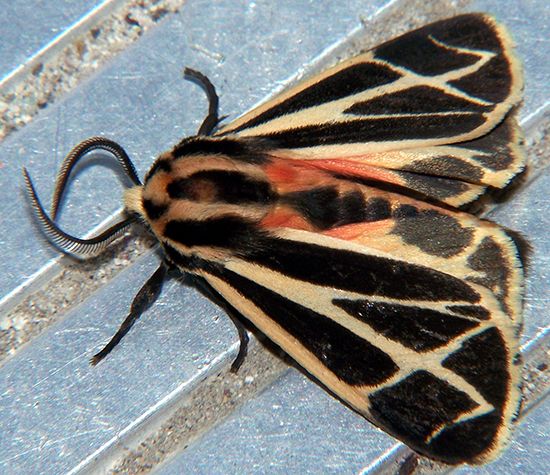
- Adult (Imago): The mature moth emerges from the pupa. Adults are characterized by thick, furry bodies and wings often featuring striking patterns.2
How do tiger moth caterpillars differ from adult tiger moths in appearance and behavior?
Tiger moth caterpillars and adults differ significantly in both their physical characteristics and their survival behaviors.
Physical Appearance
- Larvae (Caterpillars): Often called woolly bears, these caterpillars are typically characterized by their dense, hairy appearance. Their coloration varies by species; for example, the Isabella tiger moth larva is brown in the middle with black ends.14
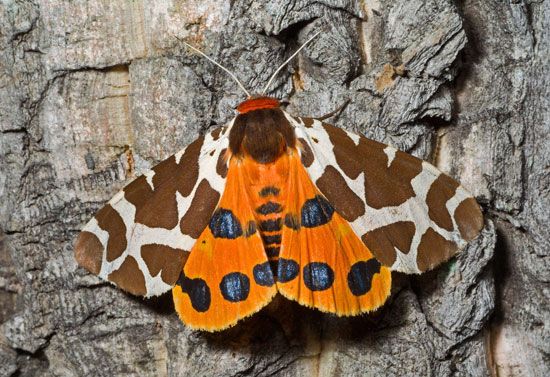
- Adults: Mature tiger moths generally have thick, furry bodies. Their wings often feature striking geometric patterns, such as dark backgrounds with white, orange, or green markings, though some species may be solid white.17
Behavioral Differences
- Defense Mechanisms: Both stages utilize distinct strategies to avoid predation. Larvae may drop suddenly when disturbed or hide in litter during the day. Many tiger moth larvae possess hairs that can cause pain or irritation to predators. Adults, conversely, may use aposematic (warning) coloration to signal their distastefulness. Some adult tiger moths also produce high-pitched, ultrasonic sounds using timbal organs to warn off bats, while others can release repellent drops from glands on their prothorax.81
- Activity: Larvae are primarily focused on feeding and growth, often hiding in vegetation or litter, whereas adults are winged insects primarily focused on reproduction and pollination.87

How do tiger moths use their unique defense mechanisms against predators?
Tiger moths (subfamily Arctiinae) have evolved a sophisticated array of defense mechanisms to protect themselves from predators, utilizing both chemical and acoustic strategies.
Chemical Defenses
Many tiger moths are distasteful to predators, a trait often advertised through aposematic (warning) coloration, such as striking geometric patterns on their wings. To reinforce this warning, they employ several chemical tactics:41
- Repellent Secretions: When disturbed, these moths can release drops of repellent substances from specialized glands located on their prothorax.4
- Toxin Injection: Some species, such as the garden tiger moth, possess sharp spines on their hind legs that can be used to inject toxins into potential attackers.4
Acoustic Defenses
Tiger moths are particularly notable for their ability to interact with bats, their primary nocturnal predators. They produce high-pitched, ultrasonic grating sounds using timbal organs—specialized drumlike structures on their bodies. These sounds serve two potential functions:4
- Warning: The clicks signal the moth’s inedibility to the bat, allowing the moth to avoid capture entirely.4
- Jamming: Some researchers believe these ultrasonic pulses may interfere with the bats’ echolocation systems, effectively masking the moth’s presence or confusing the predator’s navigation.4
How have tiger moths adapted to avoid bat predation, and what makes this adaptation unique?
Tiger moths have evolved specialized acoustic adaptations to survive predation by bats, which rely on echolocation to hunt. Unlike many other moths that perform evasive flight maneuvers or dive to the ground upon detecting a bat’s navigational pulses, tiger moths utilize unique timbal organs—drumlike structures on their bodies—to produce high-pitched, ultrasonic grating sounds.4
These acoustic signals are unique for two primary reasons:
- Warning Signal: The clicks serve as an auditory advertisement of the moth’s inedibility. Because many tiger moths are chemically defended or toxic, these sounds warn bats of their distastefulness, allowing the moth to avoid capture and the predator to avoid a negative experience.4
- Acoustic Jamming: Some researchers propose that these ultrasonic pulses function to interfere with the bats’ echolocation systems. By effectively masking the moth’s presence or confusing the bat’s navigation, the moth can prevent the predator from accurately detecting or tracking it.4
Sources
- tiger moth — Encyclopædia Britannica
- pupa — Encyclopædia Britannica
- Lepidoptera - Pupa , or chrysalis — Encyclopædia Britannica
- Lepidoptera - Protection against danger — Encyclopædia Britannica
- Lepidoptera - Egg — Encyclopædia Britannica
- Lepidoptera - Larva, or caterpillar — Encyclopædia Britannica
- woolly bear — Encyclopædia Britannica
- What’s the difference between moths and butterflies? — Encyclopædia Britannica
Published on · 3 min read