Titan Arum
The titan arum (Amorphophallus titanum), also known as the corpse flower, is a remarkable herbaceous flowering plant native to the rainforests of western…
What is the titan arum?
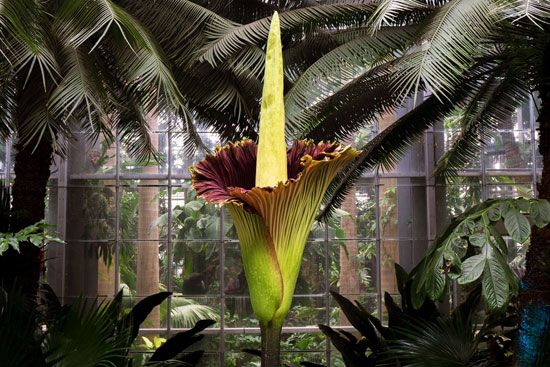
The titan arum (Amorphophallus titanum), also known as the corpse flower, is a remarkable herbaceous flowering plant native to the rainforests of western Sumatra. It is world-renowned for producing the largest unbranched inflorescence in the plant kingdom, which can reach over 3 meters (9.8 feet) in height.123
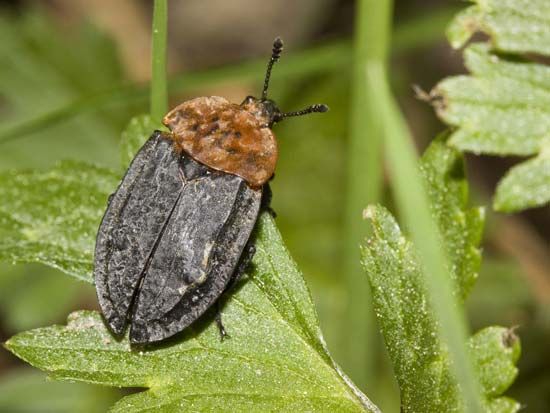
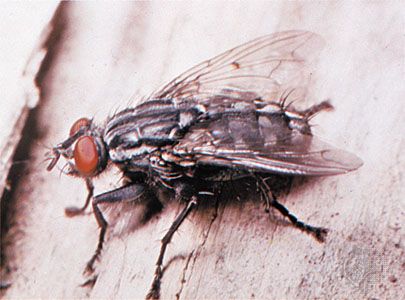
The plant’s structure consists of a central spadix surrounded by a petal-like spathe. When it blooms—an event that occurs rarely, often every 4–10 years—it emits a powerful odor of rotting flesh to attract carrion beetles and flesh flies for pollination. The bloom is short-lived, typically lasting only 24–48 hours.3
Between flowering cycles, the plant remains dormant or produces a single, massive, treelike leaf that can grow up to 7 meters tall. Energy for its growth is stored in a giant underground corm, which can weigh up to 200 pounds.3
Where does the titan arum naturally grow?
The titan arum (Amorphophallus titanum) is endemic to the steep hillsides of rainforests in western Sumatra. While it is found in this specific natural habitat, the plant is also widely cultivated in botanic gardens around the world.1
Why is the titan arum sometimes called the ‘corpse flower’?
The titan arum (Amorphophallus titanum) is called the “corpse flower” because of the powerful, foul odor it emits when it blooms, which is often described as smelling like rotting flesh.32
This distinctive scent is an evolutionary adaptation designed to attract specific pollinators, such as carrion beetles and flesh flies. These insects are typically drawn to decaying organic matter, and the plant mimics this smell to lure them in for pollination3. In addition to the smell, the plant generates heat while in bloom, which helps disperse the odor further into the surrounding environment.2
What does the titan arum look like when it blooms?
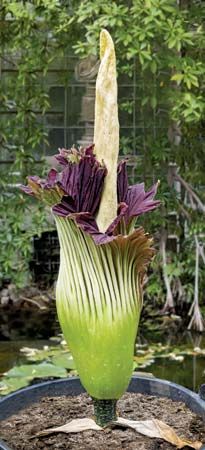
When the titan arum (Amorphophallus titanum) blooms, it presents as a massive, striking structure that functions as an inflorescence—a cluster of many small flowers rather than a single bloom.14
Its appearance is defined by two primary components:
- The Spadix: A tall, central spike that can reach over 3 meters (nearly 10 feet) in height. The upper portion is smooth and yellowish to brown in color.14
- The Spathe: A large, frilly, petal-like collar that wraps around the base of the spadix. While the exterior is green to cream-colored, the interior reveals a deep, dramatic crimson to purple hue when the structure flares open.14
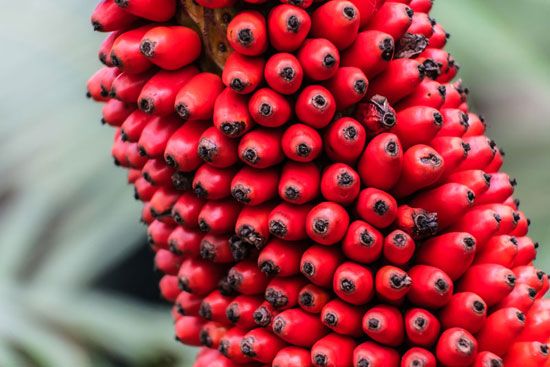
The overall form is often compared to a giant version of a calla lily4. Because the plant only blooms for 24–48 hours, this impressive display is a rare and highly anticipated event. Once the bloom period concludes, the spathe and upper spadix collapse, eventually leaving behind a cluster of bright red to orange fruits.14
Sources
- Titan arum — Encyclopædia Britannica
- corpse flower — Merriam-Webster
- titan arum — Merriam-Webster
- Stench of the Titans - “Stench of the Titans” transcript — Encyclopædia Britannica
Published on · 2 min read