Toxodon
During his voyage on the HMS Beagle, Charles Darwin collected the first fossil specimens of Toxodon. These remains were later described by the anatomist and…
How did Charles Darwin contribute to our understanding of Toxodon?
During his voyage on the HMS Beagle, Charles Darwin collected the first fossil specimens of Toxodon. These remains were later described by the anatomist and paleontologist Richard Owen.
The discovery of Toxodon was significant because it demonstrated that South American fossil mammals were distinct from those found in Europe. This observation provided crucial evidence that played a major role in 19th-century scientific discussions regarding the theory of evolution. By highlighting the unique biological history of the continent, Darwin’s collection helped reshape the understanding of how species are distributed and how they change over time.1
What can Toxodon tell us about the evolution of large mammals in South America?
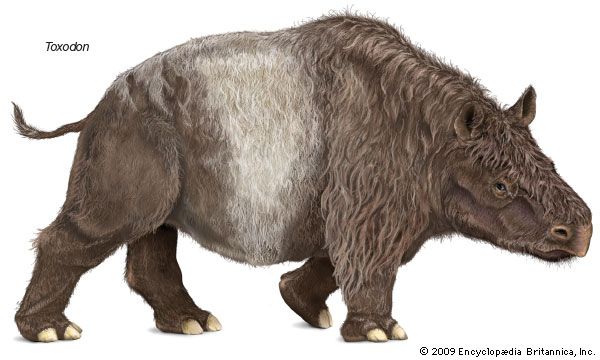
Toxodon provides significant insight into the unique evolutionary history of South American mammals, which developed in relative isolation for millions of years. As a member of the Notoungulata, Toxodon illustrates how South American fauna underwent “convergent evolution,” developing physical traits—such as its rhinoceros-like build—that paralleled the development of more advanced hoofed mammals on other continents.123
The study of Toxodon fossils was pivotal in 19th-century science because it revealed that South American fossil mammals were distinct from those in Europe, challenging existing views on the distribution of life and supporting early debates regarding evolution.3
Furthermore, Toxodon represents the biological consequences of geographic isolation and eventual reconnection. When the land bridge between North and South America formed approximately 3 million years ago, the resulting competition with invading placental mammals from the north contributed to the decline and eventual extinction of many endemic South American groups, including the toxodonts.14
When and where did Toxodon live?
Toxodon lived in South America during the late Pliocene and the Pleistocene Epoch. This period spans approximately 3.6 million to 11,700 years ago. During the Pleistocene, Toxodon was likely the most common large hoofed mammal on the continent.1
How have paleontologists learned about Toxodon, and what significant fossils have been discovered?
Paleontologists have learned about Toxodon primarily through the analysis of fossil specimens collected in South America. A landmark moment in the study of this genus occurred during the voyage of the HMS Beagle, when Charles Darwin collected Toxodon fossils. These specimens were later described by the British anatomist and paleontologist Richard Owen.1
The discovery of these fossils was scientifically significant because it demonstrated that South American fossil mammals were distinct from those found in Europe. This realization played a crucial role in 19th-century scientific debates regarding evolution, as it challenged existing perceptions of how life was distributed across the globe.1
By examining the skeletal structure of these finds, researchers have determined that Toxodon possessed a massive frame, a well-developed snout indicated by nasal openings on the top of the skull, and specialized teeth with large gaps between the incisors and cheek teeth. These physical characteristics have allowed scientists to reconstruct the animal as a rhinoceros-like creature that was likely the most common large hoofed mammal in South America during the Pleistocene Epoch.1
Sources
- Toxodon — Encyclopædia Britannica
- Notoungulata — Encyclopædia Britannica
- South America - Animal life — Encyclopædia Britannica
- plate tectonics - Evolution — Encyclopædia Britannica
- Toxodontia — Merriam-Webster
- toxodont — Merriam-Webster
Published on · 2 min read