Tsugaru Strait
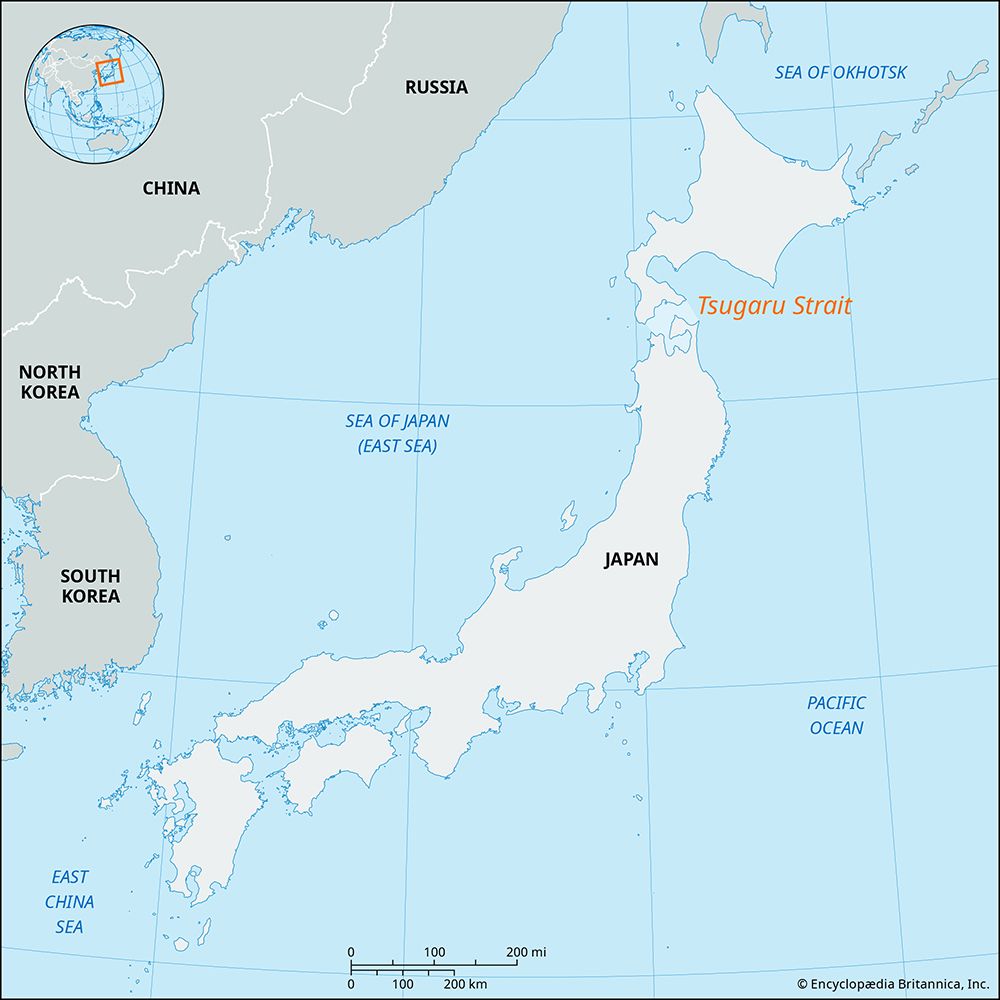
The Tsugaru Strait is a body of water in the northwest Pacific that separates the Japanese islands of Honshu to the south and Hokkaido to the north.…
What is Tsugaru Strait?
The Tsugaru Strait is a body of water in the northwest Pacific that separates the Japanese islands of Honshu to the south and Hokkaido to the north. Stretching between 15 and 25 miles (24 to 40 km) in width, the strait connects the Sea of Japan to the open ocean](https://www.britannica.com/place/Sea-of-Japan) to the open ocean.12
The strait is characterized by the Tsugaru Current, a warm, salty flow that moves from the Sea of Japan into the Pacific. Beneath these waters lies the Seikan Tunnel, a 53.8-km-long engineering marvel that links the cities of Aomori on Honshu and Hakodate on Hokkaido Hakodate on Hokkaido. The tunnel was conceived following a tragic 1954 ferry disaster in the strait and now serves as a vital, albeit logistically complex, rail link for freight and Shinkansen bullet trains.13
How was the Seikan Tunnel constructed under the sea?
The Seikan Tunnel, which links the Japanese islands of Honshu and Hokkaido, stands as one of the most significant engineering feats of the 20th century. Spanning 53.8 km (33.4 miles) in total, 23.3 km (14.3 miles) of the tunnel were excavated beneath the Tsugaru Strait.34
Construction of the tunnel was sponsored by the Japanese National Railways and spanned from 1964 to 1988. The project was a massive undertaking that employed as many as 3,000 workers at a single time. The process was fraught with extreme danger, resulting in 34 fatalities due to flooding, cave-ins, and other hazardous mishaps encountered while digging deep beneath the seabed.34
While the provided records detail the timeline and the immense human and engineering effort required, they do not specify the exact technical excavation methods used for this particular project. Unlike some other subaqueous projects that utilized the immersed-tube method, the Seikan Tunnel remains a testament to the challenges of deep-sea tunneling.4
What are the main differences between Honshu and Hokkaido?
Honshu and Hokkaido, two of Japan’s four main islands, exhibit significant differences in their history, geography, and economic development.
Geographic and Climatic Differences
- Status and Size: Honshu is the largest island and is considered the Japanese mainland, containing nearly three-fourths of the country’s prefectures. Hokkaido, the northernmost island, comprises about one-fifth of Japan’s total land area.
- Climate: Hokkaido is characterized by a cooler climate with shorter spring and fall seasons compared to Honshu. While both islands are influenced by monsoonal winds and ocean currents, Hokkaido experiences colder winters, with average January temperatures in central areas like Asahikawa reaching 18 °F (−8 °C), significantly lower than those in Tokyo.67
Historical and Cultural Context
- Development: Much of Japan’s early history and political power centered on southern Honshu. In contrast, Hokkaido was long the domain of the aboriginal Ainu peoples. Serious Japanese settlement of Hokkaido did not begin until 1869, when it was renamed from Yezo to Hokkaido.89
Economic Focus
- Honshu: The Pacific coast of Honshu serves as the nation’s primary economic center, hosting major metropolitan areas such as Tokyo–Yokohama and Osaka–Kobe.10
- Hokkaido: The economy of Hokkaido is notably driven by industries such as iron, steel, dairy, and fishing. It also contains Japan’s largest coal deposits.8
What is the history of the Shinkansen bullet trains in Japan?
The Shinkansen, Japan’s pioneering high-speed rail system, represents a landmark in modern transportation history. Originally developed by the government-owned Japanese National Railways, the system has been operated by the private Japan Railways Group since 1987.512
Origins and Expansion
The system debuted in 1964 with the New Tōkaidō Line, connecting Tokyo and Ōsaka just before the 1964 Olympic Games. Its success and aerodynamic design earned it the nickname “bullet train.” Following this, the network expanded significantly:513
- 1970s: Extensions reached Okayama (1972) and Fukuoka (1975).5
- 1980s–2000s: Lines were extended to Niigata, Morioka, and eventually Aomori by 2010.5
- Recent Developments: The network now connects Kyushu and Hokkaido, with the latter utilizing the Seikan Tunnel to cross the Tsugaru Strait.5
Technology and Safety
Shinkansen trains are electric multiple-unit vehicles powered by overhead wires. Through continuous innovation—such as prestressed concrete ties and welded tracks—speeds have increased from an initial 130 mph (210 km/h) to over 200 mph (320 km/h). Safety remains paramount, with computerized central control and specialized braking systems designed for emergency conditions.513
Sources
- Tsugaru Strait — Encyclopædia Britannica
- Tsugaru Strait — Merriam-Webster
- Seikan Tunnel — Encyclopædia Britannica
- tunnels and underground excavations - Subaqueous tunnels — Encyclopædia Britannica
- Shinkansen — Encyclopædia Britannica
- Honshu — Encyclopædia Britannica
- Japan - Climate — Encyclopædia Britannica
- Japan - Temperature — Encyclopædia Britannica
- Hokkaido — Encyclopædia Britannica
- Japan - Traditional regions — Encyclopædia Britannica
- Japan - Transportation and telecommunications — Encyclopædia Britannica
- Japan - Railways of Japan — Encyclopædia Britannica
- high-speed rail — Encyclopædia Britannica
Published on · 3 min read