Sea of Japan / East Sea
The Sea of Japan, a marginal sea of the western Pacific Ocean, has served as a vital maritime corridor for trade and cultural exchange between Japan, the…
How has the Sea of Japan played a role in the history and trade of the region?
The Sea of Japan, a marginal sea of the western Pacific Ocean, has served as a vital maritime corridor for trade and cultural exchange between Japan, the Korean peninsula, and the Asian mainland for centuries2.
Historical Trade and Cultural Exchange
Historically, the sea facilitated the movement of goods and ideas. During the Muromachi period, formal trade relations were established between Japan, China, and Korea to suppress piracy, with Japanese merchants operating in ports such as Pusan. Beyond commerce, the sea acted as a conduit for the transmission of Buddhism, Chinese writing, and urban design concepts that profoundly shaped Japanese society.12
Modern Economic Significance
Today, the sea remains an essential economic resource:
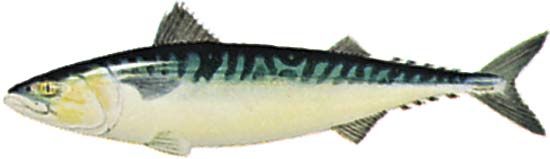
- Fisheries: The waters support a wide array of commercially valuable species, including mackerel, squid, and crustaceans, though stocks have faced depletion since World War II.34
- Resources: The seabed contains natural gas, petroleum, and magnetite sands.34
- Commerce: While much of the region’s major shipping is directed toward non-bordering nations, trade between the surrounding countries has grown, supported by the development of international ports like Vladivostok and Busan.3
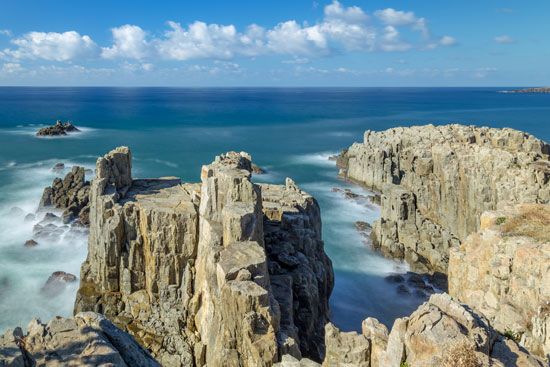
What are the geographical boundaries and characteristics of the Sea of Japan?
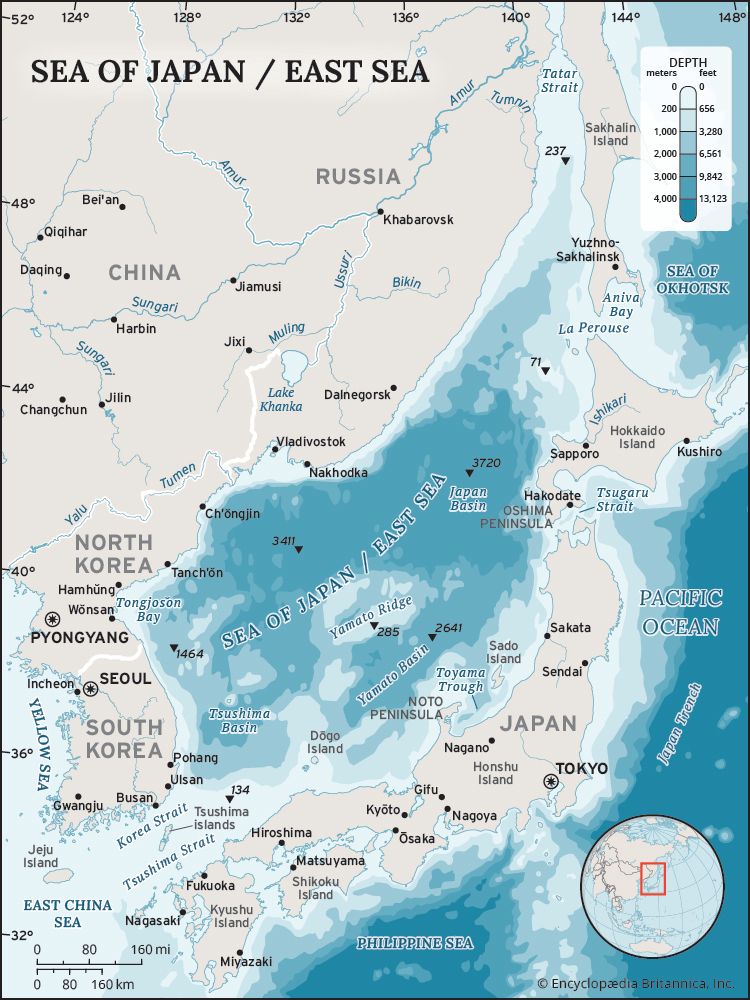
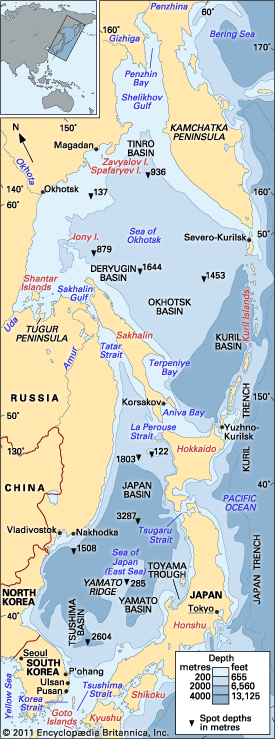
The Sea of Japan is a marginal sea of the western Pacific Ocean covering approximately 377,600 square miles (978,000 square km). It is an elliptical, semi-enclosed basin bounded to the east by Japan and Sakhalin Island, and to the west by the Korean peninsula and Russia.362
Geographical Boundaries
The sea is connected to adjacent waters through several narrow straits:
- South: The Korea Strait and Tsushima Strait connect it to the East China Sea.27
- North: The La Perouse (Sōya) Strait and Tatar Strait link it to the Sea of Okhotsk.27
- East: The Tsugaru Strait provides a connection to the Pacific, and the Kanmon Strait leads to the Inland Sea of Japan.2
Physical Characteristics
The sea features a deep basin divided into the Japan, Yamato, and Tsushima basins, with a mean depth of 5,748 feet (1,752 meters) and a maximum depth of 12,276 feet (3,742 meters). Its hydrology is characterized by a counterclockwise circulation pattern, driven by warm currents like the Tsushima Current and cold currents along the Asian mainland Current](https://www.britannica.com/place/Tsushima-Current) and cold currents along the Asian mainland.268
What are the major ports and coastal cities along the Sea of Japan?
The Sea of Japan serves as a critical maritime gateway for the nations bordering its coast, though the intensity and nature of port activity vary significantly by country.
Russian Ports
Russia maintains several key facilities on the Sea of Japan, which serve as vital links for both domestic and international trade:
- Vladivostok: As the administrative center of Primorsky kray and the eastern terminus of the Trans-Siberian Railroad, it functions as a major naval base and commercial port for consumer goods and regional supply.19
- Nakhodka: A prominent export center that features highly mechanized facilities for handling timber, coal, and containerized cargo. It also serves as a base for fishing fleets and a passenger ferry terminal to Japan.110
- Vostochny: Located near Nakhodka, this is a significant international port facility.1
South Korean Ports
South Korea’s major ports are concentrated on its southeastern coast, facilitating significant international trade:
- Busan: The country’s largest port and second-largest city, Busan is a major transportation hub with specialized terminals for foreign trade and fishing. It maintains ferry connections to Japan.111
- Ulsan and Pohang: These are essential industrial ports that support South Korea’s robust export-oriented economy.1
While these ports are vital, it is important to note that much of Japan’s own major shipping is directed toward its Pacific coast rather than the Sea of Japan, as its primary trade partners are often located beyond the sea’s immediate borders.1
What natural resources are found in and around the Sea of Japan?
The Sea of Japan is rich in both biological and mineral resources, which serve as the foundation for the regional economy.
Biological Resources
The sea supports a diverse array of commercially valuable marine life, primarily concentrated on the continental shelves and adjacent waters.
- Pelagic Fish: These include mackerel, horse mackerel, sardines, anchovies, herring, salmon, trout, sea bream, and squid.1
- Demersal Fish: Bottom-dwelling species include cod, Alaskan pollack, and Atka mackerel.1
- Crustaceans and Mammals: The region also yields shrimps and crabs, alongside populations of seals and whales.1
It is important to note that many of these fisheries have faced depletion since World War II due to intensive fishing practices and environmental pressures.13
Mineral Resources
The sea floor contains significant mineral deposits, including:
Sources
- Sea of Japan / East Sea - Economic aspects — Encyclopædia Britannica
- Sea of Japan / East Sea — Encyclopædia Britannica
- Sea of Japan / East Sea: Top Questions — Encyclopædia Britannica
- Japan - Trade between China and Japan — Encyclopædia Britannica
- Japan - Influences — Encyclopædia Britannica
- Sea of Japan / East Sea - Physiography — Encyclopædia Britannica
- Japan - Land — Encyclopædia Britannica
- Sea of Japan / East Sea - Hydrology — Encyclopædia Britannica
- Busan — Encyclopædia Britannica
- Japan - Port facilities — Encyclopædia Britannica
- Vladivostok — Encyclopædia Britannica
- economy of Japan - Port facilities — Encyclopædia Britannica
- Korea Bay — Encyclopædia Britannica
- Nakhodka — Encyclopædia Britannica
- Pacific Ocean - Environmental impact of human activity — Encyclopædia Britannica
Published on · 4 min read