Turnstone
Turnstones are notable migratory shorebirds belonging to the genus Arenaria. Their migration patterns vary by species:
What are the migration patterns of turnstones?
Turnstones are notable migratory shorebirds belonging to the genus Arenaria. Their migration patterns vary by species:
- Ruddy Turnstone (A. interpres): This species breeds primarily in the Arctic and undertakes extensive migrations to winter on seacoasts across the globe, including South Africa, Australia, New Zealand, Argentina, and Chile. They are highly capable travelers, with one banded individual recorded covering 720 km (450 miles) in a single day.1
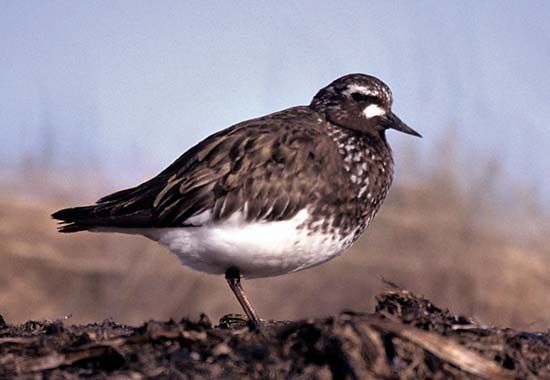
- Black Turnstone (A. melanocephala): This species has a more restricted range, breeding in Arctic Alaska and migrating south to winter as far as Mexico.1
The migration process involves distinct timing for the ruddy turnstone: after the young fledge, the female departs for wintering grounds first, followed by the male after approximately two weeks, with the young birds departing last.1
How do turnstones adapt to different environments during their migrations?
Turnstones adapt to the diverse environments encountered during their long-distance migrations primarily through specialized feeding behaviors and dietary flexibility. Their physical adaptation is centered on their short, flattened, and slightly recurved bills, which allow them to efficiently overturn pebbles and shells to access hidden food sources in various coastal habitats.1
During their migration and on their wintering grounds, these birds demonstrate significant dietary plasticity. While they feed primarily on small crustaceans and other invertebrates found along seacoasts, they are capable of diversifying their intake to include berries and even the eggs of other birds, such as terns, depending on the resources available in their current environment. This ability to shift their diet helps them sustain the high energy demands required for their extensive travels between Arctic breeding grounds and wintering sites as far away as South Africa, Australia, and South America.1
Where can turnstones typically be found in their natural habitat?
Turnstones are primarily found in coastal environments, reflecting their role as specialized shorebirds. Their natural habitat varies significantly depending on the time of year:
- Breeding Grounds: Both species of turnstones, the ruddy turnstone and the black turnstone, primarily breed in the Arctic regions, with the black turnstone specifically nesting in Arctic Alaska.1
- Wintering Grounds: During the non-breeding season, these birds are found along seacoasts globally. The ruddy turnstone is a wide-ranging migrant, wintering on coasts in South Africa, Australia, New Zealand, Argentina, and Chile. The black turnstone has a more restricted wintering range, extending as far south as Mexico.1
In these habitats, they utilize their unique bills to forage among pebbles and shells for crustaceans and other invertebrates.1
What are the main physical characteristics of turnstones?
Turnstones are distinct shorebirds belonging to the genus Arenaria and the family Scolopacidae. Their physical characteristics are well-adapted to their foraging habits and migratory lifestyle:
- Size: These birds typically reach a length of approximately 20 cm (8 inches).1
- Bill Structure: A defining feature is their short, flattened bill, which is slightly recurved or upturned at the tip. This specialized shape allows them to effectively overturn pebbles and shells to access food.1
- Plumage Patterns:
These physical traits enable them to thrive in diverse coastal environments while supporting their long-distance migratory journeys between the Arctic and various global wintering grounds.1
Sources
- Turnstone — Encyclopædia Britannica
Published on · 3 min read