Vireo
Vireos are passerine birds that exhibit migratory behavior, particularly in species found in North America. Many vireos, such as the warbling vireo, migrate…
How do vireos migrate, and what are their migration patterns?
Vireos are passerine birds that exhibit migratory behavior, particularly in species found in North America. Many vireos, such as the warbling vireo, migrate south during the autumn months to reach their wintering grounds.1
The migration process is driven by a complex internal rhythm involving the pituitary gland, which prepares the birds physiologically by stimulating fat deposition and metabolic changes. While the pituitary cycle provides a general readiness for migration, the actual initiation of flight is influenced by ecological conditions, including food availability and weather patterns.2
Regarding their specific patterns, many vireos are nocturnal migrants, meaning they travel primarily at night. During these flights, they often call to one another. Like other small passerines, they may travel along broad airways rather than narrow, defined paths, and they are capable of crossing large bodies of water. Their flight paths and directions are often adjusted in response to wind force and direction.13
What are the distinctive physical characteristics of vireos?
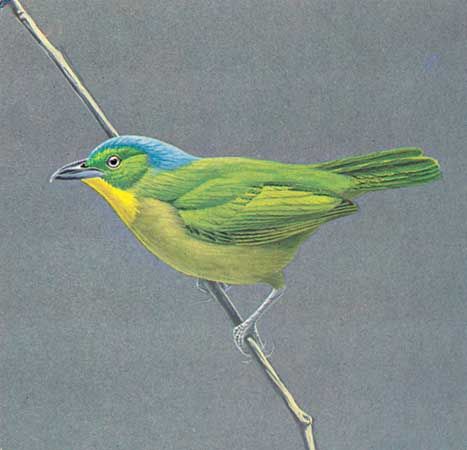
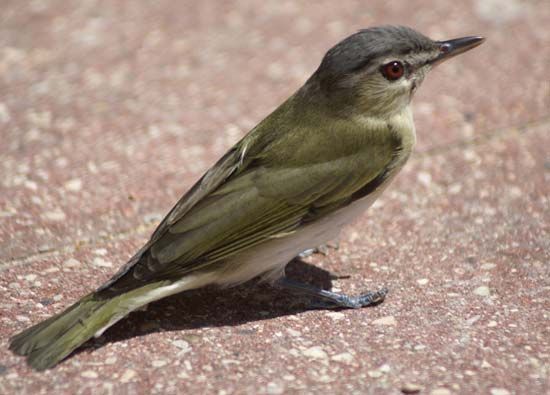
Vireos (family Vireonidae) are small passerine birds native to the New World, typically ranging from 10 to 18 cm (4 to 7 inches) in length. They are generally characterized by a plain, modest appearance, with plumage primarily featuring olivaceous (greenish) and grayish shades, often accented with touches of white or yellow.14
Key physical features include:
- Bill: They possess a stout, narrow bill that is slightly notched and hook-tipped, often accompanied by fine bristles at the base. Some species, such as the shrike-vireo, exhibit a more pronounced hook, resembling the bills of true shrikes.15
- Body Structure: They are generally shy, forest-dwelling birds with a compact build.15
- Nesting: A distinctive behavioral and structural trait is their construction of a cuplike, pensile nest, which is typically suspended from the fork of a branch.14
While they are often plain in color, some species display specific markings, such as the black-outlined white eye stripe found on the red-eyed vireo.1
What is the typical diet of vireos, and how do they forage for food?
Vireos are primarily insectivorous birds that have developed specialized foraging behaviors to suit their environment. They typically forage for insects by gleaning them from small twigs and foliage within trees and bushes.16
In addition to their insect-based diet, vireos also consume berries during the fall and winter months. Their physical adaptations, such as a stout but narrow, slightly notched, and hook-tipped bill, assist them in these feeding activities.1
Where are vireos typically found, and what are their preferred habitats?
Vireos are exclusively found in the New World, with a distribution spanning from southern Canada through the Americas to Argentina.1
Regarding their preferred habitats, these birds are primarily associated with wooded environments:
- Forests: Many species, including the shrike-vireo, are forest-dwelling birds. These habitats range from tropical regions in southern Mexico down to central Brazil and Peru.15
- Open Woodlands: Species such as the warbling vireo are commonly found in open woods, particularly during the North American summer.1
- General Foraging Areas: As they are primarily tree- and bush-dwelling birds, they rely on environments that provide ample foliage for foraging.1
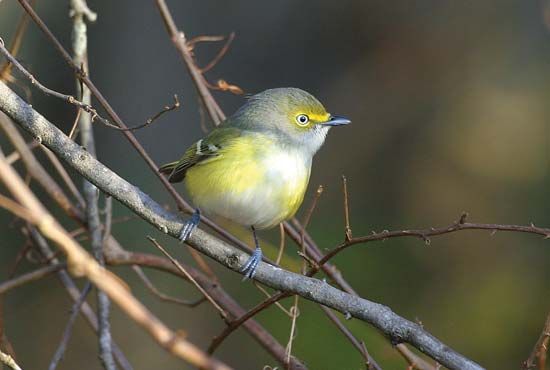
While some species are migratory—such as the warbling vireo, which travels south in the autumn—others are well-established in specific regions, like the white-eyed vireo, which is common in Bermuda.1
Sources
- Vireo — Encyclopædia Britannica
- Migration - Physiological stimulus of migration — Encyclopædia Britannica
- Migration - Modes of migration — Encyclopædia Britannica
- Vireonidae — Merriam-Webster
- Shrike-vireo — Encyclopædia Britannica
- Passeriform - Size range and structural diversity — Encyclopædia Britannica
- Falconiform - Feeding — Encyclopædia Britannica
Published on · 3 min read