Velociraptor
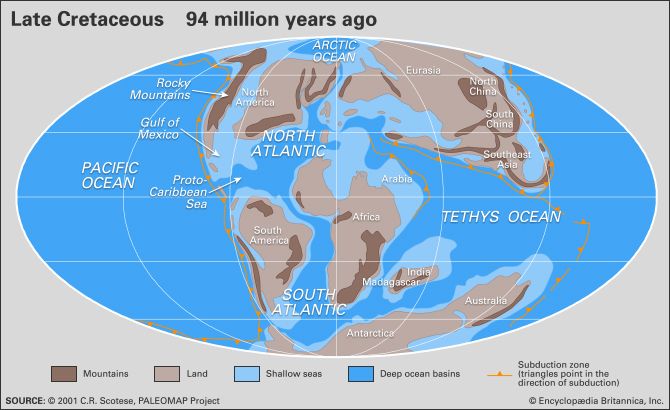
Velociraptor was a genus of dinosaur that lived in central and eastern Asia during the late Cretaceous Period, approximately 99 to 65 million years ago. As a…
What is Velociraptor?
Velociraptor was a genus of dinosaur that lived in central and eastern Asia during the late Cretaceous Period, approximately 99 to 65 million years ago. As a member of the dromaeosaur family, it was a swift, agile predator that primarily hunted small herbivores.1
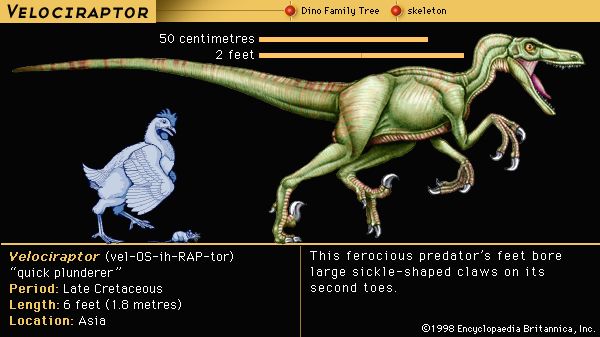
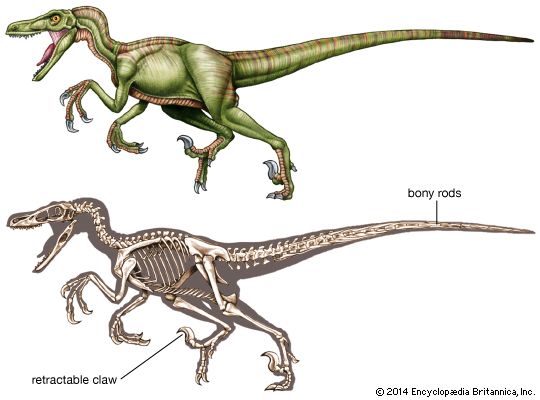
Physically, Velociraptor was relatively small, reaching about 1.8 meters (6 feet) in length and weighing up to 45 kg (100 pounds). It was characterized by an unusually large claw on each foot and ossified tendon reinforcements in its tail, which allowed it to maintain balance while striking at prey. It is closely related to the North American Deinonychus. Fossil evidence from Mongolia has provided direct insight into its behavior, including a famous discovery of a Velociraptor found in the clutches of its prey, the herbivore Protoceratops.12
Did Velociraptors have feathers?
Yes, scientific evidence indicates that Velociraptor possessed feathers. While the Velociraptor genus is a member of the dromaeosaur family—a group of theropod dinosaurs closely related to birds—the specific fossil record for Velociraptor is often noted for its skeletal features rather than soft-tissue preservation.34
However, paleontologists have confirmed the presence of feathers in other closely related dromaeosaurs, such as Sinornithosaurus, discovered in the well-preserved Liaoning deposits of China. These findings, along with broader phylogenetic analysis, demonstrate that many small carnivorous dinosaurs were covered in featherlike, filamentous structures. These structures likely evolved for purposes such as insulation, display, or camouflage, rather than for flight.35
How does the real Velociraptor compare to the one in movies?
The Velociraptor depicted in popular films like Jurassic Park is often conflated with its larger relative, Deinonychus. While the movie monsters are portrayed as human-sized or larger, the real Velociraptor was significantly smaller, reaching a length of about 1.8 meters (6 feet) and weighing no more than 45 kg (100 pounds).561
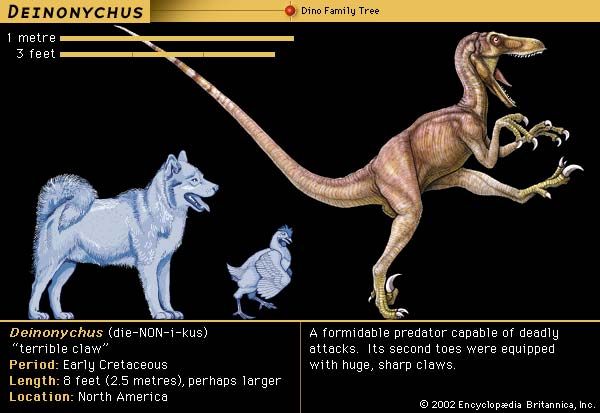
In contrast, Deinonychus, which served as the primary model for the film’s “raptors,” was more robust, measuring up to 2.5 to 3 meters (8 to 10 feet) in length and weighing between 45 and 70 kg.57
Both dinosaurs were dromaeosaurs—agile, bipedal theropods that utilized a specialized, sickle-shaped killing claw on their second toe. While the films emphasize their intelligence and pack-hunting behavior, the real animals were swift predators that relied on complex coordination to hunt small- to medium-sized herbivores. Additionally, unlike the scaly, reptilian appearance in the movies, scientific consensus suggests these dinosaurs were covered in feathers.571
What are dromaeosaurs?
Dromaeosaurs (family Dromaeosauridae) were a group of agile, bipedal, carnivorous theropod dinosaurs that thrived in Asia and North America during the Cretaceous Period. Known for their speed and predatory efficiency, they are considered the closest relatives of birds.77
Key characteristics of dromaeosaurs include:
- Specialized Anatomy: They possessed a unique, flexible second toe on each foot equipped with a large, sickle-shaped killing claw. This talon was held off the ground while walking and was used for raking or slicing prey.57
- Grasping Hands: Their long arms ended in slender, three-clawed hands. A specialized wrist joint allowed these hands to flex sideways, a motion that likely aided in seizing prey and is similar to the movement used in the flight stroke of modern birds.57
- Stiffened Tails: Their tails were unusually long and reinforced by bundles of slim bony rods, which served as a counterbalance during complex, high-speed maneuvers.57
- Intelligence: They possessed relatively large brains, allowing for a degree of coordination and complex movement that was unusual among reptiles.5
Well-known members of this family include Deinonychus, Velociraptor, and Dromaeosaurus.57
Sources
- Velociraptor — Encyclopædia Britannica
- dinosaur - The flesh eaters — Encyclopædia Britannica
- feathered dinosaur — Encyclopædia Britannica
- dinosaur - Dinosaur descendants — Encyclopædia Britannica
- Velociraptor: Top Questions — Encyclopædia Britannica
- Deinonychus — Encyclopædia Britannica
- dromaeosaur — Encyclopædia Britannica
- dinosaur - Tetanurae — Encyclopædia Britannica
Published on · 3 min read