Viburnum
The provided search results do not contain information regarding the medicinal or cultural uses of viburnum plants. The available documentation focuses on…
Are there any medicinal or cultural uses associated with viburnum plants?
The provided search results do not contain information regarding the medicinal or cultural uses of viburnum plants. The available documentation focuses on the botanical classification, physical characteristics, and ornamental cultivation of the genus, which includes approximately 175 species of shrubs and small trees native to temperate and subtropical regions.12
In which regions of the world are viburnum plants commonly found?
Viburnum plants are primarily native to temperate and subtropical regions of Eurasia and North America/place/Eurasia) and North America.1
The distribution of specific species varies significantly across these regions:
- North America: Home to several species, including the hobblebush (V. alnifolium), the black haw (V. prunifolium), the southern black haw (V. rufidulum), the sheepberry (V. lentago), and the arrowwood (V. dentatum).1
- Europe and North Africa: The European cranberry (V. opulus) and the wayfaring tree (V. lantana) are native to these areas.1
- Mediterranean: The laurustinus (V. tinus) is native to this region.1
- Asia: Species such as the sweet viburnum (V. odoratissimum) are native to India and Japan, while others are found in Malaysia.1
What are some popular species of viburnum and their unique features?
Many Viburnum species are prized for their ornamental foliage, fragrant flowers, and colorful fruit. Here are some popular species and their unique features:
- European Cranberry (V. opulus): Also known as the highbush cranberry or water elder, this small tree features three- to five-lobed, maple-like leaves that turn red in autumn. It produces round heads of white flowers followed by clusters of translucent, bright red berries.1
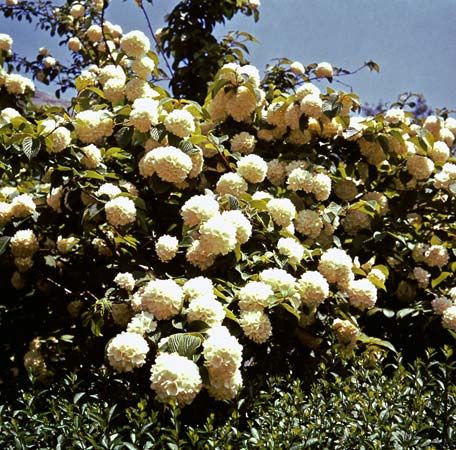
- Snowball Bushes: Several varieties are cultivated for their round, roselike heads of sterile florets. These include the V. opulus variety roseum (guelder rose), the Chinese snowball (V. macrocephalum), and the Japanese snowball (V. plicatum).1
- Black Haw (V. prunifolium): A North American species reaching 4.5 meters in height, characterized by plum-like leaves, small white flower clusters, and blue-black berries.1
- Sweet Viburnum (V. odoratissimum): Native to India and Japan, this species is noted for its shiny, dark-green evergreen leaves and large, fragrant flower clusters.1
- Laurustinus (V. tinus): A 3-meter-tall evergreen native to the Mediterranean, featuring oblong leaves.1
How are viburnum plants used in landscaping and gardening?
Viburnum plants are highly valued in landscaping and gardening primarily for their ornamental qualities. Gardeners and landscape designers frequently select these shrubs and small trees for their attractive foliage, which often provides seasonal interest, such as the vibrant autumn colors seen in the European cranberry (V. opulus).1
Beyond their leaves, viburnum species are prized for their clusters of fragrant, typically white flowers. Certain varieties, such as the guelder rose, Chinese snowball, and Japanese snowball, are specifically cultivated for their striking, round, roselike heads of sterile florets. These plants also contribute to garden aesthetics through their colorful fruit, which can range from bright red to blue-black depending on the species.1
Because the genus includes both deciduous and evergreen options—such as the Mediterranean laurustinus or the sweet viburnum—they offer versatility for various garden designs, providing either seasonal color changes or year-round greenery.1
Sources
- Viburnum — Encyclopædia Britannica
- viburnum — Merriam-Webster
- black haw — Merriam-Webster
Published on · 2 min read