Rhodora
The rhodora (Rhododendron canadense) is a deciduous shrub belonging to the heath family (Ericaceae). Native to northeastern North America, it typically…
What is rhodora?
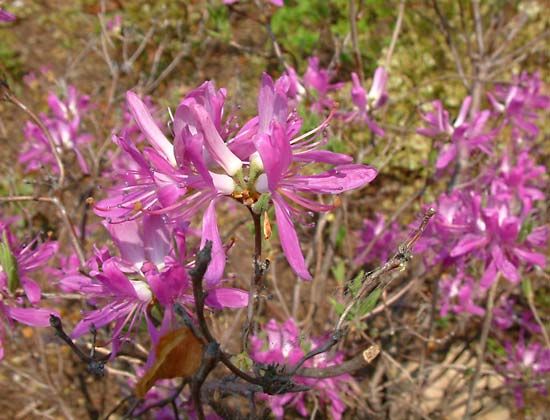
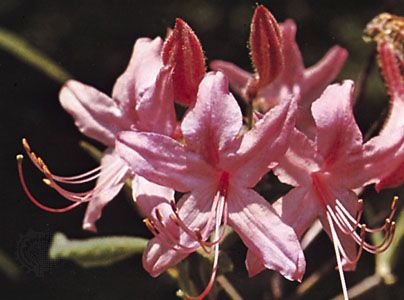
The rhodora (Rhododendron canadense) is a deciduous shrub belonging to the heath family (Ericaceae). Native to northeastern North America, it typically thrives in swampy regions and reaches a height of approximately 90 cm (3 feet).1
The plant is characterized by alternate, smooth-edged leaves that are grayish and hairy on the undersurface. Its showy, rosy-purple flowers bloom in the spring before the foliage appears, though a white-flowered variety known as albiflorum also exists. Often classified as an azalea, the name “rhodora” originates from a 1763 genus designation by Linnaeus. For further context on its classification, you may also be interested in the broader rhododendron genus.12
What are the main characteristics of the heath family?
The Ericaceae family, commonly known as the heath family, is a diverse group of flowering plants comprising approximately 126 genera and 4,000 species. Primarily consisting of shrubs and small trees, they are widely distributed across temperate, arctic, and tropical montane climates.34
Key characteristics include:
- Habitat: Most species thrive in acidic, well-lit, and often poorly drained soils. They frequently form symbiotic relationships with fungi in their roots to aid nutrient uptake, particularly nitrogen.34
- Leaves: Often evergreen and xeromorphic (adapted to limited water), leaves can be simple, oppositely arranged, or whorled. Some species have small, narrow leaves, while others are thick and hard.345
- Flowers: Typically conspicuous, flowers often feature fused petals forming urn-shaped or tubular corollas. They usually possess 5 sepals, 5 petals, and 10 stamens.34
- Reproduction: Pollination strategies are varied, involving insects, birds, or wind. Fruits may be berries, capsules, or drupes.453
How do deciduous shrubs differ from evergreen shrubs?
The primary difference between deciduous and evergreen shrubs lies in their leaf retention and seasonal adaptation strategies.
- Deciduous Shrubs: These plants shed their leaves annually, typically as days shorten in autumn or during a dry season. Because their leaves are often thin and delicate, they do not require a high investment of chemical energy to produce, making it efficient for the plant to discard them rather than protect them against harsh winter conditions. Common examples include forsythia, viburnum, and lilac.6789
- Evergreen Shrubs: These plants retain their foliage throughout the year and into the following growing season. Their leaves are generally thicker, tougher, and more leathery than those of deciduous plants, which helps them resist water loss and survive freezing temperatures. Because these leaves are costly to produce, the plant retains them for two or more years to maximize photosynthetic activity. They are categorized into coniferous types, such as yew and juniper, and broad-leaved types, such as rhododendron and holly.71089
What other types of plants are found in North American swamps?
North American swamps are primarily defined by their woody vegetation, though the specific species present depend on regional hydrology and soil conditions. While trees are the dominant feature, several other types of plants are commonly found in these ecosystems:
- Trees: Beyond the iconic bald cypress, North American swamps frequently host red maple, tupelo, and Atlantic white cedar. Other common woody species include willows, alders, and cottonwood, the latter of which is particularly sensitive to prolonged submersion.1112
- Emergent Vegetation: In areas where the canopy opens or along the fringes of swamps, you will often find cattails and common reeds. These plants are well-adapted to waterlogged conditions.11
- Hydrophytes: Because swamps are often part of a larger wetland mosaic, they frequently intermingle with marsh-like areas dominated by grasses and sedges, particularly in regions like the Florida Everglades.plant/Cyperaceae), particularly in regions like the Florida Everglades.1113
Sources
- rhodora — Encyclopædia Britannica
- rhodora — Merriam-Webster
- Ericaceae — Encyclopædia Britannica
- Ericales - Ericaceae — Encyclopædia Britannica
- heath — Encyclopædia Britannica
- Plant development - Seasonal adaptations — Encyclopædia Britannica
- Evergreen — Encyclopædia Britannica
- Temperate forest - Environment — Encyclopædia Britannica
- horticulture - Shrubs — Encyclopædia Britannica
- evergreen — Merriam-Webster
- Swamp — Encyclopædia Britannica
- Wetland - Freshwater forested swamps — Encyclopædia Britannica
- Wetland - Freshwater marshes — Encyclopædia Britannica
Published on · 3 min read