Vosges
Sorry, the Britannica knowledge base does not contain information regarding how human activities like agriculture and forestry have specifically shaped the…
How has human activity, such as agriculture and forestry, shaped the Vosges landscape over time?
Sorry, the Britannica knowledge base does not contain information regarding how human activities like agriculture and forestry have specifically shaped the Vosges landscape over time.
The available records focus on the region’s geological formation, its role as a historical border, and its current status as a destination for tourism and outdoor activities such as hiking and skiing.123
What is the climate like in the Vosges region, and how does it affect local vegetation?
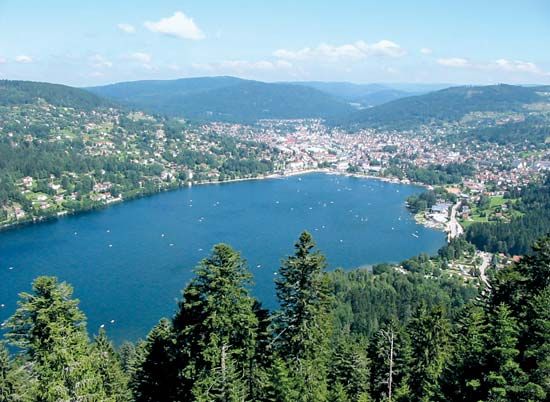
The Vosges region experiences a climate characterized by significant elevation-based variations. The higher mountain summits are subject to cold, snowy conditions during the winter months, while the lower, sheltered slopes—particularly to the southeast—benefit from a milder climate that supports vineyards in the Alsace region vineyards in the Alsace region.2
This climate directly dictates the local vegetation, which follows distinct altitudinal zones typical of high mountain environments in eastern France. The vegetation patterns include:
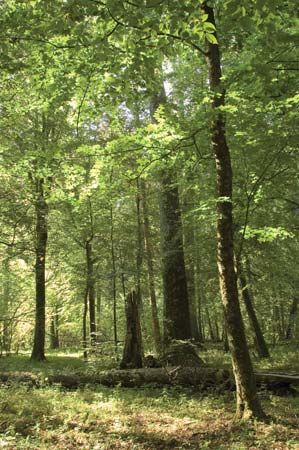
- Lower Elevations: The slopes are covered by deciduous forests, primarily consisting of beech woods.2
- Higher Elevations: As elevation increases, these give way to coniferous forests dominated by fir, mountain pine, and larch, alongside significant areas of planted spruce.2
- Above the Tree Line: The highest zones feature mountain pastures, which are often characterized by stunted trees and a variety of flowers that bloom during the spring and early summer.2
The Vosges massif remains one of the primary areas of forest cover in France, reflecting the region’s suitability for these specific plant communities.2
What is the geographical location and extent of the Vosges massif in France?
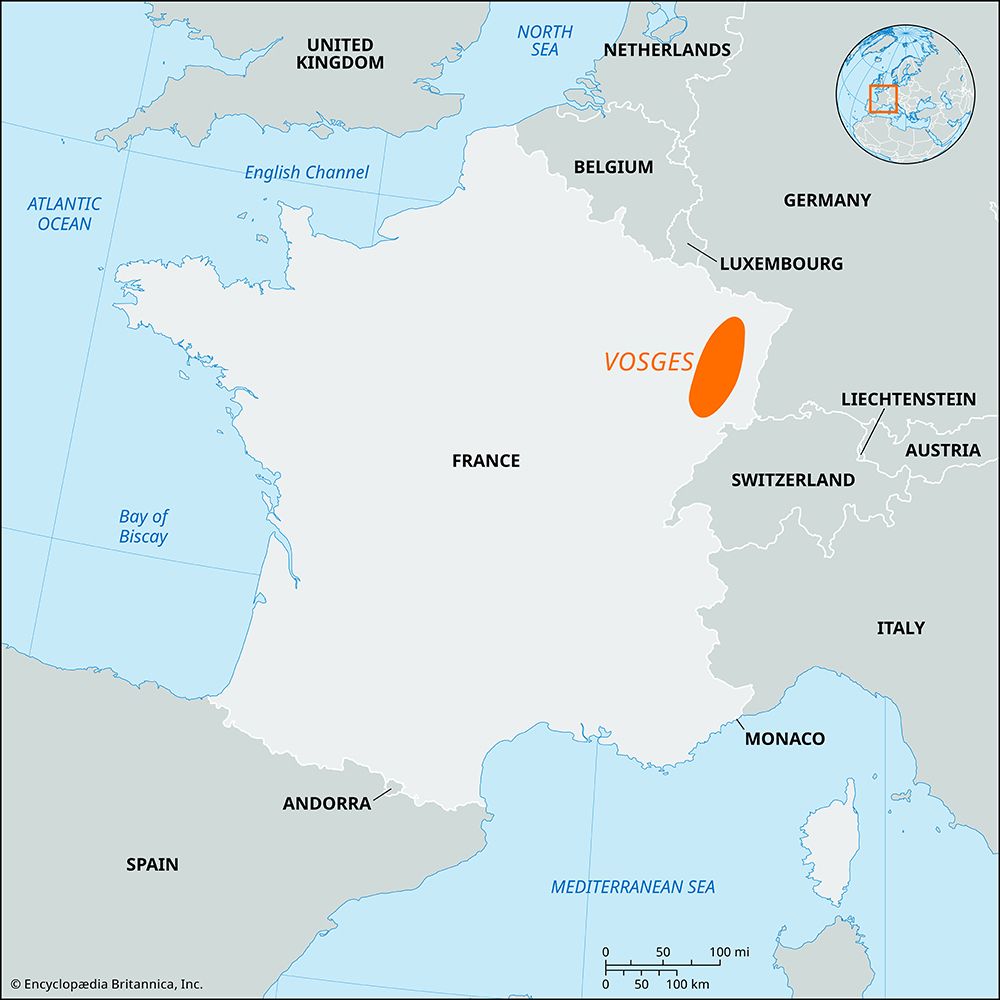
The Vosges massif is a range of ancient, dome-shaped mountains located in eastern France, extending across the départements of Haut-Rhin, Bas-Rhin, and Vosges. Situated west of the Rhine River Valley, the massif serves as a prominent geographical feature that separates the plains of Alsace to the east from the scarplands of Lorraine to the west.25
The extent and topography of the massif are defined by the following characteristics:
- Dimensions: The mountains rise north of the Belfort Gap, spreading westward for more than 40 miles (64 km) toward the Moselle River Valley and northward for over 70 miles (114 km) parallel to the Rhine.2
- Geological Structure: The southern portion consists primarily of granite chains, while the northern region is composed of red sandstone.25
- Elevation: The range reaches its highest points in the south, where summits known as ballons exceed 4,000 feet (1,200 meters), culminating in the Ballon de Guebwiller at 4,672 feet (1,424 meters). In the north, elevations are generally lower, reaching 3,307 feet (1,008 meters) at Le Donon before dropping below 2,000 feet (600 meters) past the Col de Saverne.25
- Slopes: The eastern slopes fall abruptly toward the Rhine Valley, whereas the western slopes descend more gently.25
What are some traditional customs and cultural practices unique to the Vosges area?
While the Vosges region is rich in history and geography, the provided search results do not contain specific information regarding unique traditional customs or cultural practices of the area.
The available information focuses primarily on the region’s physical geography, its industrial history—such as the decline of textile production and the enduring traditions of glassware, crystal, and furniture making—and its role as a destination for outdoor activities like hiking and skiing.
Sources
- Lorraine — Encyclopædia Britannica
- Vosges — Encyclopædia Britannica
- France - The Vosges — Encyclopædia Britannica
- France - Plant life — Encyclopædia Britannica
- Rhine River - Physiography — Encyclopædia Britannica
- Vosges — Merriam-Webster
Published on · 3 min read