Rhine River
The Rhine River benefits from a remarkably powerful and even flow due to its diverse tributary system, which balances the river's hydrological regime.
What are the major tributaries of the Rhine River and how do they contribute to its flow?
The Rhine River benefits from a remarkably powerful and even flow due to its diverse tributary system, which balances the river’s hydrological regime.12
Tributaries and Hydrological Impact
The Rhine’s flow is shaped by two primary types of regimes:
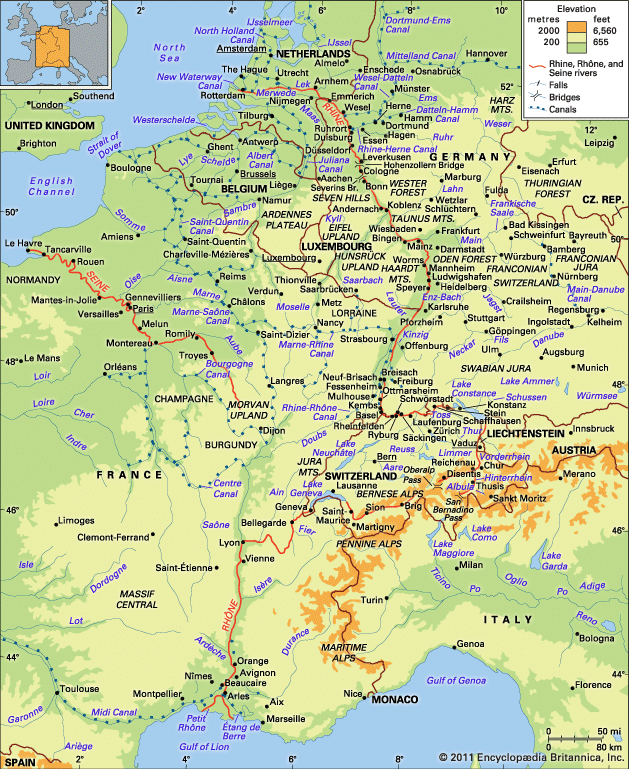
- Alpine Tributaries: The Aare, along with the Thur, Töss, and Glatt, contribute to an Alpine regime characterized by high water levels in spring and early summer due to snowmelt. The Aare is particularly significant, as it carries more water on average than the Rhine itself at their confluence.13
- Upland Tributaries: Tributaries such as the Neckar, Main, and Moselle drain the Central German Uplands and eastern France. These rivers typically experience maximum flow during the winter, which helps moderate the seasonal imbalances of the Alpine headwaters.321
By combining these distinct seasonal peaks, the tributaries ensure that the Rhine maintains a consistent discharge, making it one of the most reliable and busiest navigable waterways in Europe.12
What is the geographical course of the Rhine River, and which countries does it flow through?
The Rhine River is one of Europe’s most significant waterways, flowing approximately 765 miles (1,230 km) from the Alps to the North Sea.24
Geographical Course
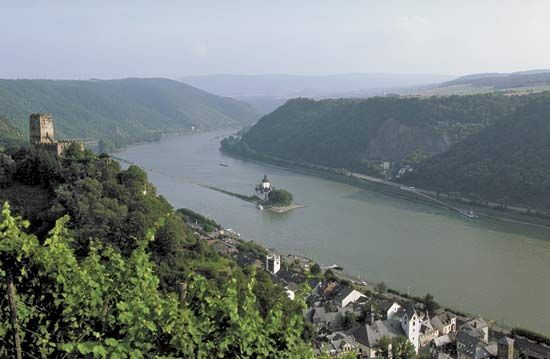
The river originates in the Swiss Alps through two headstreams: the Vorderrhein and the Hinterrhein. After they converge, the Rhine flows through Lake Constance and continues as the “High Rhine” toward Basel. Below Basel, it turns northward, traversing a broad valley before entering a spectacular 90-mile gorge section between Bingen and Bonn. Finally, the river enters the Netherlands, where it breaks into a complex delta before reaching the sea.24
Countries Traversed
The Rhine flows through or along the borders of several nations:
- Switzerland: Where it originates and defines parts of the border.24
- Liechtenstein: The river forms part of the border between Switzerland and the principality.2
- Austria: It forms a portion of the border with Switzerland.2
- Germany: The river flows through significant portions of German territory.24
- France: It serves as a boundary between France and Germany downstream from Basel.24
- Netherlands: The river terminates here in its delta region.24
What are some famous bridges or other architectural structures along the Rhine River?
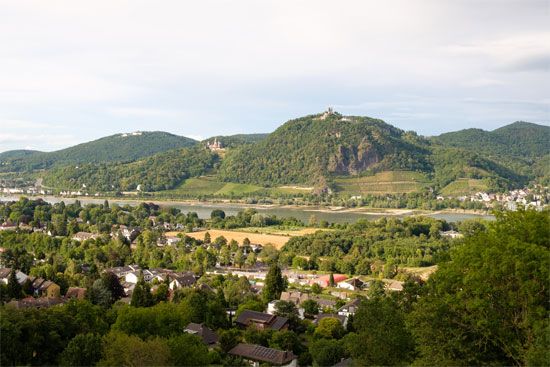
The Rhine River valley is home to a wealth of historic and modern architectural landmarks, ranging from medieval fortresses to iconic Gothic cathedrals.
Notable Bridges
- Hohenzollern Bridge: Located in Cologne, this rebuilt railway bridge is a vital transport link across the river.4
- Severin Bridge: A modern structure that spans the Rhine in Cologne, serving as a key piece of the city’s infrastructure.4
- Baldwin Bridge: Built in 1343, this historic bridge crosses the Moselle River near its confluence with the Rhine in Koblenz.5
Castles and Fortresses
- Ehrenbreitstein Fortress: Dominating the Rhine at Koblenz, this site was rebuilt between 1816 and 1832 into one of the strongest fortresses in Europe.54
- Medieval Castles: The middle Rhine gorge is famous for its numerous castles, including the castle of Kaub, which stands on an island in the river, and the medieval Mouse Tower (Mausturm) near BingenMausturm) near Bingen.4
Religious and Civic Architecture
- Cologne Cathedral: A masterpiece of Gothic style, this cathedral features twin towers rising 515 feet and houses significant medieval treasures, such as the gold shrine of the Magi.2
- Romanesque Churches: The Rhine valley is known for Rhenish architecture, a style of Romanesque design. Cologne alone features several notable examples, including Sankt Gereon and Gross Sankt Martin.26
- Electoral Palace: Located in Koblenz, this 18th-century palace is a prominent example of the region’s civic architecture.5
What are some of the major cities located along the Rhine River, and how have they historically benefited from the river?
The Rhine River has served as a vital artery for trade and industrial development in Europe for centuries. Its role as a major transport route has fostered the growth of numerous historic and industrial cities along its banks.2
Major Cities Along the Rhine
The river passes through several significant urban centers, each with a unique relationship to the waterway:
- Basel, Switzerland: A key inland port that serves as a gateway for river traffic entering Switzerland.210
- Strasbourg, France: A historic city located at the confluence of the Ill River, serving as a major cultural and political hub.42
- Mainz and Worms, Germany: Ancient cities that have long benefited from their strategic positions along the river’s trade routes.2
- Cologne, Germany: A major historic and commercial center that has relied on the Rhine for centuries to facilitate trade and transport.42
- Düsseldorf and Duisburg, Germany: Industrial powerhouses; Duisburg, in particular, is essential for handling bulk commodities like coal, coke, and iron ore from the Ruhr region.4
- Rotterdam, Netherlands: Located at the river’s delta, it is home to Europoort, one of the world’s largest ports, connecting the Rhine to the North Sea.4
Historical and Economic Benefits
Historically, the Rhine provided a reliable water transport route when land travel was difficult and expensive. The river’s importance surged during the 19th century due to the removal of political toll barriers, the introduction of steam-powered vessels, and the rise of modern industry.1110
The availability of cheap water transport allowed cities along the Rhine to become major axes of industrial production, particularly in the chemical and coal sectors, by keeping the costs of raw materials low. Today, while freight patterns have evolved, the river remains a critical commercial artery, supported by international agreements that ensure free navigation for all nations.21011
Sources
- Rhine River - Hydrology of the Rhine River — Encyclopædia Britannica
- Rhine River - Physiography — Encyclopædia Britannica
- Germany - Drainage of Germany — Encyclopædia Britannica
- Rhine River — Encyclopædia Britannica
- Koblenz — Encyclopædia Britannica
- Rhine River - Navigational improvements — Encyclopædia Britannica
- Rhine River - History of the Rhine River — Encyclopædia Britannica
- Cologne - Architecture of Cologne — Encyclopædia Britannica
- Rhenish architecture — Merriam-Webster
- Rhine River - The economy — Encyclopædia Britannica
- Rhine River - Traffic — Encyclopædia Britannica
- Netherlands - Drainage and dikes — Encyclopædia Britannica
Published on · 4 min read