Warta River
The Warta River is a major waterway in west-central Poland, stretching 502 miles (808 km) from its source near Zawiercie in the Silesian-Kraków uplands to…
What is Warta River?
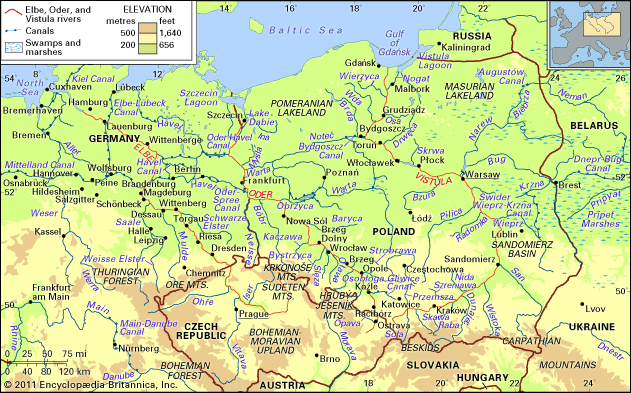
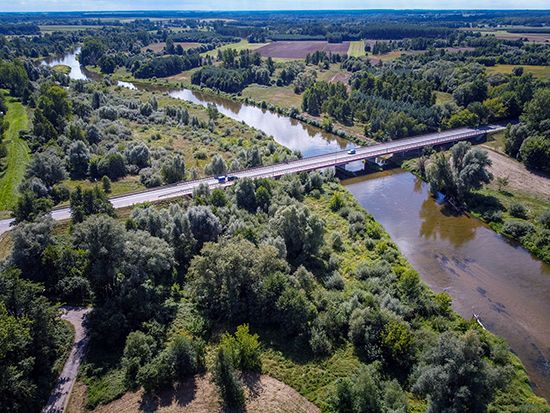
The Warta River is a major waterway in west-central Poland, stretching 502 miles (808 km) from its source near Zawiercie in the Silesian-Kraków uplands to its confluence with the Oder River at Kostrzyn.1
As the second-longest river located entirely within Poland, it drains a significant agricultural region of the Polish plain. Key features of the river include:1
- Basin Size: It covers 21,084 square miles (54,607 square km), ranking as the third-largest basin in the country.1
- Navigation: Approximately half of its length, spanning from Kostrzyn to Konin, is navigable.1
- Elevation: The river descends 1,224 feet (373 m) from its headwaters to its mouth.1
- Major Cities: Significant urban centers situated along its course include Częstochowa, Konin, Poznań, and Gorzów Wielkopolski.1
How does the Warta River connect to the Oder River?
The Warta River connects to the Oder River at a confluence located at Kostrzyn, in the western part of Poland’s Lubuskie province.1
As a major right-bank tributary, the Warta serves as a vital component of Poland’s inland waterway network. Beyond this direct physical connection, the Warta is also part of a broader water route that links the Oder with the Vistula River. This integrated system utilizes the Warta and Noteć rivers in conjunction with the Bydgoszcz Canal to facilitate navigation across the region.2
What role does the Warta River play in Poland’s agriculture?
The Warta River plays a significant role in Poland’s agricultural landscape by draining a vast portion of the Polish plain. Its basin, which covers 21,084 square miles (54,607 square km), encompasses the southern Great Poland (Wielkopolskie) Lowland, a region recognized as one of the country’s most important agricultural areas.13
The river’s valley serves as a focal point for human activity, with major settlements and communication routes historically developing along its course. By providing essential drainage for the central lowlands, the Warta supports the productivity of these fertile plains, which are vital to the nation’s farming output. While the broader central lowlands also contain significant industrial centers, the middle Warta basin remains a cornerstone of regional agricultural development.31
What are some major historical events associated with the city of Poznań?
Poznań has a rich and complex history, serving as a cradle of the Polish state and a site of significant political upheaval. Key historical events include:
- Early Foundations: Beginning as a 9th-century stronghold, Poznań served as the capital of Poland alongside Gniezno and was the residence of the nation’s first two sovereigns. The first Polish cathedral was erected there in 968.4
- Trade and Growth: The city received municipal rights in 1253. Benefiting from duty-free trade privileges, it became a major European trade center, peaking in economic and cultural influence during the 16th century.4
- Prussian Annexation: Following the Partitions of Poland, the city was annexed by Prussia in 1793. Throughout the 19th century, the city faced intense Germanization efforts, which were met with persistent Polish resistance through cooperative organizations.4
- World War II: The city suffered immense devastation during the German occupation beginning in 1939. It was left in ruins following a 1945 siege by Soviet forces.4
- 1956 Uprising: In June 1956, industrial workers staged the Poznań Riots to demand better living standards and political reform. The violent suppression of this strike by the military forced the communist leadership to implement significant policy changes.5
Sources
- Warta River — Encyclopædia Britannica
- Oder River — Encyclopædia Britannica
- Poland - The lake region and central lowlands — Encyclopædia Britannica
- Poznań — Encyclopædia Britannica
- Poznań Riots — Encyclopædia Britannica
- Wielkopolskie — Encyclopædia Britannica
Published on · 3 min read