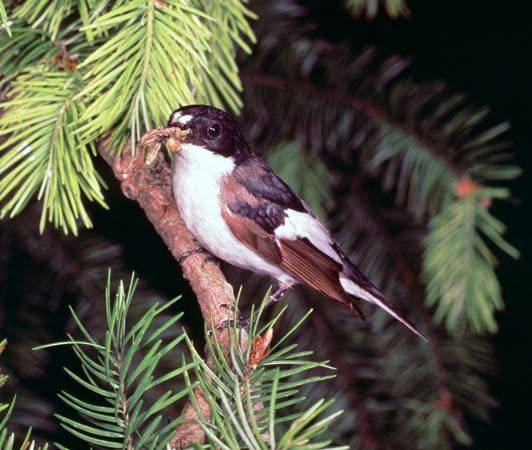
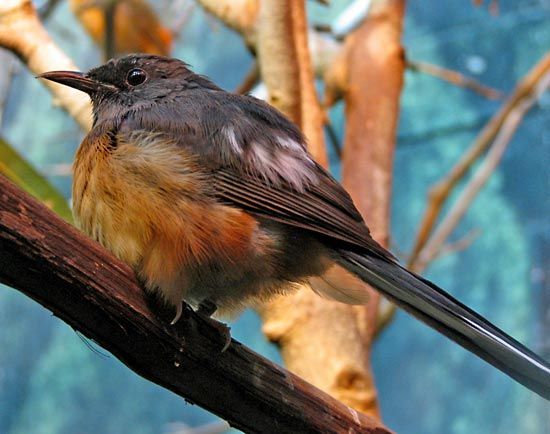
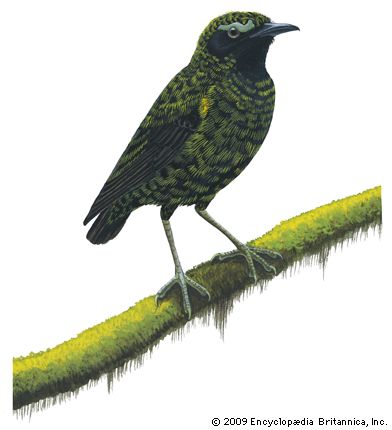
Wattle-eye
The term "wattle" refers to a fleshy, pendulous process typically found on the head or neck of a bird. In the case of wattle-eye birds—small African…
What is the significance of the ‘wattle’ in wattle-eye birds?
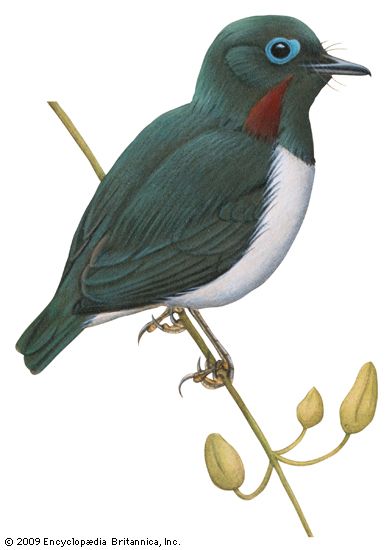
The term “wattle” refers to a fleshy, pendulous process typically found on the head or neck of a bird. In the case of wattle-eye birds—small African songbirds belonging to the family Platysteiridae—these structures manifest as bright, fleshy eye ornaments.12
While the provided information identifies these wattles as distinctive physical features located above or below the eyes depending on the genus, it does not explicitly detail their biological or evolutionary significance, such as their role in mate selection or signaling. These birds are otherwise characterized by their black-and-white plumage, insectivorous diet, and habit of raising their long rump feathers during moments of excitement.2
How many species of wattle-eye birds exist, and what are some examples?
The provided search results do not specify the exact total number of species of wattle-eye birds. These birds belong to the family Platysteiridae, which some authorities classify within the flycatcher subfamily, Muscicapinae.
While a precise count is not available in the provided text, the following are examples of wattle-eye species:
- Scarlet-spectacled wattle-eye (Platysteira cyanea): Distributed across transequatorial regions.
- Chestnut wattle-eye (Dyaphorophyia castanea): Found in west-central Africa.
- Cape puffback flycatcher (Batis capensis): A common garden bird in the east and south of Africa.
These birds are generally characterized by their small, stubby appearance, black-and-white plumage, and insectivorous diet. Notably, while many species possess fleshy eye ornaments known as wattles, the genus Batis lacks these structures entirely.
What are the feeding habits and diet of wattle-eye birds?
Wattle-eye birds are primarily insectivorous, meaning their diet consists of insects. They are active foragers that hunt within forests and gardens to secure their food.
Their feeding behavior is characterized by distinct, audible actions: they frequently flick their wings and snap their beaks while catching prey. This combination of movement and sound is a notable aspect of their foraging strategy as they navigate their habitats in search of insects.1
Where are wattle-eye birds typically found in the wild?
Wattle-eye birds are native to the African continent, where they inhabit a variety of environments ranging from dense forests to human-cultivated gardens.1
Their distribution varies by species:
- The scarlet-spectacled wattle-eye (Platysteira cyanea) is found across transequatorial regions of Africa.1
- The chestnut wattle-eye (Dyaphorophyia castanea) is primarily located in west-central Africa.1
- The Cape puffback flycatcher (Batis capensis) is a common sight in gardens throughout the eastern and southern regions of the continent.1
These birds are well-adapted to these diverse habitats, where they actively forage for insects among the foliage.1
Sources
- Wattle-eye — Encyclopædia Britannica
- wattle — Merriam-Webster
- beak wattle — Merriam-Webster
- flatworm - Annotated classification — Encyclopædia Britannica
Published on · 2 min read