Weddell Seal
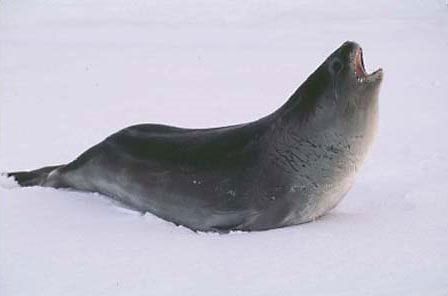
The Weddell seal (Leptonychotes weddellii) is a nonmigratory, earless seal (family Phocidae) native to the coastal regions of Antarctica.
What is Weddell seal?
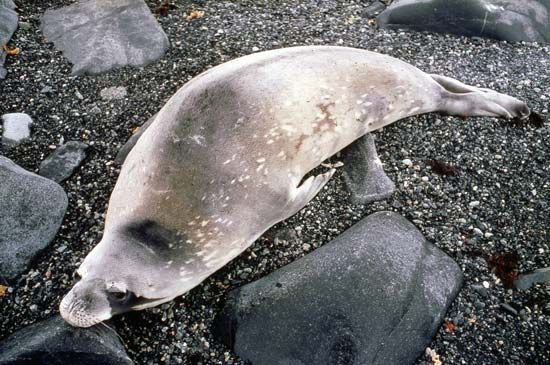
The Weddell seal (Leptonychotes weddellii) is a nonmigratory, earless seal (family Phocidae) native to the coastal regions of Antarctica.12
These rotund marine mammals typically grow to about 3 meters (10 feet) in length and weigh approximately 400 kg (880 pounds), with females generally being larger than males. As adults, they are characterized by a dark gray coat with lighter undersides and pale blotches.1
Weddell seals are highly adapted to the extreme Antarctic environment. They are unique in their ability to survive under fast ice during the winter by using their canine and incisor teeth to gnaw and maintain open breathing holes. They are also accomplished divers, capable of remaining submerged for over an hour and reaching depths of 600 meters to hunt for fish, cephalopods, and other marine life. It is estimated that there are approximately 1,000,000 Weddell seals living in the Antarctic zone.12
How do Weddell seals maintain breathing holes in the ice during winter?
To survive the harsh Antarctic winter, Weddell seals remain under the fast ice by actively maintaining breathing holes. They accomplish this by using their canine and incisor teeth to gnaw at the ice, ensuring the openings remain clear for surfacing and respiration.12
What are the primary differences between Weddell seals and other Antarctic seals like the leopard seal?
While both the Weddell seal and the leopard seal are earless seals (family Phocidae) inhabiting Antarctic regions, they exhibit distinct differences in behavior, diet, and physical characteristics:
- Dietary Habits: The leopard seal is a notable predator that feeds on warm-blooded prey, including penguins, seabirds, and other seals, in addition to fish and krill. In contrast, the Weddell seal primarily consumes fish and other marine life like cephalopods.45
- Social Behavior: Leopard seals are generally solitary animals. While most seals are gregarious during breeding, the specific social structures and hunting behaviors differ significantly between these species.45
- Physical Adaptations: The leopard seal is characterized by a slender body, a relatively long head, and distinct three-cusped cheek teeth. The Weddell seal is known for its exceptional diving capabilities, reaching depths of 600 meters and remaining submerged for over an hour—a feat that surpasses many other seal species.45
- Environmental Interaction: Weddell seals are uniquely adapted to survive under fast ice by using their teeth to maintain breathing holes, allowing them to inhabit areas that other seals might avoid during the winter.5
What physiological adaptations allow Weddell seals to dive to such extreme depths?
Weddell seals are remarkable divers, capable of remaining submerged for up to 73 minutes and reaching depths of 600 meters. While the provided information highlights their status as accomplished divers, their ability to perform such extreme feats is supported by specialized physiological adaptations common to deep-diving marine mammals.1
These adaptations typically include:
- High Oxygen Storage: They possess a high concentration of hemoglobin in their blood and myoglobin in their muscles, allowing them to store significantly more oxygen than terrestrial mammals.
- Efficient Oxygen Use: During dives, they exhibit bradycardia (a slowed heart rate) and peripheral vasoconstriction, which redirects oxygenated blood primarily to essential organs like the brain and heart.
- Tolerance to Lactic Acid: Their muscles are highly tolerant of the lactic acid buildup that occurs during prolonged anaerobic activity, enabling them to remain active even when oxygen stores are depleted.
We could dive deeper into how these seals manage the extreme pressure at such depths or explore their unique reproductive behaviors.
Sources
- Weddell seal — Encyclopædia Britannica
- Antarctica - Sea life — Encyclopædia Britannica
- Weddell seal — Merriam-Webster
- leopard seal — Encyclopædia Britannica
- seal — Encyclopædia Britannica
Published on · 3 min read