What’s the Difference Between Jam, Jelly, and Preserves?
The primary difference between jelly, jam, and preserves lies in the amount and form of the fruit used in their preparation.
What’s the Difference Between Jam, Jelly, and Preserves?
The primary difference between jelly, jam, and preserves lies in the amount and form of the fruit used in their preparation.1
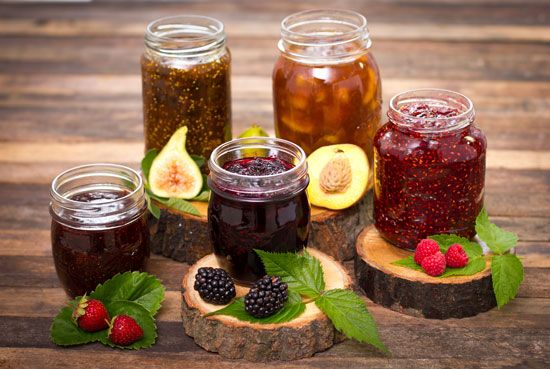
- Jelly: Made by crushing fruit and discarding the solids, leaving only the juice. This juice is mixed with pectin, sugar, and acid to create a smooth, clear, gelatinous spread.12
- Jam: Created by crushing the entire fruit, including pulp and fibers. It retains more of the fruit’s texture than jelly, offering a balance between spreadability and fruit content.12
- Preserves: Contain the most fruit, consisting of whole or large, chopped pieces suspended in a syrup or jam-like base. Because they retain the largest amount of fruit, they are often preferred for baking and cooking.12
These products are shelf-stable because the combination of sugar, acid, and pectin creates an environment that inhibits the growth of microorganisms.2
What is the role of pectin in making fruit spreads?
Pectin is a group of water-soluble carbohydrate substances found in the cell walls of plants that serves as the essential thickening agent in fruit spreads. Its primary role is to form a stable, gel-like structure by binding water within the mixture.342
In the production of jellies, jams, and marmalades, pectin works in conjunction with sugar and acid to create a successful “set”. This process is critical for several reasons:32
- Gel Formation: Pectin binds available water to create a complete gel; if the pectin level is inadequate, the product will fail to set properly.2
- Preservation: By binding water and lowering the pH of the mixture, the combination of pectin, sugar, and acid creates an environment that inhibits the growth of microorganisms, ensuring the product is shelf-stable.2
- Consistency: Commercial pectin, often derived from citrus peels or apple pomace, is frequently added when the natural fruit content is insufficient to achieve the desired texture.32
How is marmalade different from jam and jelly?
While all three are fruit-based spreads, marmalade is distinct from jam and jelly primarily due to its ingredients and texture:
- Marmalade: Typically made from citrus fruit, it is a jellylike concentrate consisting of prepared juice and suspended slices of fruit rind or peel.5
- Jam: Unlike jelly, jam is made from the entire fruit, including the pulp, providing a thicker, less clear consistency.52
- Jelly: This is a semitransparent confection made specifically from the strained juice of fruits or vegetables, resulting in a smooth, clear gel without fruit solids or pulp.52
While jellies rely on the strained juice of a fruit, both jams and marmalades incorporate more substantial fruit components—pulp for jam and sliced peel for marmalade—to achieve their unique textures. All three rely on the essential combination of sugar, acid, and pectin to create a shelf-stable, gelled product.52
Why are sugar and acid important for food preservation?
Sugar and acid are fundamental to food preservation because they create an environment that inhibits the growth of spoilage and pathogenic microorganisms.728
The Role of Sugar Sugar acts as a preservative primarily by binding available water within a food product. By increasing the concentration of solutes, sugar reduces the water activity—the amount of water available for microbial growth—thereby preventing deterioration. In products like jams and jellies, sugar is essential for achieving the necessary concentration of soluble solids, typically around 65 percent, which helps ensure the product remains shelf-stable.279
The Role of Acid Acidity is critical for two main reasons:
- Microbial Inhibition: A low pH environment is naturally hostile to many bacteria, effectively stopping their growth.108
- Pectin Activation: In fruit spreads, increased acidity activates the chemical reaction required for pectin to “set,” which further lowers water activity and stabilizes the gel structure.210
When used together, these ingredients ensure that food remains safe and shelf-stable by controlling the chemical and biological conditions of the product.2
Sources
- What’s the Difference Between Jam, Jelly, and Preserves? — Encyclopædia Britannica
- fruit processing - Fruit preserves , jams, and jellies — Encyclopædia Britannica
- Pectin — Encyclopædia Britannica
- pectin — Merriam-Webster
- marmalade — Merriam-Webster
- jelly — Encyclopædia Britannica
- food preservation - Chemical preservation — Encyclopædia Britannica
- fruit processing - Fruit preservation — Encyclopædia Britannica
- food additive - Antimicrobials — Encyclopædia Britannica
- food preservation - Quality of canned foods — Encyclopædia Britannica
- food preservation - Controlling water activity — Encyclopædia Britannica
Published on · 3 min read