White Mustard
White mustard (Sinapis alba) and brown mustard (Brassica juncea) are the two primary types of mustard used to produce the popular condiment. While both share…
How does white mustard compare to other mustard varieties like black or brown mustard?
White mustard (Sinapis alba) and brown mustard (Brassica juncea) are the two primary types of mustard used to produce the popular condiment. While both share similar physical characteristics—being nearly globular, finely pitted, and roughly 2.5 mm in diameter—they differ significantly in flavor profile and culinary application.1
- Flavor: Brown mustard is stronger and more pungent than white mustard. When mixed with water, brown mustard produces a volatile oil with an acrid taste and irritating odor, whereas white mustard produces a nonvolatile oil that lacks a strong odor but creates a distinct sensation of heat on the tongue.231
- Culinary Use: Due to its sharpness, brown mustard is a staple in French-type pastes. White mustard is preferred for milder American- or German-style pastes. Both varieties are often combined in English mustard products.123
- Cultivation: Brown mustard has largely replaced black mustard (Brassica nigra) in commercial production because it is better suited for mechanized harvesting.2
How tall does the white mustard plant typically grow, and what do its flowers look like?
The white mustard plant (Sinapis alba) is an erect, sparsely branching annual that grows rapidly, typically reaching a full height of 1.5 to 2 metres (5 to 6.5 feet) by the time its flowers fade and fruits appear.3
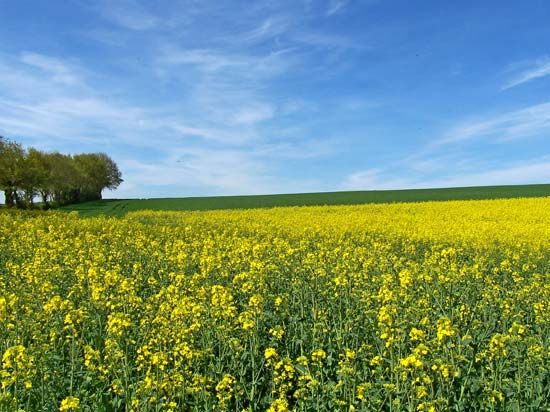
The plant’s flowers are characterized by four yellow petals and possess a fragrance often described as similar to honey. These flowers appear in a dense phase during early summer before giving way to large, bristly fruit pods that are swollen around the seeds and taper to a point.3
In which regions of the world is white mustard native, and where is it commonly cultivated today?
White mustard (Sinapis alba) is native to the Mediterranean region. Over time, it has naturalized throughout much of the world and is now considered an agricultural weed or invasive species in various areas outside its original range.31
Today, white mustard is commonly cultivated in temperate regions across the globe. It is primarily grown as a spring-sown crop, with significant production occurring on the Great Plains of Canada and the United States, as well as in Hungary and Britain. In these major producing countries, the cultivation of the plant is fully mechanized.13
How is white mustard cultivated and what are its preferred growing conditions?
White mustard (Sinapis alba) is a resilient crop that is relatively easy and inexpensive to cultivate. Because it is highly adaptable, it can flourish on many different types of soil and is capable of tolerating extremes of weather without suffering serious harm. Furthermore, the plant is notably hardy, as it is affected by very few insect pests or plant diseases.3
Cultivation Practices
The cultivation of white mustard is a straightforward, fully mechanized process in the world’s primary producing countries. The plant is grown as a spring-sown annual crop. Following a period of rapid growth and dense flowering in early summer, the plants reach their full height of 1.5 to 2 metres (5 to 6.5 feet). The cycle concludes in early autumn, when the dry seeds are harvested.3
Beyond its primary use for mustard seeds, the plant is also cultivated as a green manure and fodder crop, and its young seedlings are sometimes harvested to be eaten fresh as sprouts.3
Sources
- mustard — Encyclopædia Britannica
- Brown mustard — Encyclopædia Britannica
- white mustard — Encyclopædia Britannica
- white mustard — Merriam-Webster
Published on · 2 min read