Why Do We Have Seasons?
Seasons occur primarily because Earth is tilted on its axis at an angle of approximately 23.5° as it orbits the Sun. This tilt causes different hemispheres…
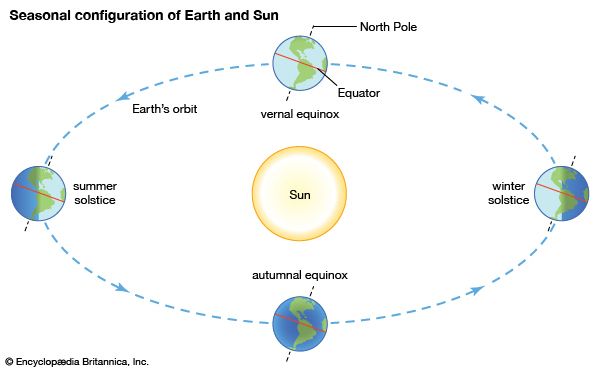
Why do we have seasons?
Seasons occur primarily because Earth is tilted on its axis at an angle of approximately 23.5° as it orbits the Sun. This tilt causes different hemispheres to receive varying amounts of direct sunlight throughout the year.12
When a hemisphere is tilted toward the Sun, it receives more direct solar rays and longer daylight hours, resulting in the warmer temperatures of summer. Conversely, when a hemisphere is tilted away from the Sun, it receives less direct sunlight, leading to the cooler conditions of winter.132
It is a common misconception that Earth’s distance from the Sun causes the seasons; in reality, the change in distance is not a factor. Instead, the seasonal cycle is marked by solstices and equinoxes, which represent the extremes and midpoints of this solar exposure. Latitude also plays a significant role: tropical regions near the Equator experience less seasonal variation because they receive more consistent sunlight year-round compared to higher latitudes.123
How do seasons differ between the Northern and Southern Hemispheres?
Seasons in the Northern and Southern Hemispheres are essentially opposites due to the tilt of Earth’s axis. When one hemisphere is tilted toward the Sun, it experiences summer, while the other is tilted away, experiencing winter. For instance, the summer solstice in the Northern Hemisphere occurs in June, whereas the same event takes place in the Southern Hemisphere in December.15
Beyond this reversal, the two hemispheres experience seasons differently due to the distribution of land and water. The Northern Hemisphere is often called the “land hemisphere,” while the Southern Hemisphere is the “water hemisphere”.6
- Temperature Variation: In the Southern Hemisphere, the vast ocean area moderates temperature changes, leading to smaller fluctuations between summer and winter at temperate latitudes.6
- Climate Impact: The Northern Hemisphere’s larger landmass causes more extreme temperature swings—land heats up and cools down much faster than water. This creates significant seasonal shifts in atmospheric circulation and climate that are not mirrored in the Southern Hemisphere.6
Why do tropical regions experience less seasonal temperature change than temperate regions?
Tropical regions experience less seasonal temperature variation than temperate regions primarily because of their proximity to the Equator. Due to the Earth’s spherical shape and axial tilt, sunlight strikes equatorial regions at a more consistent angle throughout the year compared to higher latitudes.13
Key factors contributing to this stability include:
- Consistent Solar Angle: While temperate regions experience significant changes in the sun’s elevation angle between summer and winter, the sun remains at a high, near-vertical angle in the tropics year-round. This ensures a steady, high level of incoming solar radiation regardless of the season. level of incoming solar radiation regardless of the season.378
- Daylight Duration: Unlike higher latitudes, where the length of day varies dramatically—ranging from zero to 24 hours—the Equator maintains a nearly constant 12-hour day throughout the year. This consistency prevents the extreme seasonal swings in energy absorption seen in temperate zones.910
- Atmospheric and Geographic Factors: The tropical troposphere receives substantial radiant heating during both winter and summer seasons. While some tropical areas experience distinct wet and dry seasons due to shifts in atmospheric circulation, the overall temperature range remains minimal compared to the pronounced seasonal shifts of temperate climates.10117
What would happen to our seasons if Earth’s axial tilt were zero?
If Earth’s axial tilt were zero, the primary driver of seasonal change—the variation in the angle at which sunlight strikes the planet—would be eliminated. Currently, the obliquity of Earth’s axis (approximately 23.5°) causes each hemisphere to lean toward or away from the Sun throughout the year, resulting in the distinct summer and winter seasons we experience.111
With no axial tilt, the Sun’s rays would strike any given latitude at a constant angle throughout the entire year. This would lead to several significant changes:
- Loss of Seasonal Variation: The dramatic shifts in temperature and daylight duration that characterize temperate and polar regions would disappear. Instead, each location on Earth would experience a perpetual, unchanging climate based solely on its latitude.111
- Consistent Daylight: The length of day would remain constant at approximately 12 hours everywhere on the planet year-round, as the seasonal “leaning” that currently extends or shortens daylight hours would no longer occur.111
- Stable Solar Energy: The amount of solar radiation received at any specific latitude would remain steady, preventing the seasonal heating and cooling cycles that currently drive global weather patterns.111
Sources
- Why do we have seasons? — Encyclopædia Britannica
- What’s the Difference Between a Solstice and an Equinox? — Encyclopædia Britannica
- Climate - Distribution of radiant energy from the Sun — Encyclopædia Britannica
- Climate change - Orbital ( Milankovich ) variations — Encyclopædia Britannica
- ocean - Relative distribution of the oceans — Encyclopædia Britannica
- Solstice — Encyclopædia Britannica
- Tropical wet-dry climate — Encyclopædia Britannica
- Tropical rainforest - Environment — Encyclopædia Britannica
- Why is summer warmer than winter? — Encyclopædia Britannica
- Equator — Encyclopædia Britannica
- Atmosphere - Distribution of heat from the Sun — Encyclopædia Britannica
- Pleistocene Epoch - Cause of the climatic changes and glaciations — Encyclopædia Britannica
Published on · 3 min read