Why Is Summer Warmer Than Winter?
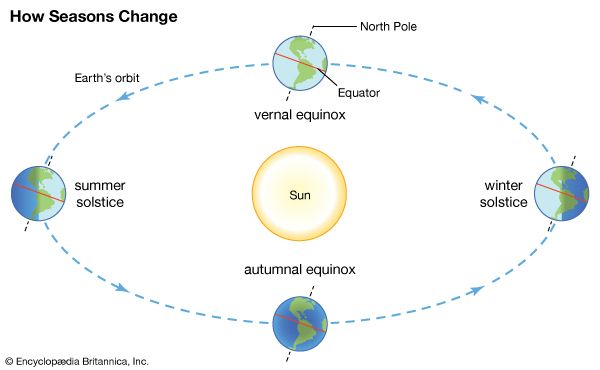
Summer is warmer than winter primarily due to the tilt of Earth’s axis, which is inclined at approximately 23.5° relative to its orbital plane.
Why is summer warmer than winter?
Summer is warmer than winter primarily due to the tilt of Earth’s axis, which is inclined at approximately 23.5° relative to its orbital plane.123
When a hemisphere is tilted toward the Sun, it receives sunlight at a more direct angle. This direct radiation is more intense because the energy is concentrated over a smaller area, leading to increased absorption of solar energy and warmer temperatures. Additionally, this tilt results in longer daylight hours, providing more time for the surface to absorb heat. Conversely, the hemisphere tilted away from the Sun receives sunlight at an oblique angle, spreading the energy over a larger area and resulting in shorter days and cooler temperatures, which we experience as winter.1243
It is a common misconception that Earth’s distance from the Sun causes the seasons; in fact, the planet’s elliptical orbit has a negligible effect on seasonal temperature changes compared to the impact of axial tilt.13
How do equinoxes differ from solstices?
Equinoxes and solstices are astronomical events that mark the changing of the seasons, but they represent opposite positions of the Sun in the sky relative to Earth’s Equator.6
Equinoxes
An equinox occurs when the Sun is positioned exactly above the Equator. While often associated with equal day and night, the actual day of equal length—the equilux—typically occurs a few days before the vernal equinox or after the autumnal equinox due to atmospheric refraction and the way sunrise and sunset are defined.76
Solstices
A solstice occurs when the Sun’s apparent path reaches its farthest point north or south of the Equator. These moments correspond to the extremes of daylight duration:28
- Summer Solstice: The longest day of the year, marking the start of summer.86
- Winter Solstice: The shortest day of the year, marking the start of winter.86
At the summer solstice, the Sun’s rays are directly overhead at either the Tropic of Cancer or the Tropic of Capricorn, depending on the hemisphere.86
Why do tropical regions have less seasonal temperature change?
Tropical regions experience less seasonal temperature change primarily because they receive more consistent solar radiation throughout the year compared to higher latitudes.19
Several factors contribute to this stability:
- Consistent Solar Angle: Because of Earth’s shape, the Equator is lit more steadily year-round. In tropical regions, the Sun rises to a near-vertical position at noon daily, ensuring a high and constant level of incoming radiant energy.12
- Daylight Duration: While temperate and polar regions experience significant fluctuations in the length of daylight between summer and winter, the equatorial belt maintains a relatively constant 12-hour day throughout the year.8
- Minimal Variation: In higher latitudes, the difference in the solar angle between summer and winter is pronounced, leading to drastic temperature swings. In contrast, the tropical troposphere receives substantial heating during both winter and summer seasons, resulting in little annual temperature variation—often less than the daily (diurnal) temperature range.859
What is the significance of the Tropic of Cancer and Tropic of Capricorn?
The Tropic of Cancer and Tropic of Capricorn are significant lines of latitude that mark the northernmost and southernmost points where the Sun’s direct rays strike Earth.102
Astronomical Significance
These tropics are defined by the tilt of Earth’s axis, which is currently about 23.5°. Because of this tilt, the Sun’s vertical rays shift throughout the year:102
- Tropic of Cancer (approx. 23°27′ N): During the summer solstice in the Northern Hemisphere (around June 21), the Sun reaches its greatest northern declination and is positioned directly overhead at this latitude.1011
- Tropic of Capricorn (approx. 23°27′ S): Six months later, during the winter solstice (around December 21), the Sun’s vertical rays reach their southernmost point, striking the Tropic of Capricorn.102
Geographic and Historical Context
The region located between these two lines is known as the intertropics. The Tropic of Cancer was named for the constellation Cancer, as the Sun appeared in that constellation during the summer solstice when the line was originally designated; today, the Sun appears in the constellation Gemini on that date. Because Earth’s axial tilt varies over a 41,000-year cycle, the precise latitudes of these tropics shift slightly over time.121011
Sources
- Why do we have seasons? — Encyclopædia Britannica
- Solstice — Encyclopædia Britannica
- Why is summer warmer than winter? — Encyclopædia Britannica
- Atmosphere - Distribution of heat from the Sun — Encyclopædia Britannica
- Climate - Distribution of radiant energy from the Sun — Encyclopædia Britannica
- equinox and the Seasons — Merriam-Webster
- Vernal equinox — Encyclopædia Britannica
- What’s the Difference Between a Solstice and an Equinox? — Encyclopædia Britannica
- Tropical rainforest - Environment — Encyclopædia Britannica
- Why Does the Tropic of Cancer’s Location on Earth Move Over Time? — Encyclopædia Britannica
- intertropics — Merriam-Webster
- Tropic of Cancer — Encyclopædia Britannica
Published on · 3 min read