Why Is Antarctica a Desert?
Antarctica is classified as a desert because it receives extremely low levels of precipitation. While many people associate deserts with heat, a desert is…
Why is Antarctica a desert?
Antarctica is classified as a desert because it receives extremely low levels of precipitation. While many people associate deserts with heat, a desert is defined by its aridity and sparse vegetation rather than temperature.123
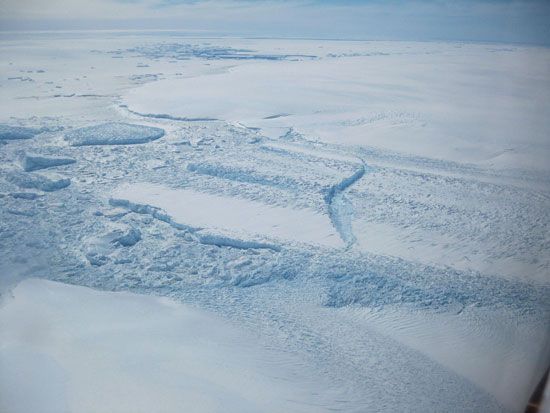
Specifically, Antarctica is categorized as a polar desert, a type of cold desert where most water is locked away in ice sheets and glaciers. The inland polar plateau receives only about 2 inches (50 mm) of precipitation annually, almost entirely as snow. The continent’s atmosphere is also exceptionally dry, containing only about one-tenth of the water vapor concentration found in temperate regions. Because of these frigid, arid conditions and the resulting lack of liquid water, the environment supports very little plant life, reinforcing its status as a “White Desert”.41
What are the main differences between polar and hot deserts?
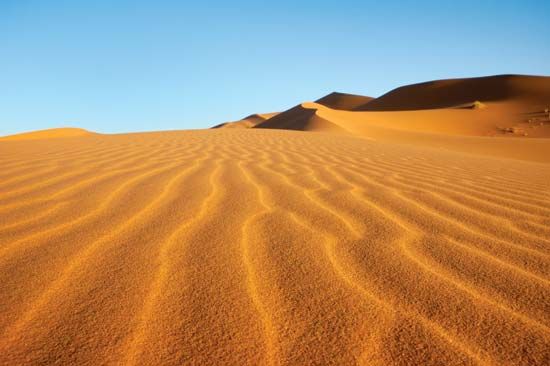
While both polar and hot deserts are defined by their extreme aridity and a lack of available moisture for plants, they differ significantly in their geographic location, temperature profiles, and environmental characteristics.54
Key Differences
- Temperature: Hot deserts, located in tropical and subtropical regions, experience high daytime temperatures that often exceed 40 °C (104 °F), with surface temperatures reaching even higher. In contrast, polar deserts are found at high latitudes and are characterized by frigid, sub-freezing temperatures, with winter lows that can drop to -40 °C (-40 °F) or below.564
- Geographic Distribution: Hot deserts typically occur between 15° and 30° latitude, often beneath descending dry air masses associated with the Hadley cell circulation. Polar deserts are situated at very high latitudes, such as the Arctic and Antarctica.564
- Water State: In hot deserts, water is scarce due to high potential evaporation rates. In polar deserts, most available water is locked away in glaciers and ice sheets, making it inaccessible to most organisms.54
- Precipitation: While both receive minimal annual precipitation (often under 25 cm), hot deserts may experience heavy, sporadic rainfall, whereas precipitation in polar deserts occurs primarily as snow or fog.54
How do animals survive in the extreme cold of Antarctica?
Animals in Antarctica have evolved specialized physiological and behavioral adaptations to survive the continent’s extreme cold.
Physiological Adaptations
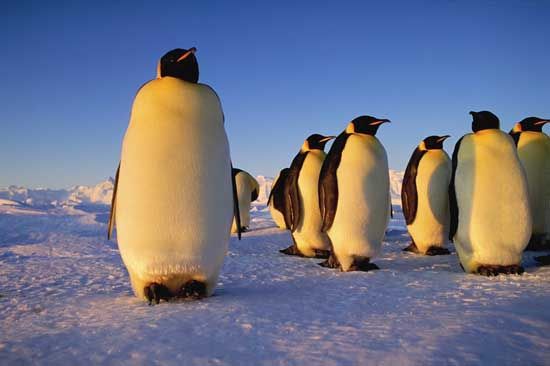
- Insulation: Penguins possess dense, short feathers that trap a layer of air against their skin, providing essential insulation. Many Antarctic species also maintain a thick layer of fat to further protect against freezing temperatures.78
- Countercurrent Heat Exchange: To prevent heat loss through their extremities, penguins utilize a specialized system of thermal conduction. Closely aligned arteries and veins in their lower limbs allow warm blood flowing from the body core to transfer heat to the cooler blood returning from the feet. This keeps the feet at a temperature that prevents ice from melting on contact while conserving core body heat.78
Behavioral Strategies
- Huddling: During harsh storms, penguins gather in large, tightly packed groups. This communal behavior allows them to share body heat and shield one another from the wind and cold.7
- Energy Management: While most birds migrate away from the continent as the ice pack expands, some species, such as the emperor penguin, remain throughout the winter, relying on their adaptations to endure the long, dark season.9
What is the difference between an ice sheet and a glacier?
An ice sheet is a specific type of glacier that covers a vast landmass, typically exceeding 50,000 square kilometers. While all ice sheets are glaciers, not all glaciers are ice sheets.1112
The primary differences between them relate to their scale and their relationship with the surrounding landscape:
- Topography and Flow: Mountain glaciers (or valley glaciers) are confined by the high relief of mountainous terrain, which dictates their flow patterns. In contrast, ice sheets are continuous, pancakelike masses that bury the underlying landscape, with flow directed outward from the center.13
- Size and Extent: Ice sheets are massive, continental-scale features, such as those found in Antarctica and Greenland. Smaller versions of these continuous ice masses are referred to as ice caps12.111412
- Outlet Glaciers: At the periphery of an ice sheet, the ice may thin and become restricted by local topography, forming outlet glaciers that resemble the lower reaches of mountain glacier systems.1311
Sources
- Why is Antarctica a desert? — Encyclopædia Britannica
- Desert — Encyclopædia Britannica
- list of deserts — Encyclopædia Britannica
- Cold desert — Encyclopædia Britannica
- Desert - Environment — Encyclopædia Britannica
- Tropical and subtropical desert climate — Encyclopædia Britannica
- How do penguins stay warm? — Encyclopædia Britannica
- penguin - Form and function — Encyclopædia Britannica
- Antarctica - Birds — Encyclopædia Britannica
- How do sea otters stay warm? — Encyclopædia Britannica
- glacial landform - Types of glaciers — Encyclopædia Britannica
- ice sheet — Encyclopædia Britannica
- glacier — Encyclopædia Britannica
- What’s the Difference Between a Glacier and an Ice Floe? — Encyclopædia Britannica
- ice — Encyclopædia Britannica
Published on · 3 min read