Wolf
Wolves are highly social animals that rely on complex communication to maintain their dominance hierarchy and strengthen social bonds within the pack.
How do wolves communicate with each other through vocalizations and body language?
Wolves are highly social animals that rely on complex communication to maintain their dominance hierarchy and strengthen social bonds within the pack.12
Vocalizations
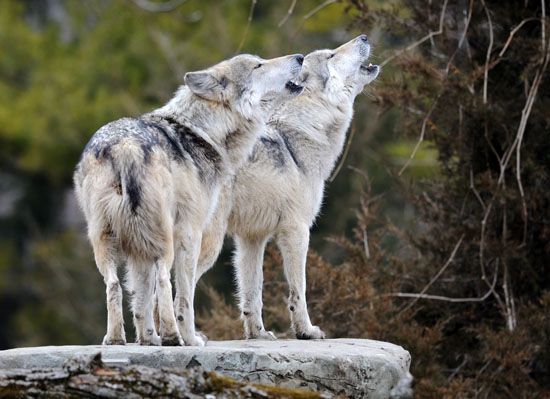
The most iconic form of communication is howling, a vocalization that serves several purposes:
- Location: It helps pack members stay in contact when separated, especially during hunts.12
- Territorial Defense: Aggressive howls warn rival packs to stay away from the group’s territory.12
- Social Connection: Research suggests wolves also howl to express affection toward pack members with whom they share a strong bond, rather than out of anxiety.2
Body Language and Visual Signaling
Wolves utilize visual signaling to convey information and maintain order within the group. This includes:
- Facial expressions: Used to communicate intent or status.1
- Body and tail position: These physical postures are essential for signaling rank and social standing among pack members.1
In addition to these methods, wolves use scent marking with urine and feces to define their boundaries to neighboring packs.12
How have wolves been portrayed in various cultures and mythologies?
Wolves have held a complex and often contradictory place in the human imagination, ranging from revered symbols of strength to feared embodiments of evil.
Mythological Foundations
In many ancient traditions, wolves were central to foundational narratives. In Roman mythology, the legendary founders Romulus and Remus were famously saved and suckled by a she-wolf, a symbol that remains iconic to Roman history. Conversely, in Norse mythology, the monstrous wolf Fenrir represented a destructive force destined to battle the gods during Ragnarök.345
The Werewolf Tradition
The concept of the werewolf reflects a long-standing fascination with human-to-wolf transformation. Appearing in the ancient Epic of Gilgamesh and Greek mythology through the story of Lycaon, these tales often served as metaphors for moral failings or uncontrollable aggression. This archetype has persisted into modern literature and film, evolving from folklore into a staple of horror and popular culture.67
Shifting Perceptions
Early human societies that relied on hunting often admired the wolf and sought to emulate its habits. However, as human settlements expanded, the wolf was increasingly vilified as a threat to livestock and human safety, leading to widespread eradication efforts in Europe and North America. In the modern era, public perception has shifted again toward conservation and appreciation, with wolves being reintroduced to wilderness areas like Yellowstone National Park.8
How do wolves compare to other canine species, both wild and domesticated?
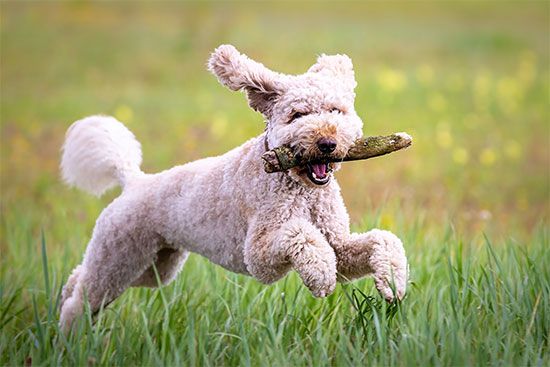
Wolves (Canis lupus) are the wild ancestors of the domestic dog, which is classified as the subspecies C. lupus familiaris. While they share instinctive behaviors like play, scent marking, and dominance hierarchies, wolves are generally more social and mature more slowly than dogs, reaching full physical and behavioral maturity around age two or three.1011
Comparison with Other Canids
Wolves differ significantly from other wild canids, such as coyotes and foxes, in both physical build and social structure:10
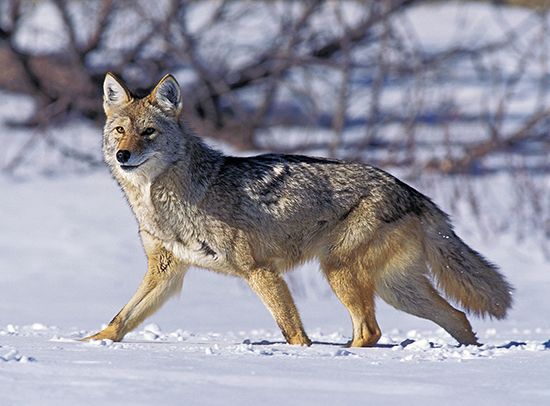
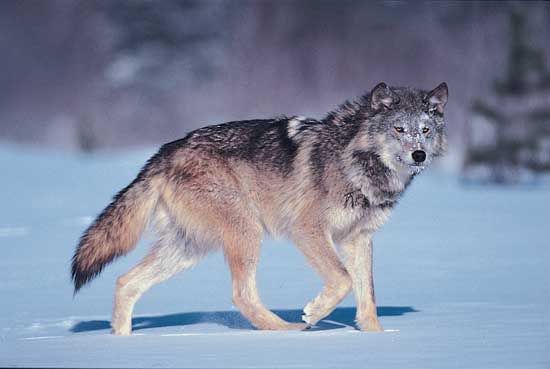
- Size and Build: Wolves are robust and muscular, built for endurance and travel, whereas coyotes are smaller, lighter, and more agile.12
- Social Structure: Wolves are highly social, living in structured family packs typically consisting of 6 to 10 individuals. Coyotes are often solitary or live in small, less structured family groups.1213
- Adaptability: While wolves have seen their range reduced by human activity, coyotes have demonstrated remarkable adaptability, expanding their range across North America into diverse environments, including urban areas.12
Despite these differences, wolves, dogs, and coyotes are closely related and capable of hybridization.1012
How are wolves distributed globally, and what are some different wolf species?
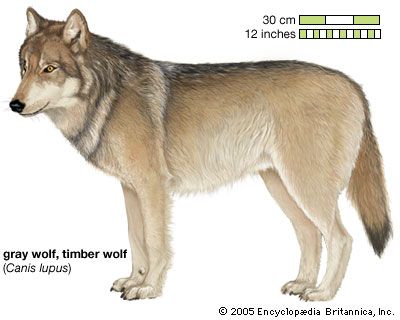
The gray wolf (Canis lupus) is the most widely distributed wolf species, historically inhabiting vast areas across the Northern Hemisphere, including North America, Eurasia, and parts of Africa. While their range has been reduced by human activity, they still occupy about two-thirds of their former territory, with global populations estimated between 200,000 and 250,000.14615
Different Wolf Species
Beyond the gray wolf, several other animals are recognized as distinct types of wolves, though taxonomic classification is often debated due to hybridization:
- Red wolf: Once considered a distinct species, molecular studies suggest it is a hybrid of the gray wolf and the coyote. It is highly endangered and found in small populations in North Carolina.16
- Eastern wolf: Native to eastern North America, it was once classified as a gray wolf subspecies but is now recognized by some as a unique species, though genetic evidence points to a hybrid origin involving gray wolves and coyotes.16
- Ethiopian wolf: A distinct, endangered species (C. simensis) found in isolated high-elevation grasslands in Ethiopia.16
- Extinct Species: The dire wolf (Aenocyon dirus) was a massive prehistoric predator of North America, while the Falkland Islands wolf (Dusicyon australis) is also extinct.1716
Sources
- gray wolf - Pack behaviour — Encyclopædia Britannica
- Why Do Wolves Howl? — Encyclopædia Britannica
- Fenrir — Encyclopædia Britannica
- werewolf - Werewolves in ancient history — Encyclopædia Britannica
- Romulus and Remus — Encyclopædia Britannica
- gray wolf - Conservation status — Encyclopædia Britannica
- werewolf - Werewolves in literature and popular culture — Encyclopædia Britannica
- ancient Rome - Rome’s foundation myth — Encyclopædia Britannica
- American Subarctic peoples - Religious beliefs — Encyclopædia Britannica
- dog - Wolves — Encyclopædia Britannica
- What is the difference between a wolf and a coyote? — Encyclopædia Britannica
- gray wolf - Physical description — Encyclopædia Britannica
- What dog is closest in DNA to a wolf? — Encyclopædia Britannica
- gray wolf — Encyclopædia Britannica
- wolf: Top Questions — Encyclopædia Britannica
- wolf - Other wolves — Encyclopædia Britannica
- wolf - Gray wolf — Encyclopædia Britannica
Published on · 4 min read