Wood Turtle
The wood turtle (Clemmys insculpta) is a semiaquatic reptile belonging to the family Emydidae, characterized by several distinct physical features:
What are the distinguishing physical characteristics of wood turtles?
The wood turtle (Clemmys insculpta) is a semiaquatic reptile belonging to the family Emydidae, characterized by several distinct physical features:
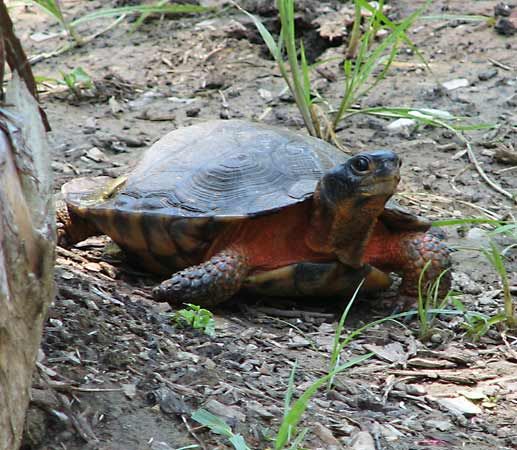
- Shell Structure: The upper shell is brown and typically measures between 15 and 20 cm (6 to 8 inches) in length. It is notably rough, featuring concentrically grooved, pyramid-like structures on each of its large plates, known as scutes.12
- Coloration: Beyond its brown shell, the turtle is easily identified by the reddish coloration found on its neck and legs.1
These turtles are native to regions ranging from Nova Scotia through the northeastern and north-central United States. While they spend time in streams during the winter and early spring, they become largely terrestrial as summer approaches, foraging in floodplains and uplands.1
Where are wood turtles typically found and what are their preferred habitats?
The wood turtle (Clemmys insculpta) is a semiaquatic species native to regions spanning from Nova Scotia through the northeastern and north-central United States.1
Their habitat preferences shift seasonally:
- Winter and Early Spring: During these months, wood turtles are primarily aquatic. They hibernate in stream banks or other areas directly adjacent to streams and are frequently found foraging or mating within the water.1
- Summer: As the season progresses, both males and females become largely terrestrial. They move into the stream’s floodplain and adjacent upland areas to forage for food, including berries, fruits, small invertebrates, eggs, and carrion.1
How do wood turtles reproduce and what is their life cycle like?
Wood turtles (Clemmys insculpta) follow a seasonal reproductive cycle tied to their semiaquatic lifestyle. Mating typically occurs in streams during late winter and early spring. Because of their shells, successful copulation requires the pair to entwine their tails to align their vents for the insertion of the male’s penis.56
Following mating, female wood turtles lay their eggs during the middle of spring. Like most turtles, they utilize their hind limbs to excavate an egg chamber in a carefully selected nest site, which they cover before departing, leaving the eggs and eventual hatchlings to survive on their own. A single clutch typically contains between 3 and 18 eggs.51
The development of the embryos is temperature-dependent, with warmer conditions generally accelerating the process. Hatchlings emerge from the eggs approximately 60 to 70 days after deposition. To exit the shell, the hatchling uses a small, pointed, keratinous bump on its snout known as a caruncle to slice through the egg membranes and shell. Once out, the young must dig their way to the surface to begin their independent lives.175
How does the wood turtle’s shell structure differ from other turtle species?
The wood turtle (Clemmys insculpta) is distinguished by its unique shell texture, which differs from many other turtles due to its rough, sculpted appearance. While many turtle species possess relatively smooth or streamlined scutes, the wood turtle’s upper shell features prominent, concentrically grooved pyramids on each of its large plates.1
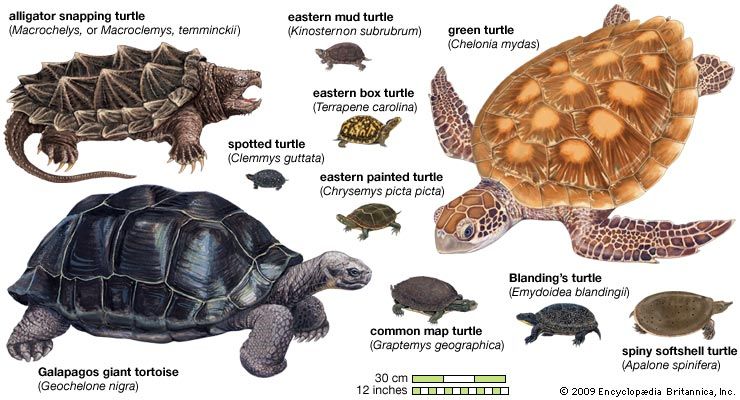
These raised, pyramid-like structures give the shell a rugged, textured surface that is characteristic of the species. In contrast, other members of the family Emydidae—such as the painted turtle or Blanding’s turtle—typically exhibit smoother or differently patterned carapaces adapted to their specific aquatic or semiaquatic lifestyles.13
Sources
- wood turtle — Encyclopædia Britannica
- wood tortoise — Merriam-Webster
- list of turtles — Encyclopædia Britannica
- turtle - Habitats — Encyclopædia Britannica
- turtle - Reproductive age and activity — Encyclopædia Britannica
- reptile - Embryonic development and parental care — Encyclopædia Britannica
- turtle - Courtship and copulation — Encyclopædia Britannica
- turtle - Egg development and hatching — Encyclopædia Britannica
Published on · 2 min read