Yak
Yaks survive in extreme environments through specialized physical and physiological adaptations.
How do yaks survive in extreme cold temperatures and high altitudes?
Yaks survive in extreme environments through specialized physical and physiological adaptations.
Cold Resistance
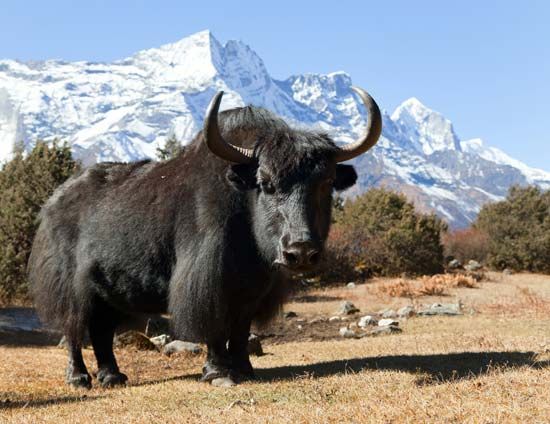
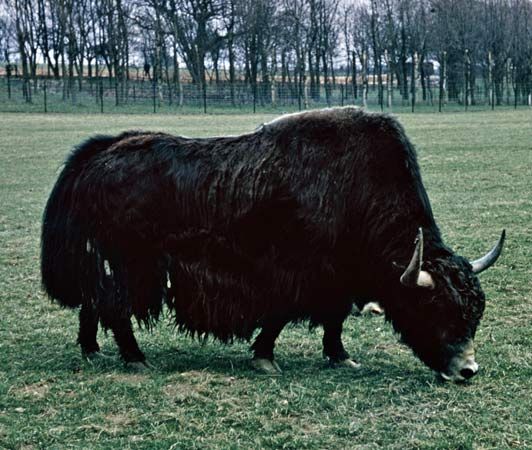
To thrive in temperatures as low as −40 °C (−40 °F), yaks possess a dense, double-layered coat. This consists of a coarse outer layer and a soft undercoat that traps body heat, providing superior insulation against chilling winds and snow in regions like the Himalayas and the Tibetan Plateau.1
High-Altitude Adaptation
Unlike humans, who rely on the reversible process of acclimatization to handle low oxygen levels, yaks are genetically adapted to high altitudes. Their hemoglobin exhibits a high oxygen affinity, allowing their blood to reach full oxygen saturation even when the partial pressure of oxygen in the air is low. Consequently, they do not require the physiological changes seen in acclimatized humans, such as increased red blood cell production or elevated pulmonary blood pressure.2
Where are yaks primarily found in the wild and in domesticated settings?
Yaks are primarily found in high-altitude regions, typically at elevations between 4,000 and 6,000 meters (14,000–20,000 feet).3
Wild Populations
Historically, wild yaks (Bos mutus) ranged from the Himalayas to Lake Baikal in Siberia. Following significant population declines due to hunting in the 20th century, they are now found in small, isolated numbers in northern Tibet and the Ladakh steppe of India.31
Domesticated Populations
Domesticated yaks (Bos grunniens) are widespread across high-altitude areas where human populations reside. They are primarily found in:
- China: The largest concentration of domesticated yaks.3
- Central Asia: Including Mongolia and Nepal.3
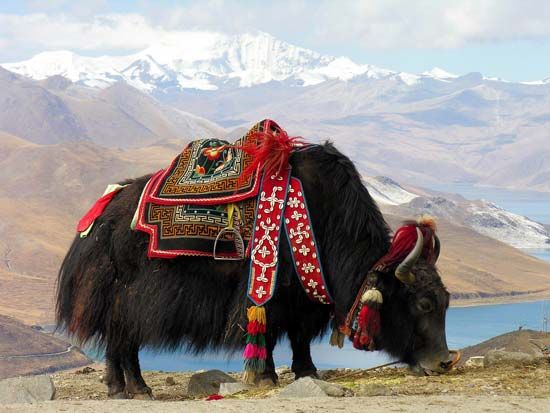
These animals were likely first domesticated in Tibet to serve as beasts of burden for trade caravans and are now essential to local economies for their milk, meat, hides, and fur, as well as for agricultural labor.3
What are the main differences between wild yaks and domesticated yaks?
Wild yaks (Bos mutus) and domesticated yaks (Bos grunniens) exhibit several key differences in size, appearance, and temperament, though they remain closely related enough to interbreed with cattle.3
Physical and Behavioral Differences
- Size: Wild yaks are significantly larger than their domesticated counterparts. Bulls in the wild can stand up to 2 meters tall at the shoulder and weigh over 800 kg (1,800 pounds), whereas domesticated yaks are generally smaller.3
- Coloration: Wild yaks typically feature a uniform blackish or brown coat. In contrast, domesticated yaks display more variable coloration, with white splotches being a common trait.3
- Temperament and Utility: Domesticated yaks have been selectively bred for tractability, making them suitable for use as beasts of burden, agricultural labor, and high milk production. Wild yaks, by nature, are not adapted for these human-directed tasks.3
While both types share the same physiological adaptations for high-altitude survival—such as increased lung capacity and specialized blood cells—the wild population is currently considered endangered due to hunting and the genetic dilution caused by interbreeding with domestic cattle.3
How are yaks being used in cross-breeding programs with cattle, and what are the results?
Yaks are frequently cross-bred with various kinds of cattle due to their close biological relationship within the family Bovidae.3
Results of Cross-breeding
The primary result of these cross-breeding programs is the creation of hybrids that combine the desirable traits of both species. While the yak is uniquely adapted to extreme high-altitude environments—possessing a lung capacity three times that of cattle and specialized red blood cells for efficient oxygen transport—cattle often provide different agricultural advantages.3
However, this practice also presents significant conservation concerns. Interbreeding between domestic cattle and wild yaks is a major factor contributing to the endangerment of the wild yak (Bos mutus), as it leads to the genetic dilution of the wild population.3
Sources
- Why do yaks have long hair on their bodies? — Encyclopædia Britannica
- human respiratory system - High altitudes — Encyclopædia Britannica
- yak — Encyclopædia Britannica
Published on · 3 min read