Zebra Mussel
The zebra mussel (Dreissena polymorpha) is a small, freshwater bivalve mollusk native to Eurasia, named for the distinct, irregular dark striping on its…
What is zebra mussel?
The zebra mussel (Dreissena polymorpha) is a small, freshwater bivalve mollusk native to Eurasia, named for the distinct, irregular dark striping on its shell.12
As an invasive species, the zebra mussel is considered a significant environmental and commercial pest. First appearing in Europe in the early 19th century, it was likely transported to North America via ship ballast water around 1986, eventually colonizing all of the Great Lakes2.3
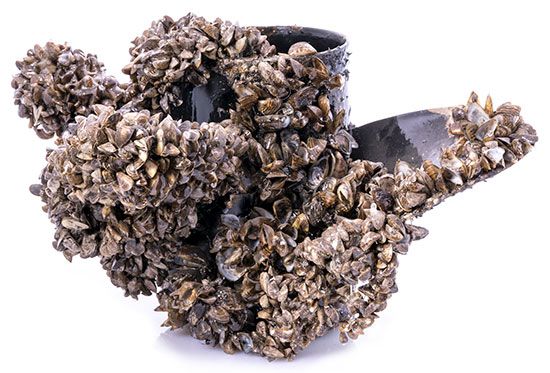
These mussels are highly prolific and use byssus threads to adhere in dense clusters to almost any submerged surface, including water-intake pipes, bridge abutments, and even native mussel species. Their presence causes severe damage by:23
- Disrupting food webs: They consume vast amounts of phytoplankton, starving native fish and driving indigenous mussel populations toward extinction.23
- Causing infrastructure damage: Their massive clustering clogs industrial and municipal water-intake valves and pipes.12
What are quagga mussels and how do they compare to zebra mussels?
The quagga mussel (Dreissena rostriformis bugensis) is a small, invasive freshwater bivalve mollusk native to the Dnieper River region of Eurasia. Like the zebra mussel, it was introduced to the Great Lakes—the quagga mussel appearing shortly after in 1989—where it has become a significant ecological and economic pest by clogging water-intake infrastructure and disrupting food webs through the consumption of phytoplankton and disrupting food webs through the consumption of phytoplankton.4
Comparison of Quagga and Zebra Mussels
While both species are closely related and share similar habits, they exhibit distinct differences:
- Appearance: The quagga mussel is named for its resemblance to the quagga (an extinct relative of the zebra), as it is less markedly striped than the zebra mussel.2
- Dominance: In some environments, such as Lake Michigan, quagga mussels have proven to be more aggressive invaders, in some cases nearly annihilating established zebra mussel populations.2
- Habitat: Both species colonize submerged surfaces, but the quagga mussel has demonstrated a high capacity for rapid colonization across various North American waterways, including the Colorado River.24
How does ship ballast water contribute to the spread of invasive species?
Ship ballast water is a critical vector for the global spread of invasive species. To maintain stability and structural integrity, commercial vessels take on large volumes of water into specialized tanks when they are not fully loaded with cargo. This water is typically drawn from the surrounding environment at a port of departure.5
When a ship reaches its destination and off-loads its cargo, it must discharge this ballast water to maintain proper buoyancy and balance. Because the water often contains a variety of organisms—including plants, animals, and microorganisms—the indiscriminate release of this water introduces these species into new, non-native ecosystems. Once released, these organisms may thrive in their new environment, often lacking natural predators, which allows them to outcompete native species and disrupt local ecological balances.5
What are some ways scientists try to control zebra mussel populations?
While the provided search results detail the destructive impact of zebra mussels on ecosystems and infrastructure, they do not contain information regarding the specific scientific methods used to control their populations.
Because the current knowledge base lacks data on these management strategies, I cannot provide an accurate answer to your query.
Sources
- zebra mussel — Merriam-Webster
- zebra mussel — Encyclopædia Britannica
- mussel — Encyclopædia Britannica
- quagga mussel — Merriam-Webster
- shipping — Encyclopædia Britannica
Published on · 2 min read