Mussel
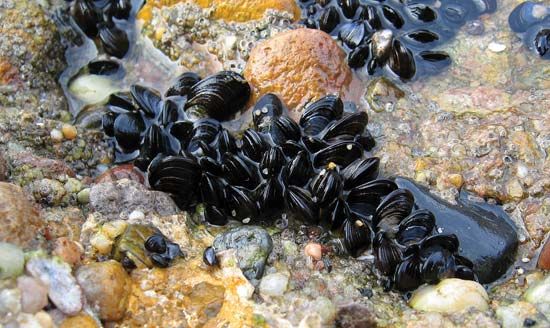
Marine mussels secure themselves to solid objects or to one another using proteinaceous structures known as byssus threads.
How do mussels attach themselves to surfaces, and what is the purpose of their byssal threads?
Marine mussels secure themselves to solid objects or to one another using proteinaceous structures known as byssus threads.1
These threads serve as a vital anchoring mechanism, allowing mussels to remain fixed in place and often form dense clusters. By attaching to surfaces, mussels can maintain their position in their environment, which is essential for their survival and feeding habits. While many species utilize these threads for stability, some mussels have adapted to burrow into soft substrates like mud or wood instead.1
What are the primary habitats where mussels can be found, and how do they adapt to these environments?
Mussels are found in a wide variety of aquatic environments, ranging from cool marine seas to freshwater streams, lakes, and ponds. Their ability to thrive in these diverse habitats is largely due to specialized morphological and behavioral adaptations.12
Primary Habitats and Adaptations
- Marine and Estuarine Shores: Many marine mussels (family Mytilidae) inhabit wave-swept rocky shores. To survive in these high-energy environments, they have evolved a triangular shell form and ventral flattening, which, combined with their byssus threads, allows them to anchor securely to hard surfaces.2
- Soft Substrates: Some species have adapted to burrow into soft environments like mud or wood. These mussels often possess laterally compressed, smooth, and elongated shells, which reduce drag and facilitate movement through sediments.12
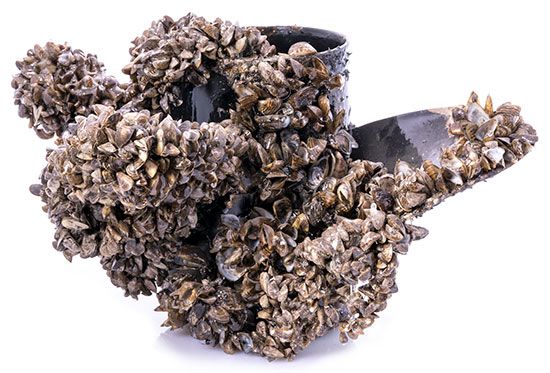
- Freshwater Systems: Freshwater mussels, or naiads, inhabit streams, lakes, and ponds globally. Certain invasive species, such as the zebra mussel, have adapted to proliferate rapidly and adhere to virtually any solid surface, including rocks, bridge abutments, and industrial water-intake pipes.13
- Intertidal Zones: In rocky intertidal areas, mussels like the California mussel dominate the landscape. They are highly resilient, though they are subject to periodic disturbances from winter storms that can scour them from rock surfaces, necessitating long-term recovery cycles.4
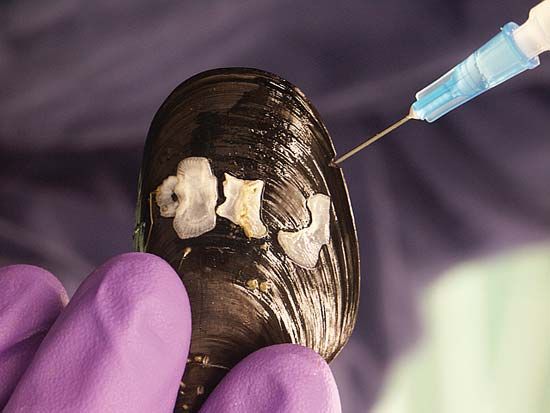
How do mussels contribute to water filtration and purification in their ecosystems?
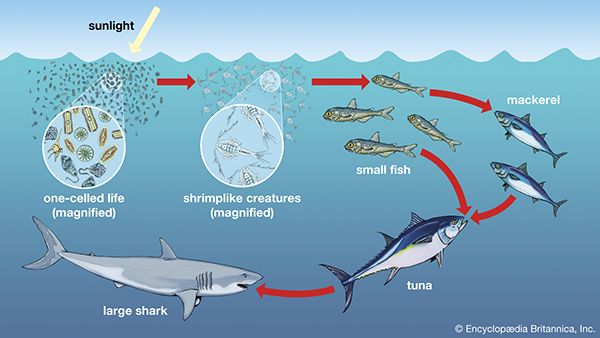
Mussels contribute to water filtration through a specialized feeding mechanism that allows them to process large volumes of water. As bivalve mollusks, they utilize their gills, which have evolved into complex filtering devices known as ctenidia.1
The Filtration Process
- Water Flow: Mussels use arrays of cilia on their gill filaments to create a constant flow of water through their mantle cavity.1
- Particle Capture: As water passes through the filtration barrier, the gills trap suspended materials, including phytoplankton, bacteria, and organic detritus.51
- Ingestion: These trapped particles are bound in mucus and transported by the cilia to the labial palps, where the food is sorted before being moved to the mouth for digestion.1
While this process effectively purifies the water by removing suspended particles, it can have significant ecological consequences. For instance, the invasive zebra mussel filters phytoplankton so aggressively that it can disrupt the local food chain, negatively impacting fish populations and native species. Additionally, because they concentrate particles from the water, mussels can also accumulate toxins from harmful algal blooms or industrial pollutants, which poses risks to both the ecosystem and human consumers.52
What is the structure and function of a mussel’s shell?
The mussel shell is a sophisticated biological structure primarily composed of calcium carbonate embedded in an organic matrix, all of which is secreted by the mantle.67
Structure
The shell consists of three distinct layers:
- Periostracum: The outermost organic layer that serves as a substrate for calcium carbonate deposition.67
- Prismatic Layer: An intermediate layer composed of calcite.7
- Nacreous Layer: A smooth inner layer, also made of calcium carbonate, which is secreted by the general surface of the mantle.7
The two valves are joined middorsally by an elastic ligament that creates an opening thrust, which works against the closing action of the adductor muscles. Additionally, a hinge plate with interlocking teeth ensures proper valve alignment and prevents shear when the shell is closed.68
Function and Adaptation
The shell serves as a vital protective barrier and is highly adapted to the mussel’s specific environment. For mussels in the family Mytilidae, the shell typically exhibits a triangular form and ventral flattening, which, combined with byssal threads, allows for secure attachment to hard surfaces in wave-swept coastal environments.39
Sources
- mussel — Encyclopædia Britannica
- bivalve - Importance — Encyclopædia Britannica
- bivalve - Size range and diversity of structure — Encyclopædia Britannica
- ecological disturbance - Disturbance and biodiversity in intertidal zones — Encyclopædia Britannica
- bivalve - Food and feeding — Encyclopædia Britannica
- bivalve - The shell — Encyclopædia Britannica
- mantle — Encyclopædia Britannica
- bivalve - External features — Encyclopædia Britannica
- Integument - Mollusks — Encyclopædia Britannica
- gastropod - The mantle — Encyclopædia Britannica
- bivalve - Features of defense and aggression — Encyclopædia Britannica
Published on · 4 min read