Academy Bay
Academy Bay is a bay located at the southern end of Santa Cruz Island, part of the Galapagos Islands in the eastern Pacific Ocean, approximately 600 miles…
What is Academy Bay?
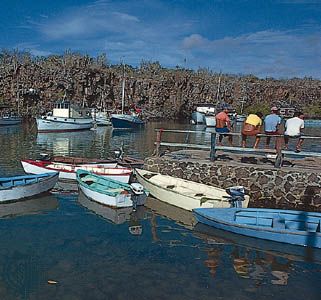
Academy Bay is a bay located at the southern end of Santa Cruz Island, part of the Galapagos Islands in the eastern Pacific Ocean, approximately 600 miles west of mainland Ecuador.1
Named in 1905 by the California Academy of Sciences Expedition, the bay is perhaps best known as the site of the Charles Darwin Research Station. Established in 1959, this station is dedicated to the study and preservation of the unique flora and fauna of the archipelago. Additionally, the bay functions as a harbor for small vessels and holds historical significance as the site where the stranded crew of the ship Alexandra was rescued in 1906.1
What is the history of the Galapagos Islands?
The Galapagos Islands were discovered in 1535 by Tomás de Berlanga, the bishop of Panama, after his ship drifted off course while traveling to Peru. He named them Las Encantadas (“The Enchanted”) and noted the abundance of large tortoises, or galápagos, for which the islands are named.2
Following their discovery, the islands were visited by Spanish voyagers, pirates, and whalers for nearly 300 years. The archipelago remained unclaimed until 1832, when Ecuador took official possession and began colonization on what is now Santa María Island.2
The islands gained international scientific fame in 1835 when the English naturalist Charles Darwin visited. His observations of the unique local fauna were instrumental in developing his theory of natural selection, which he later presented in On the Origin of Species (1859). In the 20th century, the region became a focus for conservation, leading to the establishment of the Galapagos National Park in 1959 and its designation as a UNESCO World Heritage site in 1978.2
How does the Charles Darwin Research Station protect local wildlife?
The Charles Darwin Research Station, located on Santa Cruz Island, plays a vital role in the conservation of the Galapagos Islands. Its primary mission is to promote scientific research aimed at understanding and preserving the archipelago’s unique ecosystem.23
By conducting rigorous scientific studies, the station develops strategies to protect the indigenous vegetation and animal life of the islands. This work is essential for maintaining the ecological integrity of the region, which faces ongoing challenges from the introduction of nonnative plant species, the growth of the local human population, and the impact of tourist traffic. Through its research and conservation initiatives, the station provides the necessary data and management practices to safeguard the endemic species that make the Galapagos a globally significant environment.23
What unique animals are found on Santa Cruz Island?
Santa Cruz Island is home to a variety of unique and endemic wildlife, many of which are characteristic of the broader Galapagos Islands ecosystem. Notable animals found on or associated with the island include:
- Galapagos Land Iguana (Conolophus subcristatus): This species is native to several islands in the archipelago, including Santa Cruz, and is one of the terrestrial forms of iguanas found in the region.2
- Galapagos Penguins: While their primary breeding grounds are on the western islands of Isabela and Fernandina, Santa Cruz also hosts breeding colonies of these endangered birds, which are the most northerly of all penguin species.4
- Giant Tortoises: The islands are famous for these long-lived creatures, which can reach ages of up to 150 years.5
- Galapagos Finches: These birds are well-known for their evolutionary adaptations, particularly the variation in beak shape and size among different subspecies.5
- Marine Iguanas: These unique, swimming lizards are endemic to the archipelago and are frequently seen feeding on seaweed along the coastal rocks.52
Sources
- Academy Bay — Encyclopædia Britannica
- Galapagos Islands — Encyclopædia Britannica
- Santa Cruz Island — Encyclopædia Britannica
- Galapagos penguin — Encyclopædia Britannica
- iguana — Encyclopædia Britannica
Published on · 3 min read