Iguana
Iguanas communicate primarily through visual and chemical signals, which are essential for social interactions, territorial defense, and courtship.
How do iguanas communicate with each other and with other animals?
Iguanas communicate primarily through visual and chemical signals, which are essential for social interactions, territorial defense, and courtship.1
Visual Communication
Iguanas use elaborate, ritualized displays to communicate without resorting to physical combat. These include:
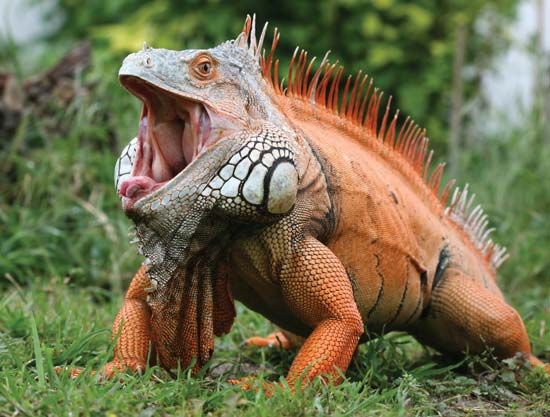
- Posturing: Puffing up their bodies to appear larger and erecting crests along their back and neck.1
- Stereotyped Movements: Engaging in head bobbing, push-ups, and tail waving.1
- Coloration: Extending a throat fan or exposing colored skin patches to signal presence or attract mates.1
Because iguanas can see into the ultraviolet spectrum, they may also use visual cues invisible to humans to identify pheromone markers.12
Chemical Communication
Chemical signals play a vital role in social recognition and territoriality. Many iguanas possess femoral pores on their thighs that secrete chemical attractants. For instance, desert iguanas can distinguish between their own odors and those of others. They often deposit pheromones in inert carriers that remain inactive until another lizard flicks the marker with its tongue, allowing for precise chemical communication.12
What are some of the largest and smallest species of iguanas?
Iguanas, which belong to the subfamily Iguaninae, are generally recognized for their relatively large size, with many adult species exceeding 1 meter (3.3 feet) in length.4
Largest Species
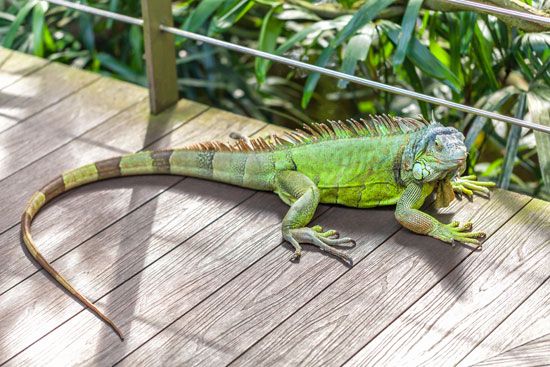
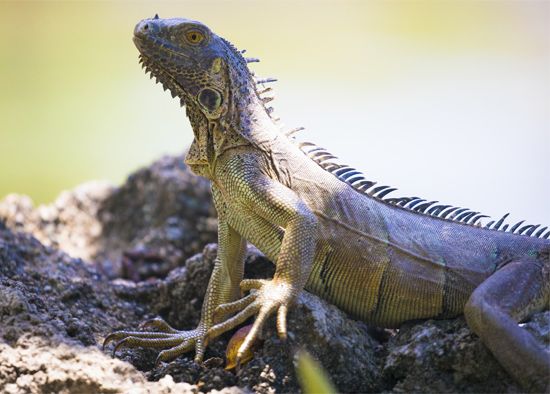
The common, or green, iguana (Iguana iguana) is among the largest members of the group. Males of this species can reach a maximum length of over 2 meters (6.6 feet) and weigh up to 8 kg (17.6 pounds).4
Other Notable Sizes
While the green iguana is a standout in terms of size, other species vary significantly:
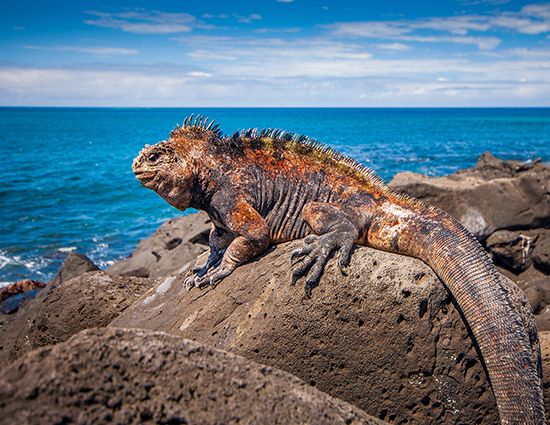
- Marine Iguanas (Amblyrhynchus): These inhabitants of the Galapagos Islands can grow up to 1.3 meters (4.3 feet) long and weigh up to 1.8 kg (4 pounds).4
- Diversity in Size: The family Iguanidae is broad, encompassing over 40 species within the subfamily Iguaninae alone, as well as hundreds of other related iguanid species that vary widely in their physical dimensions.45
While the term “iguana” is often used to refer to the larger members of the Iguanidae family, the broader family includes a vast array of lizards, such as the Anolis genus, which contains more than 200 species of varying sizes.45
How many species of iguanas are there, and where are they primarily found?
There are more than 40 species of iguanas, which are categorized into nine distinct genera within the subfamily Iguaninae. It is important to note that the term “iguana” specifically refers to these larger members of the Iguanidae family, which contains approximately 700 species of lizards in total.64
Iguanas are primarily found in the warmer regions of the Americas, ranging from southern North America through Central America and into northern South America. They also inhabit various Caribbean islands and are found as far away as Fiji in the Pacific. While they are most commonly associated with tropical forests and grasslands, some species have established invasive populations in other parts of the world, including Florida and Hawaii.6
What is the taxonomic classification of iguanas within the reptile family?
Iguanas are classified within the order Squamata, which includes all lizards and snakes. Within this order, they belong to the infraorder Iguania and the family Iguanidae.678
The taxonomic hierarchy for iguanas is as follows:
- Class: Reptilia (reptiles)6
- Order: Squamata (lizards and snakes)6
- Infraorder: Iguania8
- Family: Iguanidae76
- Subfamily: Iguaninae76
The family Iguanidae is diverse, comprising approximately 700 species across more than 40 genera. The subfamily Iguaninae, which contains the animals commonly referred to as “iguanas,” is distinct from other iguanians like the Agamidae and Chamaeleonidae families, primarily due to differences in tooth structure and evolutionary history. While iguanas are often confused with ancient reptiles due to their name, they are modern lizards and are only distantly related to dinosaurs.786
Sources
- iguana: Top Questions — Encyclopædia Britannica
- lizard - Courtship and territoriality — Encyclopædia Britannica
- Animal communication - Signal production — Encyclopædia Britannica
- iguana — Encyclopædia Britannica
- 7 of the World’s Most Dangerous Lizards and Turtles — Encyclopædia Britannica
- iguanid — Encyclopædia Britannica
- Are iguanodons and iguanas related? — Encyclopædia Britannica
- lizard - Evolution and classification — Encyclopædia Britannica
Published on · 3 min read