Bradysaurus
Bradysaurus is a genus of extinct, early reptiles that lived during the Permian Period, approximately 299 to 251 million years ago. Fossils of these…
What is Bradysaurus?
Bradysaurus is a genus of extinct, early reptiles that lived during the Permian Period, approximately 299 to 251 million years ago. Fossils of these creatures have been discovered in South Africails of these creatures have been discovered in South Africa.1
As a member of the pareiasaur group, Bradysaurus was not a dinosaur, though it represents one of the first very large land vertebrates. These animals were notable for being herbivorous, a rarity for their time. Physically, they were characterized by:1
- Massive bodies and strong limbs.1
- Grotesque skulls featuring many bony protuberances, measuring about 0.5 meters (1.6 feet) in length.1
- Leaf-shaped, crenulated teeth along the jaw margins, accompanied by palatal teeth.1
What defines the Permian Period?
The Permian Period (298.9 to 252.2 million years ago) was a transformative interval in Earth’s history, marking a significant crossroads for both global geography and the evolution of life.34
Geography and Climate
The period was defined by the assembly of the supercontinent Pangea, which incorporated most of the Earth’s landmass and was surrounded by the immense Panthalassa ocean. Early in the period, widespread glaciation and strong latitudinal climatic belts existed. However, the climate gradually warmed, leading to increasingly hot and dry conditions that profoundly impacted global environments.345
Life and Biodiversity
Permian life was remarkably diverse, with marine ecosystems often exceeding modern levels of complexity. Terrestrial life was closely linked to the diversification of plants, which transitioned from marsh-dwelling ferns and lycophytes to drier-adapted coniferophytes. This botanical expansion drove the rapid evolution of insects and the emergence of early reptile lineages that would eventually lead to mammals. reptile lineages that would eventually lead to mammals.53
The Great Extinction
The period concluded with the largest mass extinction in Earth’s history, likely triggered by extreme climatic shifts and temperature crises that decimated biodiversity, leaving fewer than 10 percent of species to survive into the subsequent Triassic Period.36
How did pareiasaurs differ from dinosaurs?
Pareiasaurs, such as the genus Bradysaurus, are often confused with dinosaurs due to their large size, but they are distinct, unrelated groups of reptiles. The primary differences include:
- Temporal Range: Pareiasaurs lived during the Permian Period (approximately 299 to 251 million years ago), long before the dinosaurs became the dominant land animals of the Mesozoic Era.8
- Physical Anatomy: Pareiasaurs were characterized by massive, heavy bodies, strong limbs, and distinctively “grotesque” skulls covered in bony protuberances. In contrast, dinosaurs are classified into two major lineages—Saurischia (“lizard-hipped”) and Ornithischia (“bird-hipped”)—based on the specific arrangement of their pelvic bones, a feature not shared by pareiasaurs.18
- Evolutionary Status: While pareiasaurs were among the first very large land vertebrates, they were not part of the dinosaurian lineage. Dinosaurs evolved later, during the Triassic Period, and include diverse groups such as theropods and sauropodomorphs.18
What were the primary food sources for early herbivores?
Early herbivorous dinosaurs relied on a diet of vegetation that was generally low in calories and protein, consisting primarily of tough, fibrous plant tissues that were difficult to digest due to high cellulose content.14
Throughout the Mesozoic Era, these herbivores fed on the available flora, which transitioned from forests dominated by gymnosperms—such as conifers, cycads, and cycadeoids—to later forests featuring angiosperms like magnolias and palmlike trees. Specific feeding habits were often dictated by the animal’s size and anatomy:14
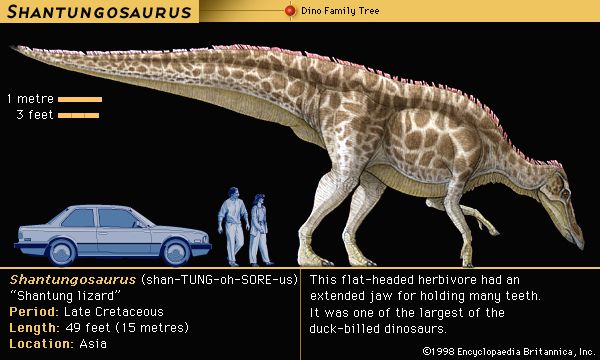
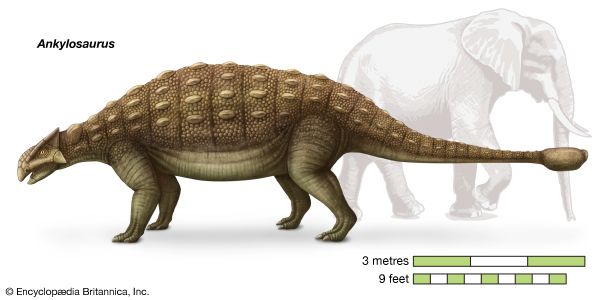
- Low-browsing: Dinosaurs such as ankylosaurs, stegosaurs, and ceratopsians likely fed on low-growing shrubbery and tough fronds.14
- High-browsing: Long-necked sauropods and tall ornithopods, such as hadrosaurs, likely browsed on treetops and high branches.14
Notably, no dinosaurs fed on grasses (Poaceae), as these plants had not yet evolved during their time.14
Sources
- Bradysaurus — Encyclopædia Britannica
- pareiasaur — Merriam-Webster
- A Journey Through Time Since the Precambrian - Permian Period: 298.9 million to 252.2 million years ago — Encyclopædia Britannica
- Permian Period - Marine and terrestrial life — Encyclopædia Britannica
- Permian Period - The Permian environment — Encyclopædia Britannica
- Permian Period - Distribution of land — Encyclopædia Britannica
- Permian Period - Temperature crises — Encyclopædia Britannica
- saurischian — Encyclopædia Britannica
- mammal: Top Questions — Encyclopædia Britannica
- Pareiasaurus — Merriam-Webster
- Pareiasauridae — Merriam-Webster
- dinosauromorph — Encyclopædia Britannica
- ornithopod — Encyclopædia Britannica
- dinosaur - The plant eaters — Encyclopædia Britannica
- mammal - Teeth — Encyclopædia Britannica
Published on · 3 min read