Al-Kufrah
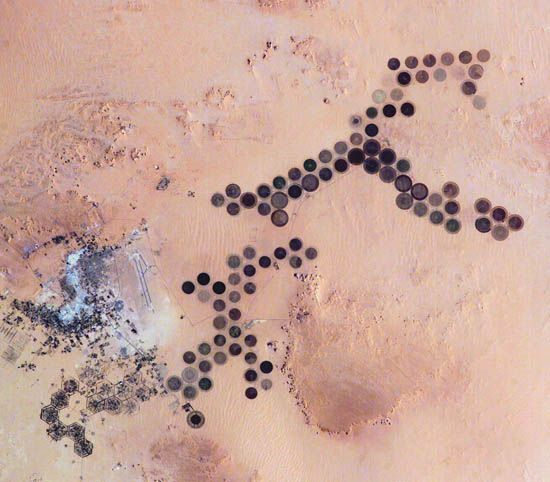
Al-Kufrah is an oasis group located in southeastern Libya, situated within an elliptical trough in the Libyan Desert. Measuring approximately 30 miles long…
What is Al-Kufrah?
Al-Kufrah is an oasis group located in southeastern Libya, situated within an elliptical trough in the Libyan Desert. Measuring approximately 30 miles long and 12 miles wide, the area has historically served as a strategic point along ancient caravan routes.1
In 1895, the oasis became the headquarters for the Sanūsī, a reformist Muslim religious fraternity, serving as their stronghold until it was occupied by Italian forces in 1931 following an aerial offensive. Today, the region’s economy relies on livestock raising and agriculture, supported by extensive date groves and irrigation from an underground reservoir. The primary towns include Al-Jawf, Al-Ṭulaylib, and Al-Ṭallāb, while Al-Ṭāj is notable for hosting a Sanūsī religious school.1
What is the Libyan Desert like?
The Libyan Desert is a harsh, arid, and inhospitable region that forms the northeastern portion of the Sahara. It extends from eastern Libya through southwestern Egypt into the extreme northwest of Sudan.com/place/Egypt) into the extreme northwest of Sudan.2
The landscape is characterized by bare rocky plateaus and vast stony or sandy plains. Approximately half of the Saharan plateau, which covers about nine-tenths of Libya, consists of sand desert, often described as a “sea of sand”. In the eastern portion of the desert, mobile sand dunes can reach heights of up to 300 feet (90 metres). The region also features significant geological variations, such as the Qattara Depression, which descends to 436 feet (133 metres) below sea level, and Mount Al-ʿUwaynāt, which serves as the desert’s highest point at 6,345 feet (1,934 metres).23
Due to extreme aridity, the desert is sparsely populated, with inhabitants primarily concentrated in scattered oases such as Al-Kufrah and various Egyptian settlements.2
Who were the Sanusi people?
The Sanūsiyyah (or Sanusi) is a Sufi Muslim brotherhood founded in 1837 by Sīdī Muḥammad ibn ʿAlī al-Sanūsī. The movement was established as a reformist order dedicated to returning to the simple, puritanical faith and lifestyle of early Islam.67
As a missionary organization, the brotherhood sought to reform the lives of Bedouins and convert non-Muslim populations across the Sahara and Central Africa. By integrating its religious lodges, known as zāwiyahs, with local tribal systems, the order gained significant influence in Cyrenaica, Fezzan, and other parts of the Libyan Desert.67
The Sanūsiyyah became a powerful political force, leading resistance against Italian colonization in the early 20th century. Following World War II, the head of the order, Idris, became the king of an independent Libya in 1951. The monarchy remained in power until it was overthrown in 1969.67
How do oases form in the middle of a desert?
An oasis is a fertile area in a desert that forms wherever there is a reliable, perennial supply of fresh water. These water sources are typically found underground and reach the surface through springs or wells, often tapping into deep aquifers that may be replenished by distant rainfall.910
Oases can form through several geological and human-influenced processes:
- Deflation: In some regions, such as the Sahara, wind erosion—known as deflation—removes loose surface material until the ground reaches the water table. This creates a depression where groundwater can collect at the surface.11
- Artesian Pressure: Some oases are supplied by artesian aquifers, where natural hydrostatic pressure forces water to the surface through cracks in the rock or man-made wells.912
- Human Engineering: Many oases are sustained or expanded through irrigation techniques. These include the use of foggaras (inclined underground tunnels), canals, and motorized pumps to tap into dispersed groundwater or divert water from distant rivers.1314
Sources
- Al-Kufrah — Encyclopædia Britannica
- Libyan Desert — Encyclopædia Britannica
- Libya - Climate of Libya — Encyclopædia Britannica
- Libya - Relief — Encyclopædia Britannica
- Gulf of Sidra — Encyclopædia Britannica
- Sanūsiyyah — Encyclopædia Britannica
- Libya - Ottoman rule — Encyclopædia Britannica
- Sanusi — Merriam-Webster
- oasis — Encyclopædia Britannica
- Turkmenistan - Oases — Encyclopædia Britannica
- aquifer — Encyclopædia Britannica
- water supply system - Groundwater sources — Encyclopædia Britannica
- deflation — Encyclopædia Britannica
- Asia - Groundwater — Encyclopædia Britannica
- Sahara - People of the Sahara — Encyclopædia Britannica
Published on · 3 min read